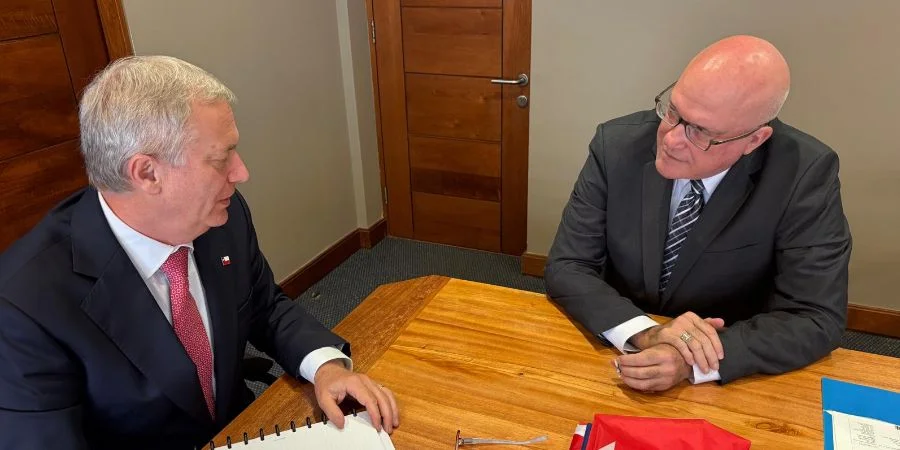
MIAMI, United States. – The elected president of Chile, José Antonio Kast, met this Friday in Santiago with Orlando Gutiérrez-Boronat, secretary general of the Assembly of the Cuban Resistance (ARC), according to a statement sent to CubaNet.
The meeting was held in the Office of the President-Elect (OPE) and lasted one hour. The statement notes that both parties “spoke widely about the Cuban reality and the struggle of the Cuban people for their freedom.”
After the meeting, Gutiérrez-Boronat stated that “this meeting, held on February 20, the anniversary of the signing of the historic Agreement for Democracy in Cuba in 1998, shows President Kast’s understanding for the cause of the rights and freedoms of the Cuban people.”
The statement places the meeting at “crucial moments for the Cuban nation” and adds that it took place when “Cuban democratic forces seek a more effective coordination of all the constituent factors of Cuban patriotism.”
In this sense, the secretary general of the ARC declared: “In these urgent moments we are going to expand the international front of support for the freedom of Cuba.”
Kast about Cuba
In his previous campaign for the presidency of Chile, in 2021, Kast qualified to the regimes of Cuba, Venezuela and Nicaragua as “dictatorships” and indicated that, if he triumphed, he would promote the breaking of relations with Havana, Caracas and Managua.
The issue was once again placed at the center of the debate after Kast, from the right, defeated the representative of the left, Jeannette Jara, by more than 16 points.
In the video that circulated again On those dates, Kast maintains: “We must end the hypocritical foreign policy itself; Cuba, Venezuela and Nicaragua are dictatorships, where the opposition is imprisoned, there is no economic, social or political freedom, where human rights are violated every day. The time has come to give a concrete signal: we are going to break relations with those dictatorships and we are going to lead a political and diplomatic process in Latin America to liberate those nations.”
The precedent is not limited to that video from November 2021. In a television interview broadcast on October 14, 2021Kast was consulted about his announcement that, in an eventual government, he would break relations with Venezuela and Cuba. In that conversation, when asked what he would do with the diplomatic representatives, he responded: “I would expel their ambassadors.”
Unlike Kast, Jara refused several times to recognize that the Island was controlled by a dictatorial regime. In April of this year, when she was still the pre-candidate of the Communist Party of Chile, stated that the government of Miguel Díaz-Canel was not a dictatorship but a different democratic system”, which unleashed strong criticism in both official and opposition sectors.
“I believe that Cuba has a democratic system different from ours… There is a single party, it is not the only system like that, each people has to define its government,” Jara said in interview with CNN Chile. With respect to VenezuelaHowever, Jara recognized that it was an “authoritarian regime” and claimed to use the terms “dictatorship” and “authoritarian regime” interchangeably to refer to that country.
The statements generated immediate reactions. Carolina Tohá, then presidential candidate of the Party for Democracy (PPD) and former Minister of the Interior, He distanced himself from Jara’s sayings: “Cuba is not a democracy. It has an authoritarian regime where there is no political pluralism, no free elections, no independent press. That, anywhere in the world, does not qualify as democracy.”