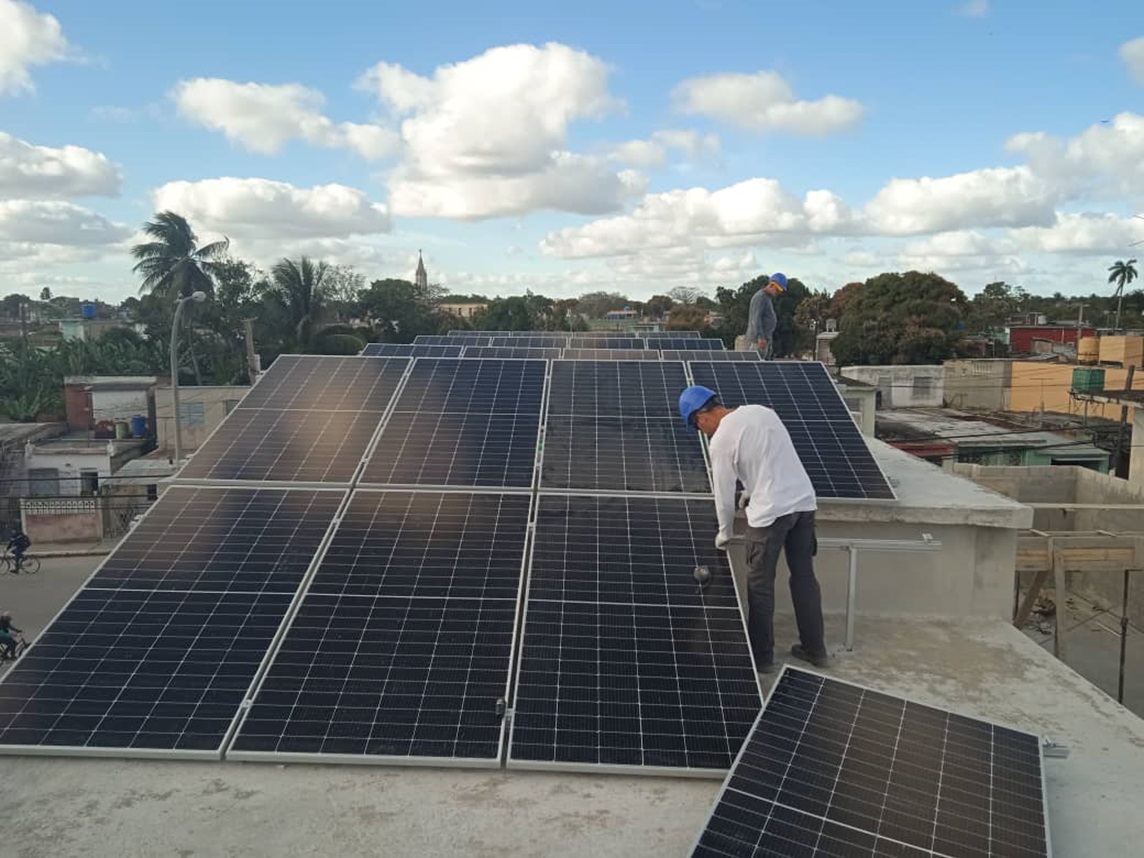
State and private companies in Cuba, as well as self-employed workers and other private workers, will be exempt from certain taxes for up to eight years if they invest in investment systems. renewable energy for its economic activity or for its delivery to the National Electric System.
This is how it is established a government resolution in force as of this Thursday with its publication in the Official Gazette. It expands what was previously regulated on the subject, at a time when the country suffers a severe energy crisis, aggravated by the US oil blockade.
The resolution of the Ministry of Finance and Prices confirms the current exemption from paying profit tax to legal entities that carry out economic activities and install renewable energy sources for their development or to deliver electricity to the country.
To this we now add the exemption from personal income tax for natural persons who also meet this condition. This second group includes self-employed workers, agricultural producers, creators and others who normally must pay said tax.
For both legal entities (companies, MSMEs, cooperatives) and natural persons, the exemption will be “in the amount of the value of the investment, during the period of its recovery and for a period of up to eight years”, in accordance with the provisions of the regulations.
Tax treatment related to the Use and Exploitation of Renewable Energy Sources is updated. Learn details of Resolution 41/2026 of the Minister of Finance and Prices. https://t.co/3kGI3MGVrf #FinancesandPrices #Cuba through @finanzasprecios
— Ministry of Finance and Prices Cuba (@finanzasprecios) February 20, 2026
Tariff exemptions
The updated standard also confirms tariff benefits for those who import renewable energy systems, as well as raw materials, components, parts or equipment to increase energy efficiency.
In this sense, natural and legal persons will not have to pay customs tax for the import of solar photovoltaic systems and their parts, as well as other products that operate from renewable sources such as solar heaters, small wind turbines, biogas motor pumps and lighting and climate systems based on solar energy.
The resolution, which includes two annexes with the goods exempt from tariff payment, clarifies that for natural persons these products will not form “part of their import value without an authorized commercial nature; with the condition that they are presented to Customs separately from the rest of the imported articles.”
In addition, companies and entities, both state and private, that import raw materials, parts or equipment for investment processes or the manufacture of devices intended for the use of renewable sources or that carry out electricity generation projects from these sources are exempt from paying tariffs.
The regulations also establish that legal entities that import raw materials, components, parts and equipment to increase energy efficiency “may be subsidized or exempt from the payment of customs tax, when economically justified” and always upon request to the Ministry of Finance and Prices.
Finally, it is maintained that “the technologies and systems linked to the use of renewable energy sources are marketed, in the wholesale or retail trade system, at non-revenue prices”, that is, with a profit of up to 25% of the costs.
Current conditions and previous figures
To access the tax benefits established in the resolution, natural and legal persons need to have a ruling from the National Office for the Rational Use of Energy (Onure), which “ensures that the installed system works correctly and complies with the required standards and technical requirements.”
In addition, a request must be submitted to the National Tax Administration Office (ONAT), which must include the recovery period of the investment made “based on the feasibility analysis,” as well as the opinion of the Onure.
With this, the ONAT will set the start date of the tax benefit “within a period of no more than 60 days”, from the delivery of the application.
On the other hand, Onure can cancel the tax exemption if it verifies that the endorsed project is not in operation. Cancellation also applies “when it is proven that the imported equipment or resources do not correspond to the approved project or the documents supporting the investment are not presented,” the newspaper abounds in this regard Granma.
According to the media, based on previous regulations related to the issue, until December 2025, Onure received 168 energy license applications from both private and state entities. Of these projects, 56 are already installed and another 112 are still “in the evaluation process.”
These figures must now grow with the updating of regulations, in an energy context marked by constant blackouts, the age and precariousness of large generating plants and a growing fuel shortage, which the Government is trying to alleviate with the expansion of renewable energies.