By Juan Palop
Small private Cuban companies have begun to directly import fuel in the midst of the US oil siege, while international firms based on the island explore this route, according to what has been learned EFE.
The option, a breath of air in the face of the energy asphyxiation induced by Washington, is, however, threatened both by the cumbersome Cuban bureaucracy, with its multiple conditions and delays, and by the ambiguous shadow of US sanctions.
Furthermore, the volumes that are being contracted are, in any case, for specific business needs and would not serve in any way to meet the country’s energy needs, of about 110 thousand barrels per day (of which 40 thousand come from its own wells).
As confirmed by several sources, the Cuban Government has held meetings in recent days with foreign businessmen and local entrepreneurs to explain to them how this management could be carried out, while economic and social paralysis progressively grips the island.
It is about specifying the announcement made last November by the Minister of Foreign Trade and Foreign Investment, Oscar Pérez-Oliva, that “shortly” foreign and mixed companies would be allowed to import their own fuel, “when necessary.”
Until now, the Cuban State held a monopoly on the import of oil and fuels—mainly through its own and rented tankers—and on the retail sale of refined products within the island.
Several participants in these meetings with government officials explained that the import of fuel tanks inside cargo ships would be similar to that of any other product abroad (through a state importer), a usually slow process.
However, they added, some extra security requirements would have to be met, since it is dangerous material, and have a certifiable safe location at the destination or store it in state companies already equipped for this use.
The Cuban authorities stressed to businessmen that the fuel that individuals may import is exclusively for self-consumption and resale is not permitted.
As explained by some interested parties, the import would be carried out in cylindrical stainless steel tanks of the T11 isotank type, which have a capacity of between 21 thousand and 26 thousand liters. These devices can be installed on any cargo ship because they are inserted into a metal structure of standard measurements.
Several companies based in the United States have specific licenses to export diesel in isotanks to Cuba, but exclusively for private clients. However, some businessmen in Cuba point out that they are exploring purchase options in other countries in the region.
The doubt about tariffs
It is not evident that the import of fuel by the private sector in Cuba is included in the executive order signed on January 29 by US President Donald Trump.
The text, specifically, provides for tariffs “on goods imported into the United States that are products of any other country that directly or indirectly sells or in any way provides oil to Cuba.”
EFE asked the United States Embassy in Cuba for a formal clarification, to confirm whether the expression “to Cuba” also included private companies – local or international established on the island – that are not controlled by the Cuban State or its network of companies.
The diplomatic legation responded briefly, referring to the original text of the executive order.
Sources involved in this trade tell EFE in this regard that they have received “signals” that the US administration is willing to tolerate these shipments.
In this same context, the British weekly The Economist published in its latest issue that the US administration is considering allowing a certain volume of fuel to enter the island to meet basic needs.
US pressure is progressively paralyzing the Cuban economy, which was already in its worst crisis in decades. In the last five years alone, the island has lost 15% of its gross domestic product (GDP) and more than 20% of its population. Inequality and poverty have skyrocketed.
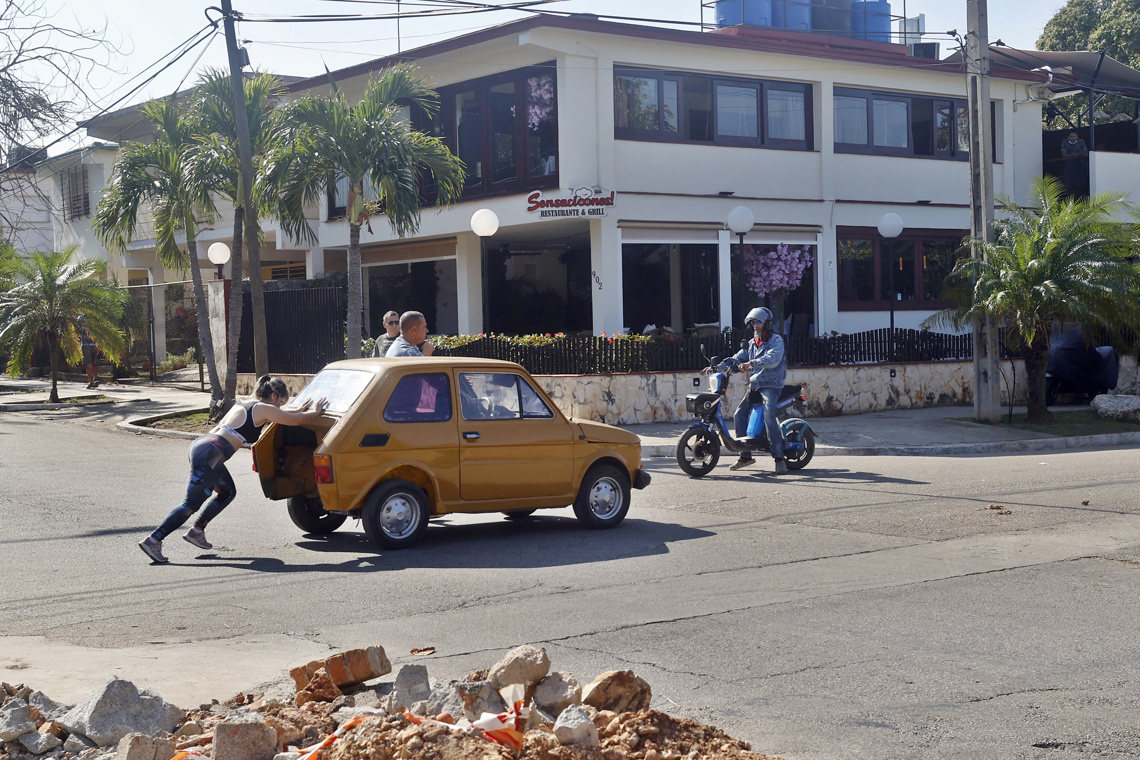
The Cuban Government has implemented a tough contingency plan to try to survive without imported oil, something unsustainable in the medium term. Hospitals are in minimal services, public transportation has practically disappeared and fuel is severely rationed.