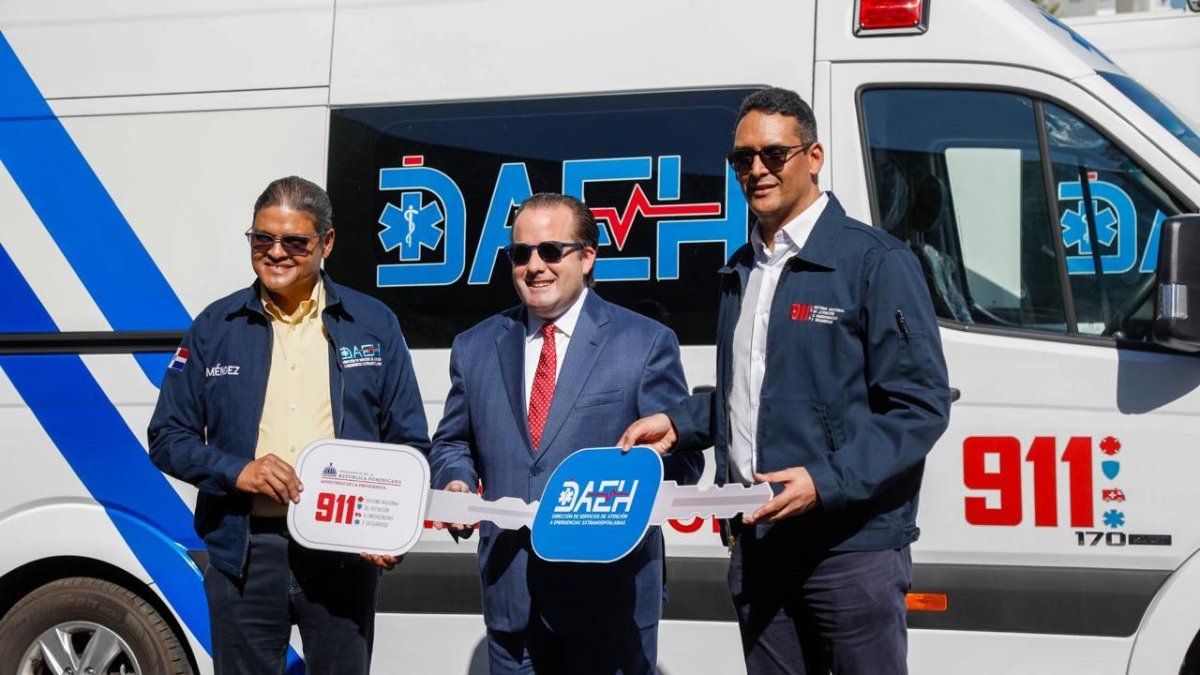
The National Emergency Care and Security System 911 delivered 50 new and modern ambulances to the Directorate of Out-of-Hospital Emergency Care Services (DAEH), with the purpose of strengthening the emergency response capacity in the national territory.
The activity, carried out at the DAEH facilities, was headed by the Minister of the Presidency and president of the National Council for Emergency Response and 911 Security, José Ignacio Paliza; the director of the DAEH, retired major general Juan Manuel Méndez García, ERD; and the executive director of the 911 System, Colonel Randolfo Rijo Gómez, ERD.
With the incorporation of the 50 units delivered in this event, the total number of ambulances integrated into the system rises to 376, guaranteeing greater tranquility, security and timely and coordinated access to emergency services in adverse situations.
In continuity with the operational planning and expansion of the service’s operation, the 911 System began its operations in the Pedernales province during the year 2025 and, by the beginning of 2026, it will continue to expand its operational coverage with the next entry into service in the municipalities of Constanza and Jima Abajo, thus strengthening the presence of the comprehensive care model in new areas and guaranteeing greater access to emergency services for the population residing in these areas of the country.
Minister Paliza valued the investment as a sign of the commitment of President Luis Abinader’s government management to strengthening essential services. He indicated that: “Through the DAEH we have incorporated more than 376 ambulances, which is equivalent to renewing about half of the existing vehicle fleet. We have introduced new technological systems, strengthened the institutional structure and consolidated an entity with more than 8,000 duly certified and trained collaborators. In addition, we have reduced response times, achieving more timely levels than those registered in 2020. This is the result of the joint effort of the DAEH and the System. 911.”
During his speech, the director of the 911 System, Rijo Gómez, highlighted that “the units delivered include 4×4 vehicles designed to operate in rural communities, highly complex terrain and areas of difficult access, even in the face of adverse weather conditions. Units designed to optimize the response in urban and suburban environments are also incorporated. In addition, they have equipment to provide life support at the scene of the event, strengthening care before hospital transfer.”
The director of the DAEH, Méndez García, stated: “Currently, we have a presence in 26 provinces, with a national coverage of 93%. In 2025 we created 20 new operational prepositions in coordination with 911, reaching a total of 474 active positions. In terms of results, during 2025 we provided pre-hospital assistance to 548,323 people through 911. In addition, we carried out 65,290 interhospital transfers coordinated by the CRUE and 1,582 neonatal transfers.”
The modern fleets delivered are made up of 4×4 Toyota Land Cruiser II and 4×4 Toyota Hilux units, as well as 4×2 Hyundai Solera H-350 ambulances and 4×2 JAC units, intended to expand operational capacity and optimize the territorial distribution of emergency resources.
In addition, the specialized vehicles are reinforced with modern medical equipment, a complete medical oxygen system, a biphasic monitor-defibrillator with transcutaneous pacemaker and multi-parameter monitoring, digital pulse oximeter, portable glucometer, electric and manual suction equipment, Kendrick-type immobilization vests, bleeding control kits with tourniquets, nebulizers for adults and pediatrics.
Likewise, they have life support backpacks differentiated by color (red, yellow, green and blue), main and folding stretchers, portable wheelchairs, splints, cervical collars and specialized material for the care of patients in critical condition.
The 911 System reiterated that the preservation of these achievements requires commitment and citizen co-responsibility through the appropriate use of the service, so that the available resources can efficiently assist those who really need it.
With this incorporation, the 911 System continues to strengthen its management model based on inter-institutional coordination, technology and action protocols that directly impact the safety and well-being of the population.