Madrid/The risk that Donald Trump’s Administration will promote an economic opening without political changes in Cuba is taking shape in some sectors. Two economists agree in this analysis, an American and a Cuban, who consider that there are evident signs that point in that direction.
“A key question is whether the United States would have tacitly assumed an ‘authoritarian modernization’ in Cuba and not a ‘regime change’ as a tolerable result,” says Cuban economist Pedro Monreal, who lives in Madrid. In a thread posted today thursday In his account of The theory follows a series of proposals that already put this wednesday on the table purely focused on what the parties could negotiate economically.
“There are at least two pieces of information that justify this hypothesis: the first is that the US position includes a rhetoric of ‘collapse’ and ‘failed regime’ in Cuba while offering a ‘deal’ (make a deal now). Pressure to force concessions and an open door to negotiations,” says the economist, who adds another argument. “The second piece of information related to the hypothesis is the ‘transactional pragmatism’ used by the diplomacy of the current US Administration. One implication of this ‘pragmatism’ is that it allows maintaining a rhetoric of ‘regime change’ qualified by concrete ‘deals’.”
Experience has shown, Monreal breaks down, that the Trump Administration seeks to force the situation to impose certain conditions, but his country must necessarily gain something from it. “Priority to the economic in diplomatic negotiations (money, tariffs, trade, investments, resources) and disregard of the ‘abstract’ (values, international rules). What is important are tangible benefits for the United States,” he points out. What could Cuba contribute in this context? It is more complicated to answer than in the Venezuelan case, where oil was evidence.
Experience has shown that the Trump Administration seeks to force the situation to impose certain conditions
The economist believes that compensation for expropriated properties through agreements in tourism, agriculture or energy is a starting point, but there could also be other opportunities for American companies in any sector, and cites agricultural imports, medicines and other essential goods, as well as tourism and remittance services, which are already authorized but have restrictions.
This approach would clash with the intentions of part of the exile, who has very favorably welcomed the initiatives of the new Miami-Dade tax collector. Dariel Fernández has been focusing on alleged cases of fraud in the use of federal licenses to trade with Cuba for about a year. These cases, in his opinion and that of other Florida politicians, would be sufficient reason to radically eliminate the authorizations, an issue that he reiterated on Monday at a press conference in the Port of Miami.
Florida Republican Congressman Carlos Giménez insisted there that these permits, intended for the benefit of private companies, can end up being used fraudulently, so it is better to eradicate them.
But the Trump Administration, Monreal maintains, can go in the completely opposite direction and “make current economic restrictions more flexible, including a reinterpretation of cash in advance that would facilitate exports from the US”, although this is a hypothesis, he says, “it seems probable.”
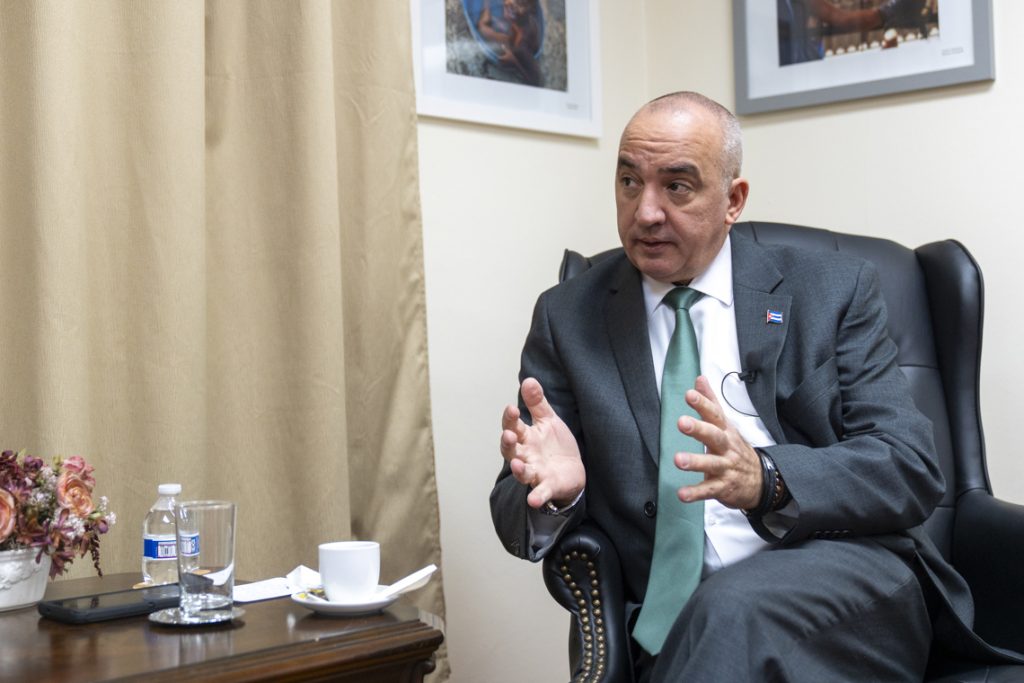
This opinion is shared by John S. Kavulich, president of the US-Cuba Economic and Trade Council, who published a column this Wednesday in Strong Coffee titled The Trump Administration is opening the diplomatic door to Cuba. In it, the economist maintains that there are three steps planned within the US Government. “First step in the negotiation, change the Cuban economy. Second, invite American companies. Third, for now, the type of government does not matter; simply that it works like China and Vietnam,” he says.
The expert maintains that Washington is not going to demand political changes from the regime, but rather economic, commercial and financial management
The expert maintains that Washington is not going to demand political changes from the regime, but rather economic, commercial and financial management. An example of this is, he argues, that China and Vietnam are led by the Communist Party, but they give opportunities to American companies. “Regardless of whether a country has an authoritarian, democratic, dictatorial, military, monarchical, oligarchic, parliamentary, participatory, presidential, theocratic, totalitarian or any other system of government, President Trump is focused on the opportunities that exist for American companies: exporting, importing and providing services,” he says.
In case there is an interpretation that Trump is not going to touch Asia, outside his area of influence in accordance with the renewed doctrine Donroe, This has already happened in Venezuela, where a Nicolás Maduro in command was replaced to support his vice president in exchange for concessions for American companies. Miguel Díaz-Canel is, Kavulich believes, a subordinate who does not even have the symbolic capital of Maduro.
“For some members of the Trump-Vance Administration, the Díaz-Canel Government is not the key problem,” emphasizes the economist, who points to economic regulations and points out that it would be an opportunity precisely for the regime to make these changes, since it would find acceptance not only from Washington, but also from China and Russia themselves, or the European Union, whose investors have been held back by the administrative rigidity of Havana.
“In May 2022, the Biden-Harris Administration authorized direct investment and financing to a private company located in Cuba, owned by a Cuban citizen. Almost four years later, the Cuban Government has not issued the necessary guidelines or regulations,” he gives as an example. “The company, based in Havana, must submit a page to its financial institution, operated by the Government of Cuba; similar to a ‘Know Your Customer’ form, officially authorizing direct investment and financing.”
The economist – knowledgeable about business between both countries, as well as in favor of favoring each other – adds that the Trump Organization, based in New York, “was interested in the opportunities related to tourism in Cuba” and believes that this may be the key to a resumption of collaboration between both countries.
It is not clear that in Florida it will be easy to accommodate a change that is limited only to the economic, but the precedent of Venezuela invites us to think that anything can happen. Marco Rubio already advanced it to Bloomberg last Saturday: “Forget, put aside for a moment the fact that there is no freedom of expression, no democracy, no respect for human rights. The fundamental problem with Cuba is that it has no economy, and the people who are in charge of that country, who control that country, do not know how to improve the daily lives of their people.”