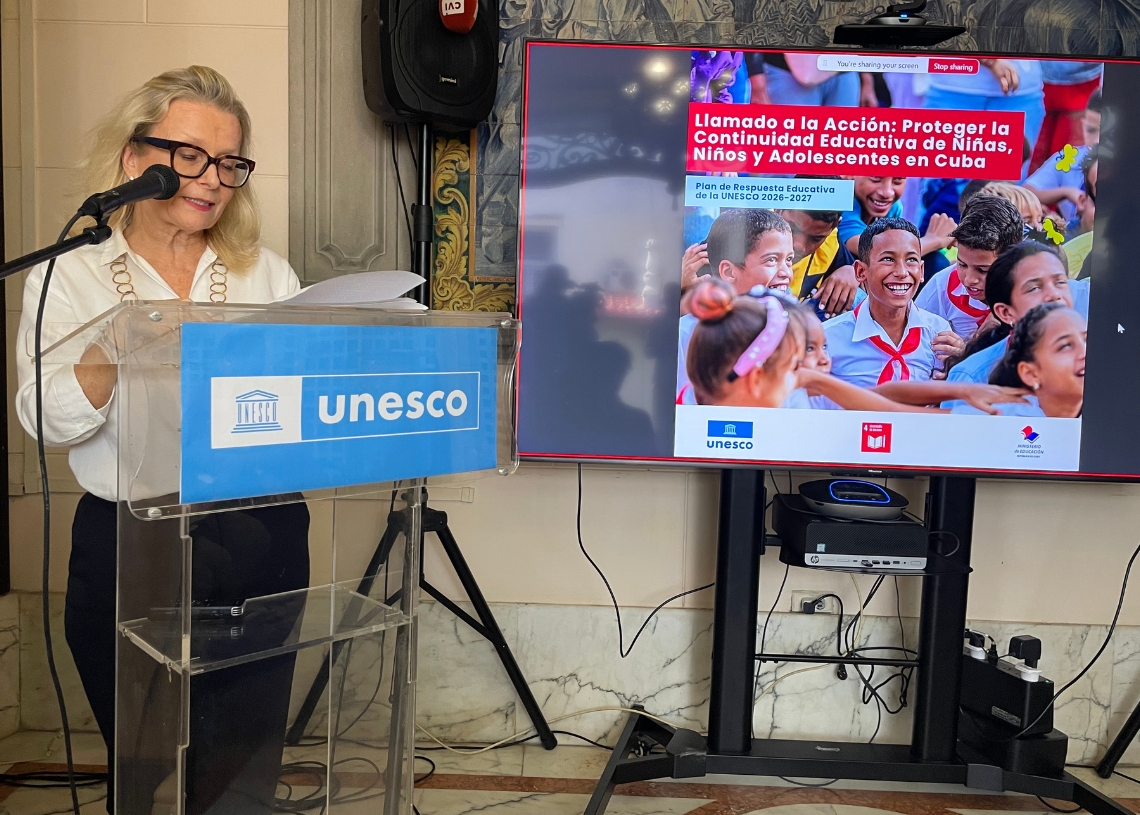
“The cost of inaction would fall on an entire generation,” said Anne Lemaistre, Director of the UNESCO Regional Office in Havana, making this Tuesday a call for action and international solidarity to protect the educational continuity of girls, boys and adolescents in Cuba, in the face of the crisis that the island is suffering.
“We urge international partners to mobilize flexible, rapid and sustained financing to ensure that every child and adolescent in Cuba can continue learning safely today and in the months to come,” concludes the statement released by Lemaistre at a press conference held at UNESCO headquarters in Havana.
The official assured that the oil blockade to which the country is currently subjected “puts additional pressure on the educational sector,” and listed specific problems in which this impact on the teaching process is seen.
“Lack of paper, raw materials that limit the printing of notebooks and textbooks, limitations on imports that make it difficult to renew furniture, equipment and infrastructure, without forgetting school food services,” are some of the areas in which the impact of the crisis in Cuba is palpable.
“Schools offer security, structure, socio-emotional stability, food and access to complementary services essential in emergency situations,” Lemaistre recalled in the call.
Concrete actions
UNESCO also offered data on the work it currently carries out in conjunction with the Cuban Ministry of Education, and the objectives it intends to achieve with the mobilization of international aid around the educational sector.
The country currently has 9,500 educational centers, and the aim is to achieve access to sustainable energy in half of them; access to gardens and nutritional education practices in 50% of the entities and offer non-financial incentives to the most affected teachers and students.
These actions are essential in the midst of a national context in which measures have had to be taken that affect the regular functioning of schools in Cuba, affecting more than a million students, says UNESCO.
Cira Piñeiro, Cuban Vice Minister of Education, told OnCuba that the decisions have been made in a particular way in each part of the country, “with the principle of maintaining the greatest presence possible due to the importance and social impact that children, adolescents and young people remain in the educational institution under the educational influence of the school.”
“We are designing several scenarios and we are looking for how we maintain the double session, how we look for cooking alternatives so that food service can be provided to the students, at what point we will have to give only one class session and how we reorganize the teaching force that, due to the impacts of both school transportation and public transportation, cannot arrive,” Piñeiro explains to us.
The crisis of these days increases other complex situations that the educational sector was already facing, such as the lack of teaching staff to cover all demand. According to the vice minister, this is a problem in certain areas of the country, and she highlights that “the eastern area has very satisfactory coverage.”
“It is easier, of course, for those institutions that have the entire group to be able to take alternatives than where the teaching coverage is already impacted and then you have several teachers who cannot arrive because they do not live near the school, the alternatives have to be greater,” he emphasizes.
The MINED implements programs such as Educating for Love, in which university students provide educational services in schools close to their homes, and continues to enable the possibility of insertion into teaching work for professionals with a university level who can teach subjects related to their training.
Joint work in times of disaster
UNESCO’s work together with the Ministry of Education in times of complex situations for the country is not new. Specifically, during the last two years, the passage through the country of natural phenomena such as hurricanes Oscar, Rafael and Melisa, as well as the earthquakes in the province of Granma, have led to the support of the international entity.
During the first days of February, the “Rebuild Hope” route was carried out, which reached educational centers damaged by Melisa in the municipalities of Juguaní, Cauto Cristo, Río Cauto, Guamá, Tercer Frente and Palma Soriano in the provinces of Granma and Santiago de Cuba.
“We have had the objective of reaching the places that are most difficult to access and where they had not yet received any assistance,” said Lemaistre, when presenting the results of this program at the meeting with the press.
The experience had already been tested last year with a tour that reached centers affected by hurricanes Óscar and Rafael and the earthquakes that in 2024 caused damage in the east of the island.
At that time, the Ministry of Education reported 876 educational centers with damages of various scales, 500 of them today still need support for their complete recovery.
More than 10 thousand students and one thousand teachers in 41 schools have been impacted by these UNESCO-MINED actions, which maintain the concept of carrying out a comprehensive intervention that combines different dimensions ranging from socio-emotional support to the donation of educational, sports and recreational materials.
The route pays special attention to providing socio-emotional support and providing training to teachers to provide future support to their students, addressing the traumas that these damages leave in the general lives of families.
UNESCO details that, as a result of the natural events, “more than 2 thousand schools require urgent support in the country, and a deficit of 26 thousand teachers is estimated, with effects on quality and educational coverage at different levels.”
“UNESCO emphasizes that education is a fundamental human right and, in emergency contexts, a factor of protection, stability and hope.”