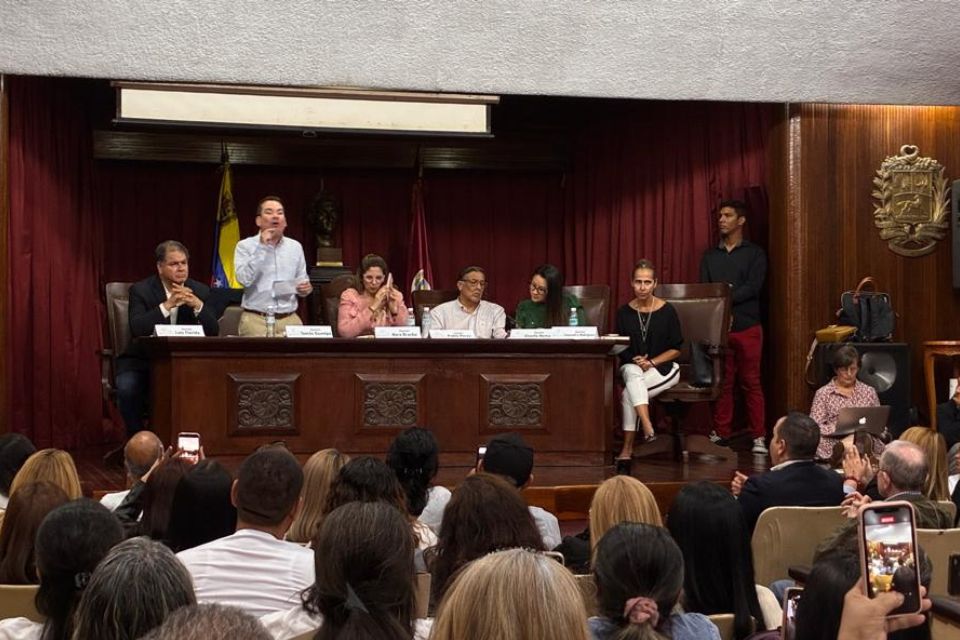
The opposition warns that it will not support articles of the amnesty law that it considers unconstitutional, while insisting that the law must guarantee equality and not leave out exiles. They demand freedom for all political prisoners
The National Assembly will resume the discussion of the amnesty law this Thursday, February 19, amid disagreements on key articles that could leave out exiles and generate new controversies, among other gaps that experts say exist in the draft law.
The deputies will meet in the morning and the session is scheduled for 4:00 pm. The parliamentarians from the opposition faction hope that the norm will be approved, although Luis Florido says: “What I cannot guarantee is what we are going to support or not, I hope we can support everything.”
However, the deputy guarantees that “whatever we do not agree on, we are not going to support.” “We are not going to support anything that violates the Constitution,” but he recognizes that the general spirit is for the discussion to be carried out in the same terms as the first six articles were made last Thursday, February 12.
“Hopefully a consensual law can be finalized that ultimately benefits the Venezuelan people,” insists Florido, who believes that for the country to “move forward it is necessary for everyone to be released.”
*Read also: AN defers discussion of the amnesty law due to discrepancies over beneficiaries
Opponents believe that article 7 makes “a prior conviction” in the wording, which says that the amnesty covers any person who is found, can be prosecuted or convicted for amnestiable acts “as long as it is legal or becomes legal”, which leaves out exiled people.
Luis Florido indicates that since that date they have not discussed the bill again and anticipates that “the debate is going to be hot, in the sense that there are several critical issues: article 7, 8, 11 and the articles that we are going to add as well.” They reiterate that they ask that article 7 comply with 21 and 49 of the Magna Carta and the presumption of innocence.
In this regard, the parliamentarian explains that in the law “there are many things to change.” He adds that it cannot be thought that the first project that was presented and approved in the first discussion will be approved “because there are many changes”, both from the official and opposition benches: “How is it going to turn out? That’s what we’re going to know tomorrow; “But I think it’s going to be much better.”
“We are trying to find a mechanism that would guarantee to the people who are not going to be imprisoned if they take advantage of the amnesty, which is the fear that any family member or any person who takes advantage of the amnesty law can feel,” emphasizes deputy Luis Florido in conversation with SuchWhich.
Florido recalls that the amnesty is the State’s renunciation of the power to sanction and affirms that “it is a step for democratic coexistence; “If it looks good, if it doesn’t look good, it’s not going to help democratic coexistence.” He promises to work to make the rule look good.
For her part, deputy Nora Bracho, vice president of the AN special commission that discusses the amnesty bill, hopes not only that this norm is approved, but “that it covers a large majority, if not all.” He promises to do everything in the hands of the 12 opposition deputies.
“We have to take care of expectations,” adds deputy Tomás Guanipa and anticipates that the law is not what they want to have nor does it include everything it should have. “It should guarantee that it is for everyone equally, but given what we are experiencing it is a step forward in the fight that will not end with this law, but with the release of all political prisoners.”
The president of the National Assembly, Jorge Rodríguez, promised at the beginning of January that there would be “numerous releases” within the framework of opening the discussion of an amnesty law; Since then, the NGO Foro Penal has only managed to count 444 releasesdespite the fact that the authorities say that the numbers exceed 800 people. This organization says that there are still more than 600 political prisoners in the country.
*Journalism in Venezuela is carried out in a hostile environment for the press with dozens of legal instruments in place to punish the word, especially the laws “against hate”, “against fascism” and “against the blockade.” This content was written taking into consideration the threats and limits that, consequently, have been imposed on the dissemination of information from within the country.
Post Views: 176