The censorship of José Jerí has opened a new chapter in the country’s political crisis.
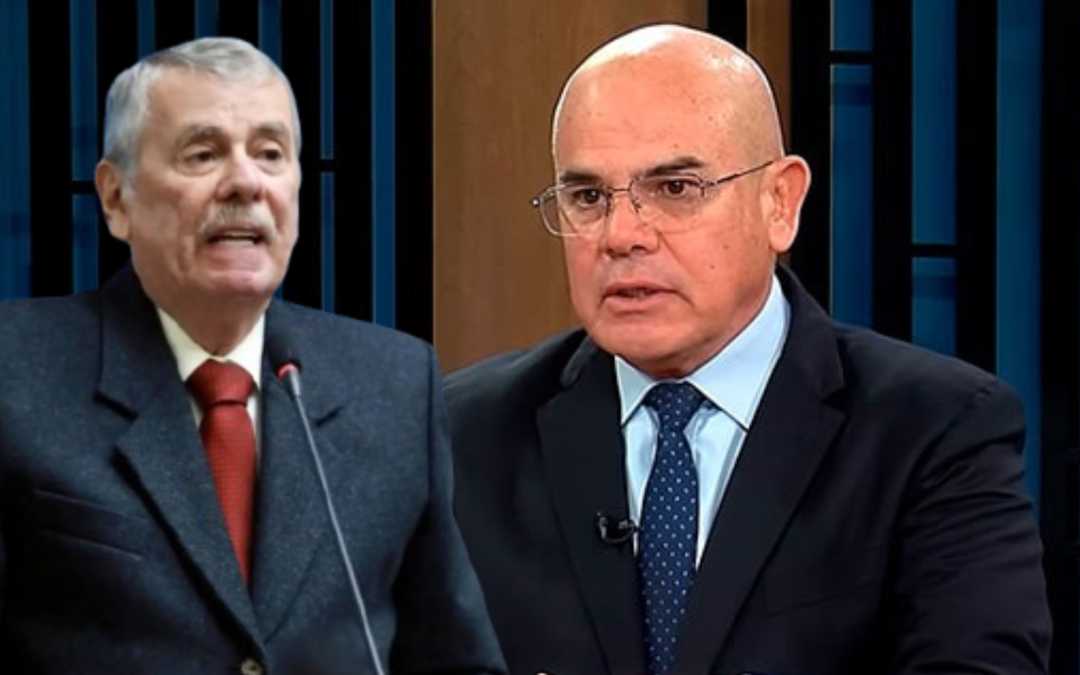
In the midst of institutional uncertainty, the president of the Council of Ministers, Ernesto Alvarezconfirmed that the current head of Congress, Fernando Rospigliosiis the one who is at the head of the State while the next constitutional steps are formalized.
“The only one who has a political mandate at this moment is Fernando Rospigliosi,” Álvarez told RPP, thus marking the official position of the Executive after the decision adopted by Parliament.
The Chief of Staff, Ernesto Álvarez, explained that the ministers will remain in their positions only as public officials, pending the appointment of their replacements.
“We ministers remain as public officials waiting for the appointment of our replacements and maintaining the functioning of our sectors,” he stated, stressing that the priority will be to guarantee administrative continuity and avoid gaps in public management.
“The decision is irreversible,” says the premier
Asked about the constitutionality of the measure, Álvarez was emphatic in pointing out that, although the issue can be discussed from a legal point of view, the parliamentary decision can no longer be reversed.
“I understand that there is no further reaction to the decision made by Congress because, although it may be debatable from a constitutional point of view, in reality the decision has already been made and is totally irreversible,” he said.
These statements demonstrate the position of the outgoing Executive of not confronting the legislative resolution and allowing an orderly transition.
In the midst of the situation, one of the issues that generates the greatest expectations is the future of the citizen security plan, one of the main demands of the population in the face of the advance of crime.
Álvarez assured that the document is already prepared. As explained, the previous minister and his technical team were in charge of incorporating pending contributions from 13 institutions external to the Executive.
“It is ready because the previous minister and his advisors were in charge of including the approaches that had not been conveniently incorporated from 13 institutions outside the Executive and it will be taken into account by the president and cabinet that come,” he indicated.
“It was a constitutional violation.”
From the Congress of the Republic, the president of the Council of Ministers, Ernesto Álvarez, launched harsh criticism against the parliamentary decision adopted against President José Jerí, considering that it did not act in accordance with what the Constitution establishes.
“It has been a constitutional infraction as the Peruvian Association of Constitutional Law has already pointed out; what corresponded was the vacancy but not the censure, but this has been a political decision whose responsibility falls on Congress,” the premier stated before the press.
Álvarez maintained that various specialists, including the Peruvian Association of Constitutional Law, have warned that the correct procedure, in accordance with the Magna Carta, would have been vacancy and not censure.
The Chief of Staff made it clear that, beyond the legal discussion, the decision adopted by Congress responds to a determination of a political nature.
“It is a political decision whose responsibility falls on Congress,” he reiterated, distancing himself from the procedure used by the Legislature.
At another time, the premier revealed that he had a recent conversation with José Jerí after the decision adopted by Parliament.
“I spoke yesterday with Jerí; what was appropriate was for us ministers to approach the president in an informal meeting and we thank him for the trust granted,” he said.
Subscribe for free to the most prestigious Gastronomic Guide in the country. SUMMUM, the weekly newsletter.
RECOMMENDED VIDEO