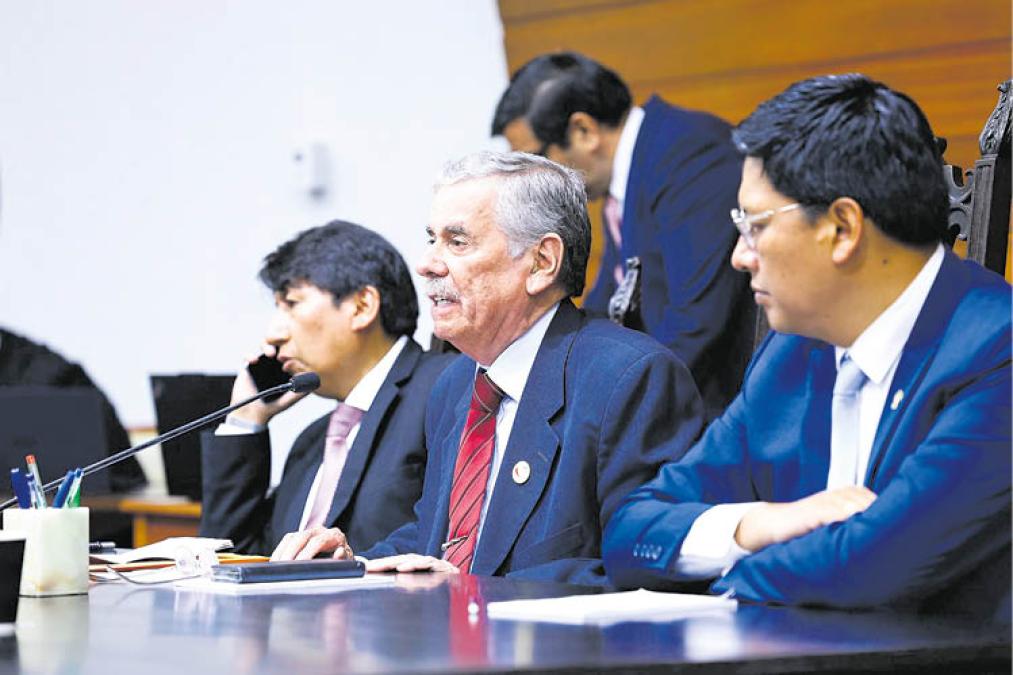
A new president has fallen before completing his term. The same Congress has managed to remove a third consecutive president. José Jerí was censured yesterday with the vote of 75 legislators and has left office only 130 days after succeeding Dina Boluarte, also dismissed.
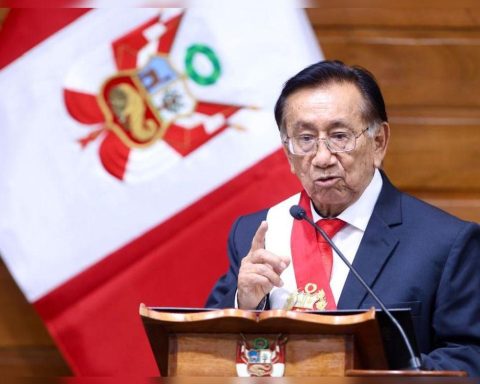
This Wednesday the country will have its fourth president in five years. Among the legislators Héctor Acuña (Honor and Democracy), María del Carmen Alva (Popular Action), Edgard Reymundo (Popular Democratic Bloc) and José María Balcázar (Free Peru), the successor of the one who paid dearly for his lack of transparency, his suspicious behavior and the lack of seriousness with which he faced the position will emerge this afternoon. Congress, as so many other times, will have the last word today in an extraordinary session that will begin at 6:00 p.m.
Among these four options will be—hopefully, it is only five months—who will hand over command, on July 28, to the candidate who manages to win the general elections.
His clandestine meetings with Chinese businessmen, the hiring of young women in public entities after meeting with him, and his lack of transparency not only generated tax complaints for influence peddling, but also prevented Jerí from staying in power longer, thus becoming the second president in the country with the shortest time in office so far this century.
Already resigned and after being notified of his censure, the former president left the Government Palace at 7:40 at night, and without a hood, dismissed amid applause by his cabinet who watched him leave at the main door and boarding his private truck. An image that seemed to show that the one who had to leave was only him.
His censure, however, will not prevent him from resuming his seat and he could even participate in the election of the next president today.
The congressional decision has left a power vacuum for long hours. Premier Ernesto Álvarez has indicated that the president of Congress, Fernando Rospigliosi, is—for him—for now, “the head of the State.”
A DEATH ANNOUNCED
Tuesday began with the smell of death for Jerí, after hours ago, Alianza Para el Progreso (APP) confirmed that its entire bench would vote in favor of censure. His 17 votes would represent the final blow to the still president and was enough to achieve censure.
At 10 in the morning the extraordinary session began in the José Faustino Sánchez Carrión auditorium. This place—which was conditioned to serve as a chamber in view of the work at the Plaza Bolívar headquarters—witnessed the 75 votes that decided Jerí’s imminent departure from office. The votes against from the Fuerza Popular and Somos Perú benches and two legislators from Acción Popular, among them Ilich López, barely reached 24; Three other congressmen abstained.
As if wanting to extend the extraordinary plenary session, at the beginning of the call they voted one by one to admit for processing the seven motions of censure that were weighing against the now former head of state. All were approved with the votes of between 69 and 78 congressmen, which suggested that the main vote for censure would exceed 70 adhesions: only the vote of 59 congressmen was needed for Jerí to leave office.
Even when the legislator from Somos Perú, a benchmate and friend of Jerí, Ana Zegarra, tried to further delay the process by proposing a point of order so that the motion of censure was declared inadmissible and the vacancy motion was applied, she only obtained the votes of 34 parliamentarians, another 71 rejected the Constitution Commission from debating it and then returning it to the Plenary.
“It is important that the president of the republic be summoned to make use of his defense,” said Zegarra, seeking to keep his friend in office for a few more hours. A life saver that didn’t work.
After that, the cards were cast for Jerí. The debate, which was going to last an hour, was discarded due to the proposal of the Popular Renewal congresswoman, Norma Yarrow, to exempt the session from it.
“They are making us all get up to make a speech that has no purpose. (…) We have spent almost two hours listening to seven motions of censure. Since yesterday it was known that that same congresswoman (Ana Zegarra) was going to ask the previous question. Better say that they want JerÍ to stay and we will all get up. We as Popular Renewal did not vote for Jerí in the Board of Directors, we did not approve that Jerí was president. How far are we going to confront each other?” Yarrow, whose party pushed for the presidential censure.
His proposal was approved again by a majority, so the vote was direct and overwhelming: 75 votes in favor. The censorship proceeded and the dismissal of Jerí from the position of president of the republic in his capacity as head of Congress was approved.
Today we will have, again, a new president. According to article 12 of the Congress Regulations, the candidate who obtains the number of votes equal to or greater than the simple majority of concurrent congressmen will be declared the winner.
If none of the four candidates obtains this simple majority, a second vote will be held between the two who have obtained the greatest number of votes. Whoever obtains the largest vote will be sworn into office and will immediately take office as the fourth president of the republic in five years.
PARLIAMENT SPEAKS
While all this was happening in Congress, through their statements outside and inside the auditorium, the legislators made clear their positions regarding Jerí’s unsustainable management.
Ernesto Bustamante of Fuerza Popular reaffirmed his opposition to the censorship and vacancy of the former president. “The country cannot submit to a new attempt at political destabilization on the eve of the general elections. If the motion of censure is voted, Fuerza Popular’s vote will be against.” And this was reflected in the plenary session. In all the votes, the orange bench voted against or abstained from deciding on Jerí’s censure.
The evident annoyance of the president of the Congress in charge and also a member of Fuerza Popular, Fernando Rospigliosi, at the result was reflected with a phrase that was leaked in the middle of the Plenary Session. “We were left without a president for two and a half days,” he told someone he spoke to on the phone.
Guido Bellido from Podemos Peru came out to announce that they would vote against a previous question “we have made the decision to vote against any previous question and today this matter has to be resolved; we as a bench are going to vote for Mr. Jeri to leave the transitional presidency of the republic.” Right after this statement, Ana Zegarra proposed the discarded point of order.
Hours after the censorship, the presidential candidate and parliamentarian of the same party, José Luna Gálvez, suggested through social networks that they will not support the candidacy of Maricarmen Alva. “Faced with the election of a new president of Congress, Podemos Peru announces that it will support a consensus figure, but in no way will it vote for a representative of the extreme right, a racist, defender of banks and who will further divide the country.”
Who also expressed their position after Jerí’s removal was Alianza Para el Progreso. “We were the first to demand the presidential resignation because the country cannot continue to tolerate more crises, more lies and more loss of trust. Our position does not respond to political calculations, but to a responsibility towards Peru. When institutions weaken, it is necessary to act,” he said in a press release.
Subscribe for free to the most prestigious Gastronomic Guide in the country. SUMMUM, the weekly newsletter. http://bit.ly/4imAPEI
RECOMMENDED VIDEO