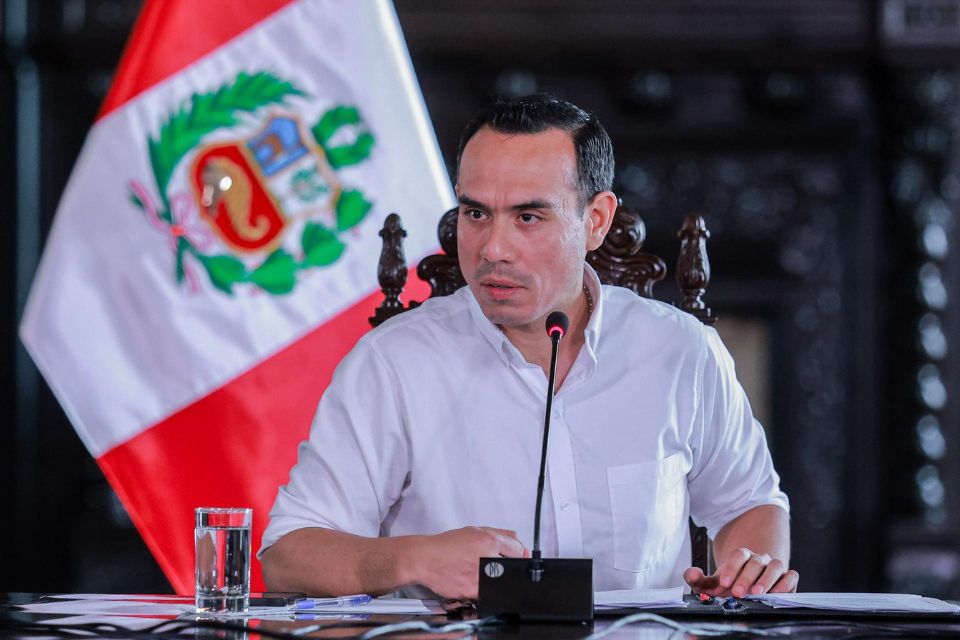
In January, the Peruvian Prosecutor’s Office opened a preliminary investigation against José Jerí for alleged “influence peddling and illegal sponsorship of interests” after learning of a covert meeting with a Chinese businessman who does business with the government.
This Tuesday, José Jerí ceased to be interim president of Peru after a brief four-month term in which he could not resist the suspicions and doubts generated by his behavior as president, by holding semi-clandestine meetings with Chinese businessmen and being accused of alleged irregularities in the hiring of officials that he had previously received in the Government Palace.
This 39-year-old lawyer, trained in Somos Perú, a right-wing party specialized in the municipal sphere, was censured by the Congress itself that put him in the presidential chair, and became the seventh ruler to fall in the midst of a deep-rooted political crisis that lasted for nearly a decade.
Jerí ascended to the head of state on October 10 in his capacity as president of Congress, at the time when his predecessor, Dina Boluarte (2022-2025), was dismissed, who in turn replaced the imprisoned leftist president Pedro Castillo (2021-2022), of whom she was vice president.
*Read also: The Peruvian Congress dismisses interim president José Jerí
He had entered Congress in 2021 to replace the disqualified former president Martín Vizcarra (2018-2022) with just 11,600 votes.
In a few months, he went from being a rank and unknown congressman to chairing parliamentary committees, then the Legislature, and from there to the presidential chair.
In the last decade, only one of seven Peruvian leaders completed their term.
rape complaint
His arrival at the head of state was marked from the beginning by a complaint of rape that allegedly occurred at the end of 2024, which was archived by the acting attorney general, Tomás Gálvez, due to lack of biological evidence, despite the fact that another defendant in the same case had declared that Jerí could have allegedly used objects or other means to carry out the rape.
As a result of this case, a judge ordered him to undergo therapy to treat a psychosexual pathology, and during his first days his old tweets went viral, in which he showed a predilection for “sex” and “women”, while on his Instagram account he followed hundreds of profiles of women who created erotic content.
In his parliamentary work, he was also accused of alleged illicit enrichment, when he was accused of allegedly having received money to advance bills in the Congressional Budget Commission that he once chaired.
Bukele style
As president, he sought to resemble Nayib Bukele in El Salvador or Daniel Noboa in Ecuador, with a reform of the penitentiary system and interventions in prisons where prisoners were exposed in submissive situations to the security forces, added to the state of emergency to combat criminal gangs.
This led him to have a popularity of more than 50% during the first weeks, but everything changed at the beginning of this year when it emerged that, as president, he had held a series of semi-clandestine meetings with Chinese businessmen, some of them contractors for the State and the presidential office itself.
Among them stands out Zhihua ‘Johnny’ Yang, whose chifa – a Peruvian-Chinese food restaurant – he went to on the night of December 26, hooded so as not to be recognized, and whose Chinese products store he visited on January 6 when hours before it had been closed by the municipal authorities.
Then there were cases of a series of government officials who were hired just after having held meetings with the president in the Government Palace, one of them after spending the entire Halloween night there and leaving the presidential headquarters the next morning.
This led the parties in Congress to seek to distance themselves from Jerí at a time when the majority of them are seeking good results in the general elections called for next April 12, after the country has had seven presidents in the last ten years.
With information from EFE agency
*Journalism in Venezuela is carried out in a hostile environment for the press with dozens of legal instruments in place to punish the word, especially the laws “against hate”, “against fascism” and “against the blockade.” This content was written taking into consideration the threats and limits that, consequently, have been imposed on the dissemination of information from within the country.
Post Views: 118