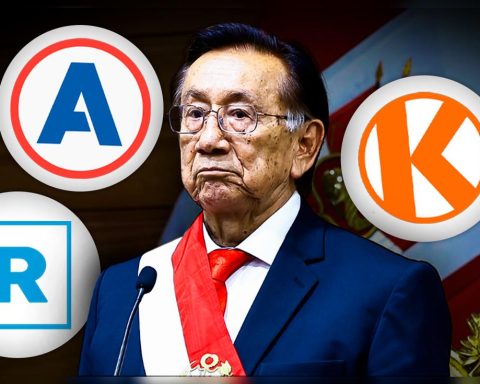
Arguing that a presidential change would cause “chaos” and “uncertainty” in the country, Fuerza Popular was the only bench that did not vote in favor of José Jerí’s motion of censure over the Chifagate case. However, contrary to that speech, in previous years it was this parliamentary group that promoted the departure of the current leaders.
In total, with its majority in Congress, Fujimorism has promoted Peru to have, after Jerí’s vacancy, eight presidents in 10 years.
The ‘Kenjivideos’ that caused PPK to resign
In the case of PPK, the orange party promoted up to two vacancy motions. The first did not reach the necessary votes, while the second was not debated because the then president resigned.
After the 2016 elections in which Fuerza Popular obtained an absolute majority in Congress, the first vacancy request was debated on December 21, 2017. It was due to the revelation of Odebrecht documents in which it was mentioned that this company had made payments to First Capital and Westfield Capital, the latter owned by Kuczynski.
There were 27 legislators, from the Fuerza Popular, Frente Amplio and Apra parties, who requested this request, alleging the “permanent moral incapacity” of the then president. However, only 79 votes were obtained in favor of the minimum 87 that were required to declare the vacancy.
In March 2028, a second vacancy motion was made. This time it was an initiative of the left-wing groups Nuevo Perú and Frente Amplio, although it was the support of Keiko Fujimori’s bench that was decisive for the motion to reach the number of adhesions necessary to be presented.
The debate and vote in Congress was scheduled for March 22, but before that Fuerza Popular broadcast a series of videos where government officials attempted an alleged purchase of votes by requesting congressman Moisés Mamani for his support in exchange for works for their region. They were called ‘Kenjivideos’ due to the presence of Kenji Fujimori in them.
This situation represented a precedent regarding the interpretation of the figure of “permanent moral incapacity” provided for in the Peruvian Constitution. Although it is provided for in article 113 of the 1993 Constitution, for years it was a little-used clause until it was the argument for the two vacancy processes launched against PPK. Since then, it was presented as a figure that could be used with a broad political criterion, not necessarily a legal one.
The Fujimori votes in the vacancies against Martín Vizcarra
The person who assumed office after PPK’s resignation was Vice President Martín Vizcarra. On September 18, 2020, the first vacancy motion presented against him due to the figure of “permanent moral incapacity” was debated after the dissemination of audios related to the Richard Swing case, who was a person close to Vizcarra and obtained contracts with the Ministry of Culture.
On that occasion, only 32 votes were obtained in favor of the minimum 87 necessary. Nine of the 15 parliamentarians from the orange bench voted in favor.
Months later, on November 9, a second vacancy was debated against Vizcarra, which reached 105 votes in favor. This time the support of the Fujimoristas was greater: 13 out of 15 voted in favor.
Resignation of Manuel Marino
After this, Manuel Merino took office, remaining only five days in office, as he resigned on November 15.
Initially, Fuerza Popular did not question this assumption because it maintained that constitutionally it was what was appropriate and maintained an institutional position in defense of legality after a vacancy process.
However, massive nationwide protests were held demanding Merino’s departure. Unfortunately, Inti Sotelo and Bryan Pintado died in that context. Faced with this and the social discomfort, the party changed its position and indicated that a resignation was necessary to reestablish stability and social peace.
Fuerza Popular and its opposition to the Sagasti government
Following the chronological line, Francisco Sagasti assumed the presidency. Although no vacancy motion was filed against him, Fuerza Popular questioned his mandate in decisions related to the management of the pandemic and changes in the Police after the November 2020 protests.
Furthermore, after the defeat of Keiko Fujimori in the 2021 Elections, the leader insisted the president review the alleged irregularities that occurred in the electoral process and that caused his defeat.
Sagasti remained firm in his position, indicating that “no athlete questions the rules of the competition in which he has participated, after losing.”
Orange bench voted in favor of 3 vacancy motions against Pedro Castillo
With Pedro Castillo now head of state after his victory in the 2021 Elections, Keiko Fujimori’s bench was critical of his Government and was one of the main drivers of the vacancy processes. In the three presented against him, the votes were always majority in favor and he had an active participation in the process.
Dina Boluarte and the last-minute Fujimori impulse that achieved her departure
Finally, after the vacancy of Pedro Castillo, Dina Boluarte’s mandate received citizen rejection from the beginning due to deaths in protests.
Due to this and its inefficient management to stop crime, up to seven vacancy motions were presented against it, but none succeeded until October 10, 2025, the date on which the necessary votes were reached due to the last-minute support of Fuerza Popular.
After marking distance and not supporting any motion against Boluarte. The party changed its initial position in which they assured that they would not be part and announced that this time they would vote in favor because they could not “allow even one more victim” as a result of insecurity.