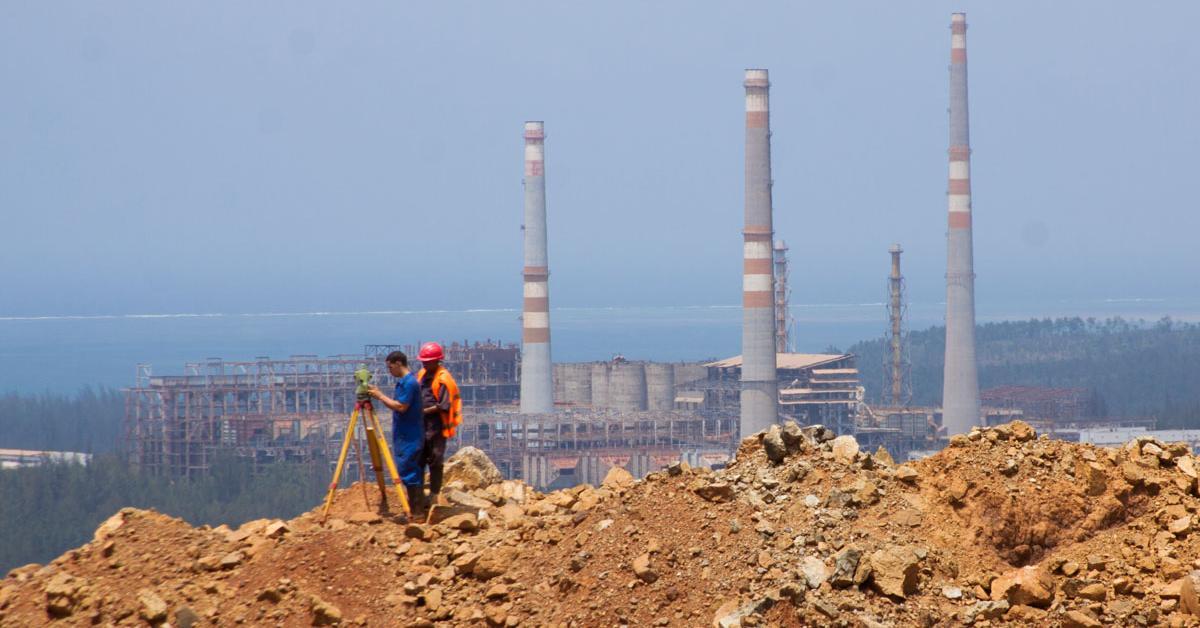
Madrid/The Canadian company Sherritt announced this Tuesday that it is suspending its activities in Cuba due to lack of fuel. “The corporation plans to pause mining operations and put the processing plant on standby over the next week, during which planned maintenance activities will be carried out,” the mining giant said. in a statementreferring to the nickel and cobalt mines that the firm operates in Moa, Holguín.
The decision has been made, he explains, after having received “a notification that the fuel deliveries planned for Moa will not be fulfilled and the deadline for the resumption of deliveries is unknown.”
Sherritt assures that the measure is not having “an immediate impact” on the refinery that operates in Fort Saskatchewan, in the Canadian province of Alberta, which continues to produce nickel and cobalt “finished for sale.” The company estimates it has enough raw materials until approximately mid-April.
At the same time, he affirms that the operations carried out with Energas – the Boca de Jaruco, Puerto Escondido and Varadero plants, between Mayabeque and Matanzas – “continue as planned without any impact.”
The miner concludes that “it hopes to be able to provide an updated projection for 2026 once it has greater certainty about the supply chain”
Although the statement attempts to remove alarmism, Sherritt denotes concern by acknowledging that “it is evaluating the options available to maintain operations and prolong production at Moa and Fort Saskatchewan, while implementing measures to preserve and maximize liquidity.” Among these measures is requesting financing.
The miner concludes that it “expects to be able to provide an updated projection for 2026 once it has greater certainty about the supply chain and the timelines for the full resumption of operations at its mine and processing facilities in Moa.”
Less than a month ago, the company announced its 2025 resultswell below not only those of the previous year but also the forecasts that had been set, and indicated, in a corporate note, that it was working with its partner on the Island, the state-owned Energas, in a “comprehensive operational restructuring” in the Moa mines, when analyzing the “adverse operating conditions” in Cuba.
“Our efforts seek to strengthen the productivity and reliability of mine operations amidst greater geopolitical uncertainty and, ultimately, pave the way for us to obtain the maximum benefit from our expansion,” said Peter Hancock, named interim director of the company on December 8 in place of Leon Binedell, who had served as chief executive officer (CEO) for the previous four years.
Since his appointment, Hancock noted, he had worked with the Cuban State “on a comprehensive operational restructuring at Moa to address the challenges we see in 2025 and support the return to consistent operational performance at the field.” The company’s energy division, he asserted, “demonstrates what can be achieved with focused operational improvements, with our dividends doubling this year to 26 million.” And he promised: “We will apply the same operational discipline at Moa to replicate that success in the years to come.”
If already in the second quarter of 2025, the company reported multi-million dollar losses –from 51.4 million dollars in the same period of the previous year to 43.7 million–, last year’s global results followed the same trend. Sherritt expected to extract between 31,000 and 33,000 tons of nickel last year, but only achieved 25,240, which is almost 17% less than what was achieved in 2024. Of cobalt, it expected to extract 3,300 tons and however it remained at 2,729 at the end of the year, about 15% less in the year-on-year comparison.
The company cited among the main problems that the Moa plant faced in 2025 the lack of supplies, delays, prolonged blackouts that affect the entire Island and the effects of Hurricane Melissa.
That statement was issued just before the siege intensified, with the threat of imposing tariffs on those who supply oil to the Island.
“Sherritt is actively monitoring recent regional geopolitical events and working closely with its partner in the joint venture to anticipate and respond to potential risks,” the company added last month, in clear reference to the looming energy crisis in Cuba following the United States intervention in Venezuela on January 3, which resulted in the capture of Nicolás Maduro and his wife, Cilia Flores, and the persecution in the Caribbean of sanctioned oil tankers.
That statement was issued just before the siege intensified, with the threat – via executive order signed by Donald Trump – of imposing tariffs on those who supply oil to the Island. This represents, in any case, the final straw for a business in decline.
As he warned 14ymedio William Pitt, the Canadian giant, is in trouble, and needs imported fuel to be able to work the nickel and cobalt mines it operates in Moa, the economic base of that company.
“A company that was the best foreign investment Cuba has ever had,” observed the American businessman, whose family the regime expropriated multiple mining properties in 1960. Pitt himself told this newspaper the economic disaster that Sherritt was experiencingwhose power plants and gas wells, operated in cooperation with Energieshad until now produced “the most reliable and best managed energy services” in the country.
To this he associated, in fact, the change of its management leadership. “Sherritt has lost so much money that it is suffering a revolution among its shareholders in Canada,” said the businessman when referring to the replacement of Binedell by Hancock, who Pitt described as “personnel from another competitive company.”