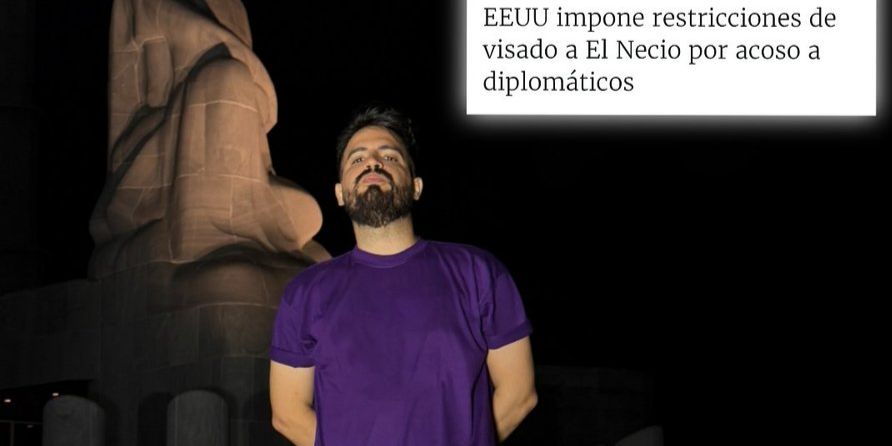
LIMA, Peru – The journalist and spokesperson for the Castro regime Pedro Jorge Velázquez, known as El Necio on social networks, published a statement this Saturday in response to the visa restriction that the United States accused of harassment of American diplomats.
On Facebook, El Necio reacted to the news with the words: “a source of pride for me.” On the other hand, in a text who published in X (formerly Twitter) under the title “Declaration #1”, he claims that he is “an ordinary young Cuban” and vindicated his work for the propaganda apparatus of the Havana dictatorship.
“For 5 years I have been doing my work through social networks and collaborating with the media,” he acknowledged. Contradictorily, in the same paragraph Velázquez argues that he has no current employment relationship with the Cuban government or state institutions.
The sanction against El Necio, originally reported by the media Martí Noticias, responds to the recent measures announced by Washington against officials and those involved under the Castro regime in acts of harassment and harassment against US diplomats on the Island.
Among the actions that the United States authorities attribute to Necio, the dissemination of images in which the license plates of diplomatic vehicles are observed, as well as information considered sensitive by security analysts, stand out.
In this regard, Velázquez’s “Declaration #1” presents the event as his “last journalistic investigation” where it demonstrates “the purchase of fuel (gasoline) by US diplomats.” in the capital of the Island.
“The sanction is irrelevant to me. I have never had, nor have I requested, a visa to enter the United States. It has never crossed my mind to visit that country with so much beauty in Latin America and with so much humanism in the neighborhoods of my country,” the accused highlighted.
Likewise, El Necio warns that what happened represents a serious violation of press freedom and constitutes a precedent of censorship and coercion towards any young Cuban who speaks out against the blockade or practices journalism that does not please Donald Trump’s administration.
The Castro spokesman maintained that his restriction is an “attack on the exercise of free and independent journalism” that he exercises, in his opinion, “under ethical principles, with triangulation of sources and verifications.”
“My work is to spread the truth, not to please the power that sanctions me,” he justified.
His statement concludes with the resolution to continue in Cuba, telling “the truth” of his circumstances, “the harshness of these times.” “Making the necessary criticisms and campaigning for a better world,” the publication emphasizes.
Velázquez would be one of the first people sanctioned in Cuba for his role in “campaigns of harassment, dissemination of sensitive content and intimidation actions directed against the Chargé d’Affaires of the United States Embassy in Havana, Mike Hammer,” official sources point out. Martí News.
Last Thursday, the United States Undersecretary of State, Christopher Landau, assured that Washington knows the identity of the people who harassed to Hammer during recent tours of the Island and announced that it will respond, “among other things,” with visa sanctions against those involved.
“Small groups of agents of the Cuban regime have been harassing our distinguished Chargé d’Affaires in Havana, Ambassador Mike Hammer, as he travels around the Island in the performance of his diplomatic duties. I want these people to understand that we know who they are, and we will respond accordingly with, among other things, visa sanctions,” Landau wrote. on his official account on X.
In the same message he added: “Under basic standards of international law, diplomats must be free to carry out their duties without harassment from thugs.”
In the particular case of Velazquez, identified as El Necio on social networks, his participation within the Castro scheme transcends that of a simple content creator or political “influencer” on the internet, as he has stood out as an agent of the propaganda and repressive organs of the dictatorship.