“If by mid-March we do not see a tanker on the horizon, Cuba will have reached zero hour,” warned Jorge Piñón, a researcher at the Energy Institute at the University of Texas, USA. in conversation with the Spanish newspaper The Country published this Saturday.
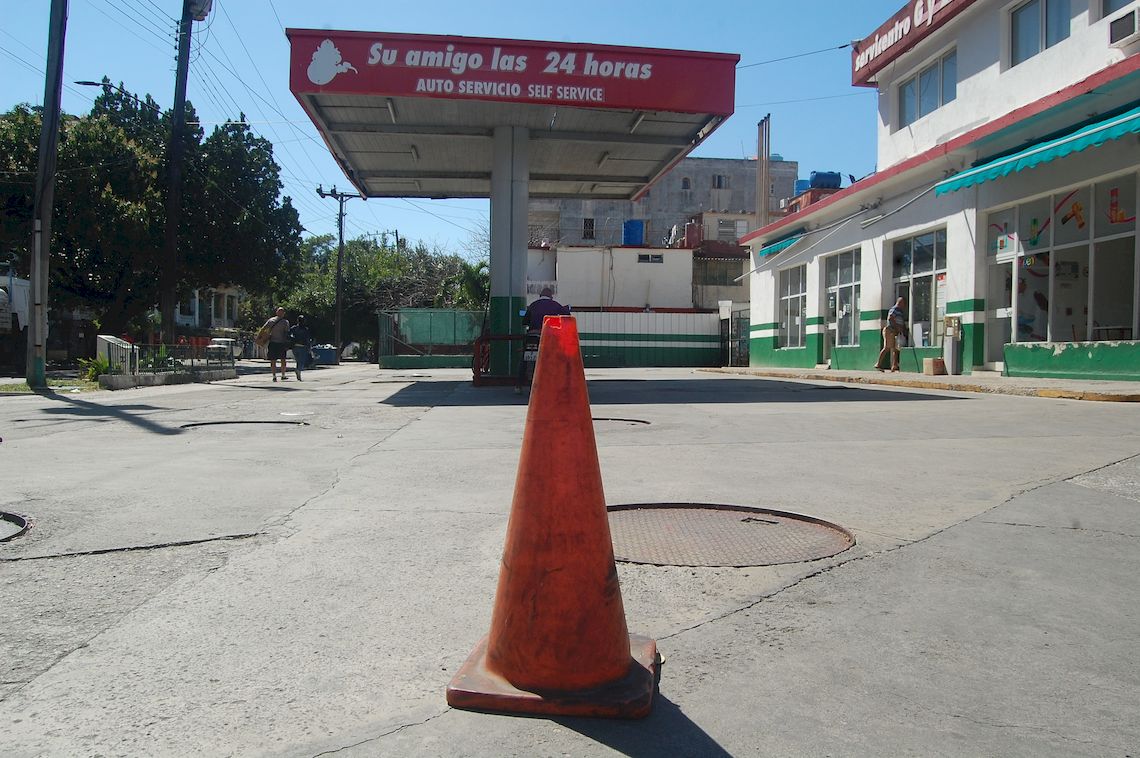
The phrase summarizes the severity of the energy crisis that the island is going through, marked by the lack of hydrocarbons, the deterioration of thermoelectric plants and the tightening of the US blockade that seeks to suffocate the country’s economy, which has decreased 15% in the last five years.
“It’s going to get worse.” Transportation crisis after the oil blockade of Cuba
An expert’s warning
Born in Cárdenas, Matanzas, in 1946 and with a long career in companies such as Shell, Amoco Oil and BP, Piñón closely follows each shipment of crude oil that arrives in Cuba.
According to his calculations, in line with other international ones, the country needs about 100 thousand barrels per day to sustain basic electricity and transportation services, but national production barely covers 40 thousand. The rest depended on shipments from Venezuela, Mexico and Russia.
“The last ship that brought crude oil to Havana was the Ocean Mariner, which loaded 85 thousand barrels from Mexico and docked on January 9,” he recalled. Supplies have since been disrupted. “The situation in Cuba is extremely critical,” he emphasized.
The expert stressed that the island lacks strategic reserves and storage capacity: “It has always lived up to date with oil.” The lack of liquid fuels affects not only mobility and electricity generation, but also the distribution of water and the preparation of food, based on electric cooking systems that are widespread on the island.
In addition, Piñón pointed out that 60% of thermoelectric plants do not work due to lack of maintenance and that the electrical system, aged and damaged, only offers an intermittent supply. “They are trying to increase renewable energy, particularly solar, but they are small parks that operate only when the sun shines,” he explained.
In his historical analysis, Piñón recalled that Cuba has depended on powers ideologically aligned with the government: first the Soviet Union and then Venezuela. “With Chávez, from 2007 to 2015, Cuba was receiving almost 100 thousand barrels a day,” he calculated.
For the oil academic, the current crisis is also the result of the government’s refusal to modify its economic model: “Cuba has not wanted to let go of its centralized model and is the only country that still operates under a model from the days of Stalin.”
Piñón left Cuba in 1960, when he was barely 14 years old, as part of the so-called Operation Peter Pan that followed the revolutionary triumph of 1959 and which, organized by the CIA and the American Catholic Church, extracted some 15,000 children and adolescents without their parents under a disinformation campaign about the abolition of parental rights on the island.
In the United States, Piñón built a solid career in the energy industry, an experience that he later transferred to the academic field. Over the years he has returned several times as a visitor, and on each trip he has noted with regret the deterioration of the situation. Today, faced with fuel shortages, he describes the reality of the island as “dire” and warns that the difficulties for Cubans will become increasingly greater as the energy crisis continues.
“Somewhere has to give in,” he insists about the political dialogue that can exist between Havana and Washington. “What is happening is hard for everyone, whether Cubans here or Cubans there,” he told The Country.
Brazil: solidarity and pressure on Petrobras
While the island faces shortages, in Brazil oil workers and social movements launched the “Oil for Cuba” campaign. The Unified Federation of Petroleum Workers (FUP) sent an official letter to Petrobras requesting a meeting to discuss an emergency shipment of fuel, said a agency office Latin Press.
“Petrobras, as a public company of a sovereign country, must get involved to guarantee the supply of oil to the Caribbean nation,” declared Paulo Neves, director of the FUP.
The initiative has the support of unions, political parties and organizations such as the Movement of Landless Rural Workers (MST), which also promotes the purchase of medicines to send to Cuba.
João Pedro Stedile, leader of the MST, denounced that the US blockade has affected the Cuban government’s ability to acquire medicines on the international market. “At a minimum, we have an obligation to find a way to alleviate the suffering of those who suffer from an illness there,” he said.
The government of Luiz Inácio Lula da Silva is studying coordinating a shipment of humanitarian aid, following the example of Mexico. According to the Ministry of Agrarian Development, the action would be carried out by the Brazilian Cooperation Agency. Lula himself has urged the Workers’ Party to support Cuba, calling the situation a “speculative massacre” by the United States.
A cartoon published on the Brasil247 portal summarized the spirit of support: Fidel Castro points to Trump and says, “You blocked the oil that goes to Cuba, but we will resist with something that you do not have, the solidarity and sympathy of the world.”
Flotilla organizer with aid to Cuba: “We cannot allow the siege against the island to be normalized”
Marco Rubio: “Cuba does not have an economy”
In contrast to the gestures of solidarity, from the United States the US Secretary of State, Marco Rubio, toughened his speech against Havana.
During an interview with the agency Bloombergbounced by the German agency DPAafter participating in the Munich Security Conference, stated that “Cuba’s fundamental problem is that it does not have an economy and that the people who rule the country do not know how to improve daily life without opening their hands in the sectors they control.”
Blond held that the government has survived thanks to external aid: first from the USSR and then from Hugo Chávez. “For the first time he has no help from anyone,” he stressed. For the head of US diplomacy, Cuban leaders “prefer to be in charge of a dying country than to allow it to prosper.”
The headache of “removal” in Cuba, the constant intermittent blackouts
Massive blackouts: the UNE daily bulletin
Among other ostentatious manifestations, the energy crisis is reflected in the blackouts that affect a large part of the country daily. The Electrical Union of Cuba (UNE) reported that this Saturday 56% of the territory will be without power during the evening, when consumption increases. reviewed an office from the Spanish agency EFE.
The planned generation capacity is 1,389 megawatts against a maximum demand of 3,100 MW, leaving a deficit of 1,711 MW. It is estimated that the real impact will reach 1741 MW.
Currently, six of the 16 thermoelectric units are out of service due to breakdowns or maintenance, including two of the three largest. This source represents around 40% of the national energy mix.
On the other hand, about a thousand MW are paralyzed in distributed generation – generating sets – due to lack of fuel, since they mainly use diesel for their operation.
Independent experts estimate that between 8 billion and 10 billion dollars would be necessary to clean up the electrical system. The government, for its part, blames the US sanctions and denounces an “energy asphyxiation” along the entire line, in response to which it launched a national survival plan.
The program updated measures from another similar one designed in the 90s, with Fidel Castro in power, in light of the Soviet collapse and which contemplated the so-called “Zero Option”, for times when no oil shipments were brought to the island, an extreme that was never reached then.