On the same day that Granma advertisement, againthat the country plans to plant 200 thousand hectares of rice in 2026, retired teacher Silvia García had an epiphany in the neighborhood’s agriculture: a pound of criollo at 250 pesos.
“It’s the least expensive thing in all of this around here!”, says, exultantly, the ticher (teacher), as everyone knows her, as she has taught and reviewed English to several generations of pre- and university students in the community.
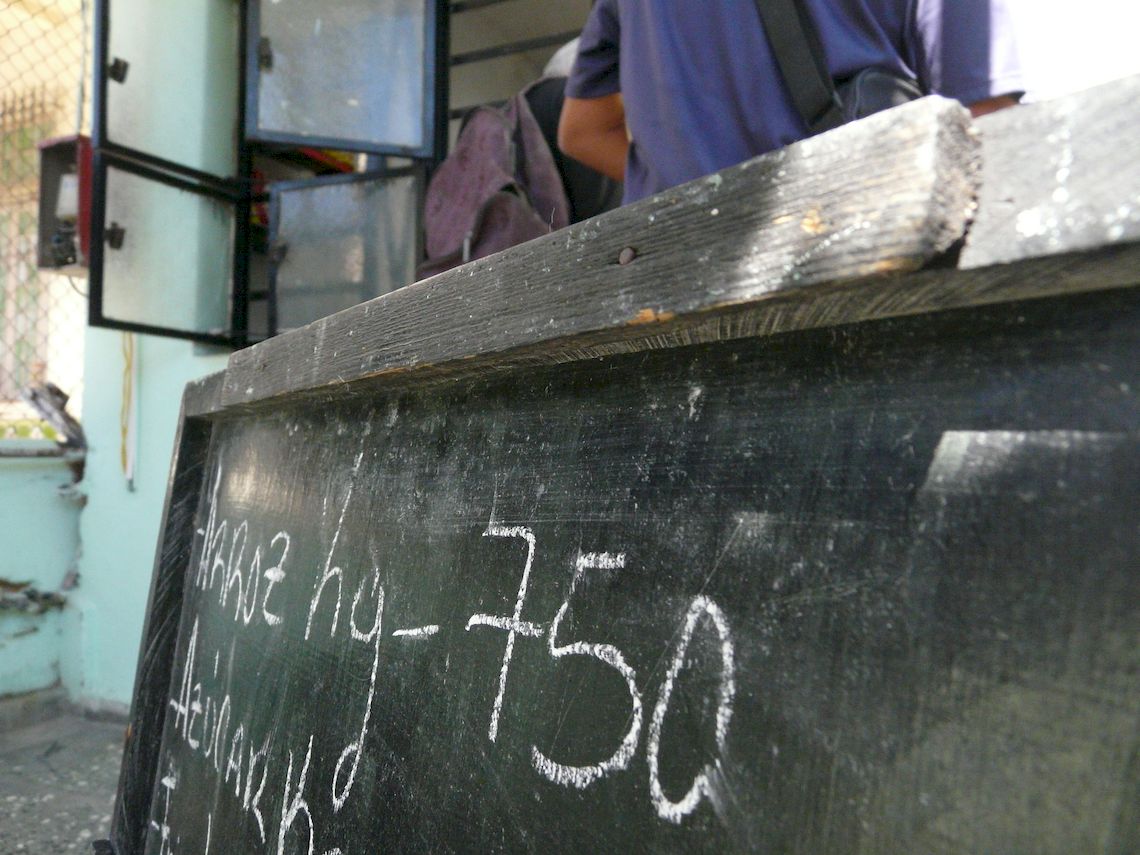
On the same street as the improvised farm that survives under the “miraculous static” of a propped-up building, they have opened another full-scale sale, where Brazilian rice is sold in bulk at 290 pesos per pound.
Silvia is lenient with the quality of the cereal. “It is true that it is somewhat dirty, especially it has some little black balls (perhaps vegetable impurities or burned grains during the drying process), which I don’t know what the hell it is and which the stallholder didn’t know how to tell me either,” he comments to another neighbor to whom he has “given the light” of the price. Either way, she confidently heads home, where her grandson, who will soon be home from school, “always hungry” is waiting for lunch. “I say As good as it gets, (It couldn’t be better) like the movie I love [Jack] Nicholson,” he says, getting lost in the narrow hallway that leads to his apartment.
The “magic” number?
This is not the first time that the official press has dedicated pages to the 200 thousand hectares plan, which is not even remotely a “magic” figure to satisfy demand. If there are no major setbacks, with this area we could obtain about 182,600 tons of cereal, that is, 30% of domestic demand.
Of course, this is a mathematical estimate: in practice, factors such as soil quality, availability of inputs (fuel, among them!), climate and technology can make the yield higher or lower.
The Cuban rice program has become one of the reasonable obsessions of the national strategy to achieve food sovereignty, for many a goal anchored—another of many—in the uncatchable horizon of political fictions.
According to engineer Israel Lugo Hernández, main specialist of the Agricultural Business Group (GAG), this year the planting of 200 thousand hectares of rice is expected, distributed over 61,035 hectares in the cold season and 138,965 in the spring season.
In 2025, the country managed to plant 122,990 hectares, exceeding the 100,000 initially planned. The result was a production of 111,528 tons of rice, destined for the Ministry of Domestic Trade, agricultural markets, tourism, productive inputs and seed. “They were committed to producing 97,685 tons and 111,528 were reached,” Lugo Hernández stated in an expanded note that the newspaper Granma published this week.
Cuba and Russia promote rice project in Sancti Spíritus to revive national production
Provinces with self-sufficiency capacity
Three provinces—Pinar del Río, Sancti Spíritus and Granma—today have sufficient production levels to guarantee their own consumption. Added to these are 22 municipalities, mostly located in those territories, that have also achieved self-sufficiency.
Engineer Laudelina Lugo Pérez, GAG specialist, recalled that between 2012 and 2018 Cuba produced 304 thousand tons of rice for consumption, but as of 2019 production was drastically reduced due to the intensification of the blockade and the difficulties in acquiring inputs.
“Cuba is one of the largest consumers of rice. The Government has maintained a stable rice program, but external conditions have limited us,” he said.
Fuel limitations and biological alternatives
One of the main obstacles has been the fuel deficit, which affects soil preparation and the maintenance of irrigation systems. “Some producers with a better economic situation have bought oil in foreign currency and thus have been able to ensure production,” explained Lugo Hernández.
In response, bioproducts and biopesticides have been introduced. More than 140 thousand hectares have been treated with biofertilizers, which has made it possible to partially compensate for the deficits in chemical inputs.
New economic actors, productive chains and international cooperation
From 2024, the rice program works jointly with ten MSMEsmainly in Sancti Spíritus, Pinar del Río and Camagüey.
Thanks to these productive chains, in 2025 3,020 hectares were planted, with an approximate production of 9,304 tons of wet paddy rice and a yield of 3.08 tons per hectare.
Forecasts for this year point to slight increases in both yields and production, reinforcing the idea that the private sector can play a complementary role in agricultural recovery.
Meanwhile, international cooperation has also been key. A project is being developed in Pinar del Río with the Vietnamese company V Mariel, in Granma with the Thai Binh company, and in Sancti Spíritus with a Russian consortium.
Thanks to the collaboration with Vietnam, a yield of 5.4 tons per hectare was achieved in Los Palacios. The Vietnamese partners have implemented three modalities: directly managed plantings, technological packages for local producers and sale of inputs.
At the time, the economist Omar Everleny He questioned the measure: “I wonder why land has been given for three years to a Vietnamese company… and you cannot give a national those same conditions. The national can also look for fresh resources with a family member or with entities abroad. National capital must be given the same treatment as foreign capital.”
On the other hand, drones are already used for planting and caring for crops, and the acquisition of this equipment by national producers is being evaluated, in coordination with the company GeoCuba.
Structural crisis and 300 million dollars
Despite these advances, national production faces a deep crisis. In 1985 Cuba produced 524 thousand tons of rice; By 2023 the figure dropped to just 27 thousand tons, which represents 5.32% of the production of four decades ago.
In the last six years, production has been reduced by 90%, forcing the country to import rice from Vietnam, Brazil and Uruguay.
Vice President Salvador Valdés Mesa revealed that in 2024 Cuba spent more than 300 million dollars importing 407 thousand tons of rice, destined for the regulated family basket.
“In the foods that we import, the largest amount is rice. There is no other that surpasses it, neither wheat nor fat,” the politician stressed.
Cuba intends to plant twice as much rice in 2026 as projected this year
Rice in the national diet, the future of the notebook and media brawls
Rice is the basic food for more than half of the world’s population and in Cuba the annual per capita consumption is around 70 kilograms. “The greatest incentive to plant rice is that in Cuba we eat rice,” insisted Valdés Mesa, recalling that the traditional rice and beans, once everyday, today has become a gastronomic exception.
At the end of December, a media scandal broke out around rice and the television program “Cuadrando la Caja”, when an expert suggested that Cubans should reduce their consumption of rice and potatoes, claiming that these crops “are not native to Cuba” and that they could not hope to maintain them as the basis of the national diet. The networks “ate alive” the author of such nonsense, Doctor of Science Roberto Caballero Grande, member of the National Executive Committee of the Cuban Association of Agricultural and Forestry Technicians.
The crisis has also impacted the supply book, created in 1962. Although Prime Minister Manuel Marrero announced in 2024 that “his days were numbered” and that people and not products would be subsidized, in 2025 the Government backed off and guaranteed its validity until the present, although at the cost of large cuts and delays in shipments and quantities of items.
The last rice delivery in Havana took place in December. It was 5 pounds, a sum of 2 and 3 pounds from previous months of 2025, whose last regular delivery month (5 pounds per capita) was July.
The government’s goal
In his appearance before the press on February 5, President Miguel Díaz-Canel said that “this year we want to achieve 200 thousand hectares of rice, which would imply a production with which we would begin to cover around 30% to 40% of the rice that we consume in the regulated basket and that is imported today.”
From a perspective gained by optimism, the president stated that “it would be a first step to achieve self-sufficiency in rice with national production in two or three years and not have to import rice into the country.”
However, according to the independent economist Pedro Monrealto achieve self-sufficiency in that period, the harvest would have to grow in an extraordinary way: around 1.29 million tons of wet rice, which would be equivalent to about 600 thousand tons of rice ready for consumption.
The specialist described this scenario as “an unlikely leap in just two or three years,” given the structural limitations of the Cuban agricultural sector, which include input deficits, obsolete machinery and low productivity.
In the words of the doctor in economic sciences, promising self-sufficiency in these conditions is “selling smoke.”