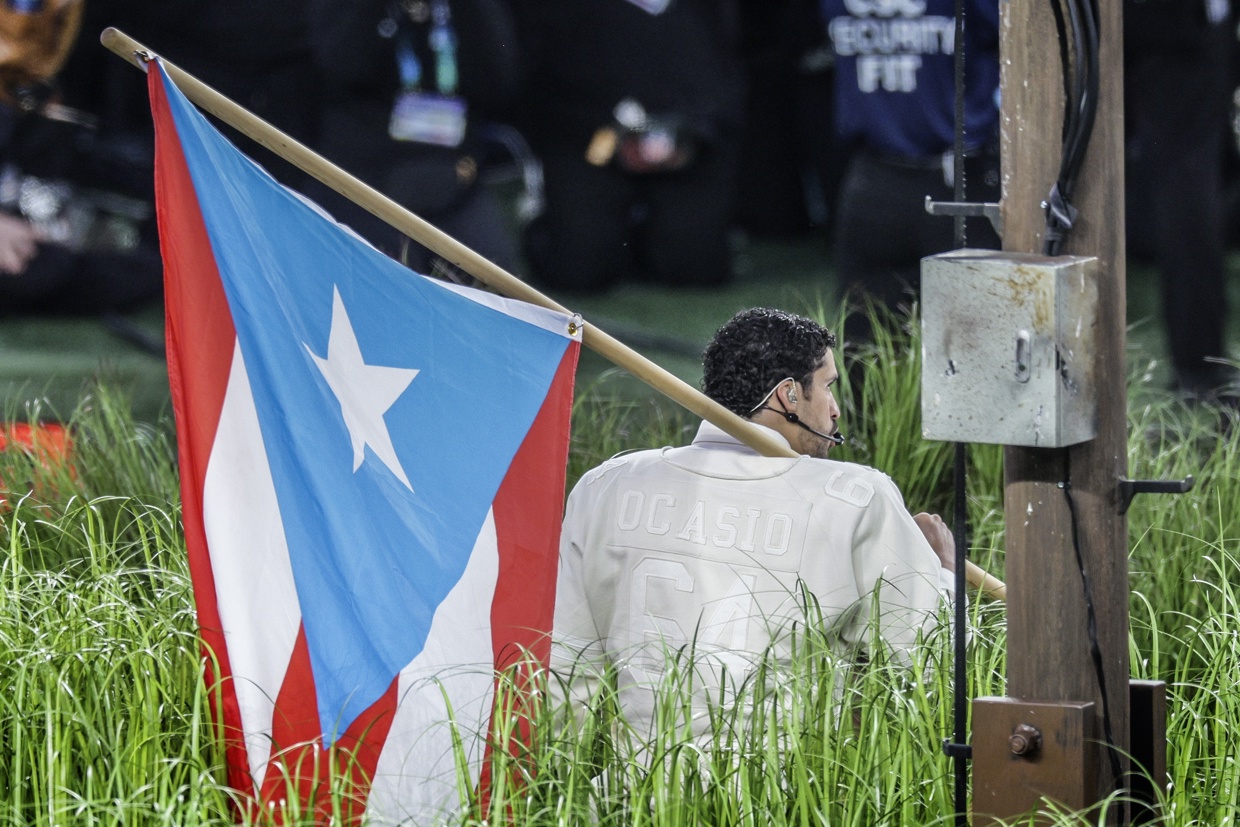
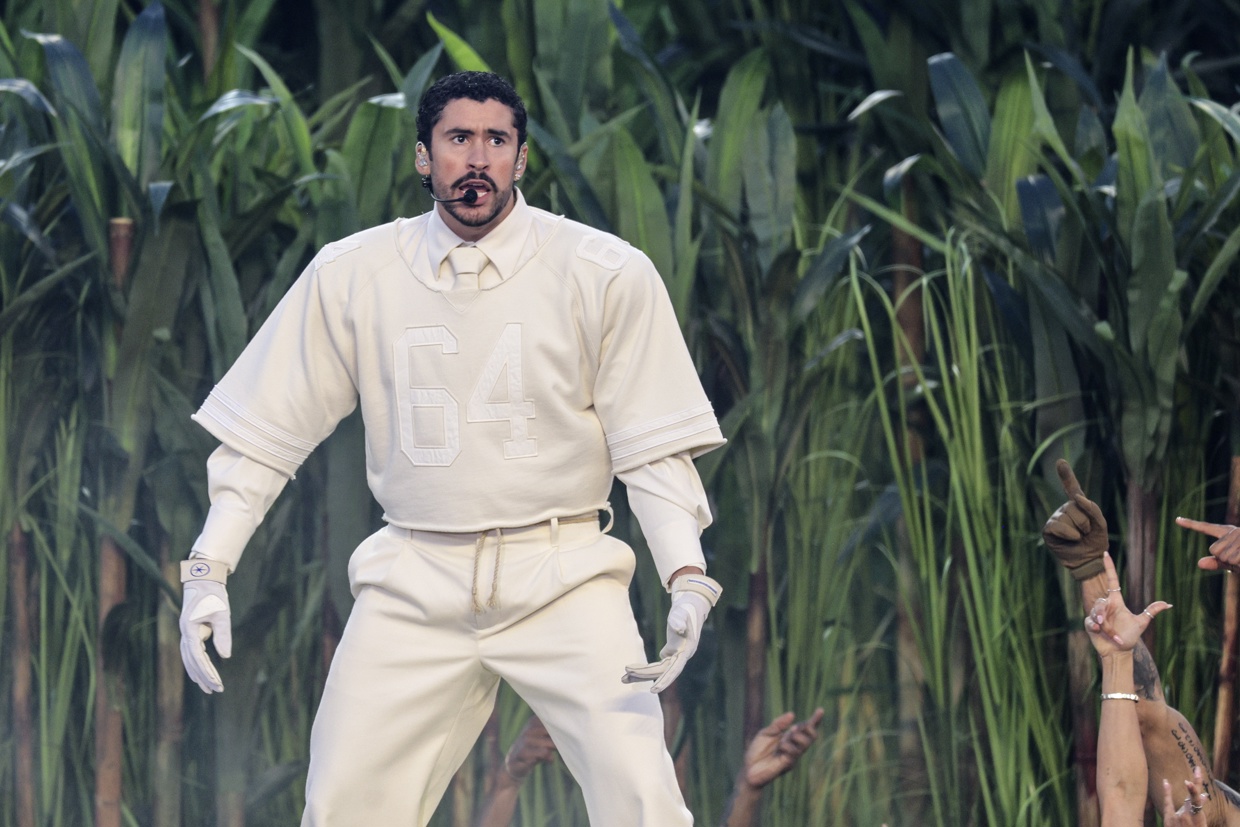
At minute 3:32 of Benito Antonio Martínez Ocasio’s show at the Super Bowl, Bad Bunny “falls” from the roof of the little house. He kicks the door and goes out into the street. As soon as you cross the threshold, the classics of the genre sound: Tego Calderón, Don Omar, Héctor el Father, Daddy Yankee.
But before that gesture—the immediate bow to the founding fathers of reggaeton—there are two decisive seconds. Benito tours the interior of the house. There are voices that react to the fall, gestures of astonishment. Bad Bunny smiles, scoundrel, and heads to the door, that border.
Before greeting his immediate teachers, Benito Antonio Martínez Ocasio has already said that his thing is not from now. It declares a longer genealogy: the sugar, the cane field – the first stage of the concert -, the historical and cultural complex of the plantation and, more specifically, the Afro-Caribbean complex that gave life, with violence and beauty, to the music, to the culture, of a fundamental part of the continent.
With that gesture, he says that he comes from where everything was depreciated before: rumba, jazz, blues; and that long history of music treated as sound and fury while archiving, with invisible rigor, the lives of the marginalized. The bolero as a narrative of the sentimental intimacy of the Caribbean; salsa as a story of the Latin city, its migrations and solidarities; the rumba with its African DNA; rap, that “CNN of black America”; he reggaeand the ungovernable spirituality of the Caribbean people. All of these genres have gone through the same thing: demerit, relegation, folklorization, commercialization, marginalization, extractivism.
Bad Bunny remakes that story: his Tinder boleros, his reggaeton and trap of social chronicle, its bomb and plena with instruments like the cuatro, its use of synthesizers and beats electronics. He is aware of the historical function of that lineage and how to kick the door with it: he builds an archive of what he wanted to erase, and he does so with infinite historical ambition.
Benito says that it comes from the Latin American identity, built in the 19th century after independence, where the nation predominated—Mexican, Argentine, Colombian, Cuban—founded on Creole and mestizo narratives. In that logic, Bad Bunny comes very specifically from the Puerto Rican identity, with its light blue flag, and its insular history of colony and resistance.
Bad Bunny, a US citizen, by history, also a full member of the Puerto Rican diaspora outside the 100×35, comes in turn from the Latin identity, a pan-ethnic category, actually quite recent, developed in the 20th century to group – from the outside – multiple immigrants under the same label: the “non-white” and “non-black”, united above all by language. An imposed, racialized identity that for decades has sought to transform itself into a new pan-Latin consciousness, a history that Benito activates with deliberation.
It comes head-on against American exceptionalism: that ancient and renewed doctrine according to which the United States would be a qualitatively superior people due to its origin, values and political system. From Manifest Destiny to the “leader of the free world,” that narrative sustained a providential patriotism that justified, in the name of a moral mission, territorial expansion, indigenous and Mexican conquest, intervention in Cuba, Puerto Rico and the Philippines, and permanent tutelage over the Caribbean, and now over South America.
This exceptionalism, which idealizes the nation while hiding its own exploitations, turned the “others”—foreigners or internal “minorities”—into threats to its historical destiny. Today it reappears, recycled, in MAGA discourse: supremacist, homogenizing, nostalgic for an impossible purity. Like the fascisms of the 20th century—Italy, Germany, Spain—it repeats an idea of “people” that is sustained by a closed identity, whose “greatness” consists in the bloody repetition of itself.
Bad Bunny also comes with the Spanish language. He says it in Spanish—Super Tazón, music from Puerto Rico, from the hamlet and the neighborhoods—and extends, in his own way, an ancient tradition: Shakespeare also wrote in tavern slang; Twain found art in the rural speech of poor whites and in the language of Mississippi blacks. Bad Bunny sings in a Spanish that the Puerto Rican Academy of Language recognizes as a cultural practice of real use, legitimate and loaded with contextual meaning.
The irony is perfect: those who call their language “vulgar” speak a vulgar language by definition, descended from latin vulgaristhe common speech of the Empire despised by Roman elites. Of caballus —rustic term— and not of equus —a cult term— “horse” emerges, the same word that, last Sunday, appears in a video after the concert where Ricky Martin hugs Bad Bunny and tells him, between laughter and pride: “You are a horse.” The language of the people reclaiming its power.

Bad Bunny also comes against historical stereotypes about Latin. Since the 16th century, the European gaze produced a catalog of dehumanized figures—savage indigenous people, lazy, infantile, demonized Afro-descendants—that legitimized conquest and slavery. That logic survived in the US: the Latino—especially the Mexican—excluded from “Anglo” spaces, portrayed as incapable for speaking Spanish. At the beginning of the 20th century it was defined as “the most docile animal in the world.” Lynchings, expulsions, school segregation, disproportionate police surveillance, humiliating caricatures: these images became popular culture and, worse, common sense.
Against this background, Bad Bunny confronts the stereotype that dictates how a Latino should behave—hot, extroverted, “managable”—and that pushes to dilute identity: soften the accent, Anglicize the name, hide clothes, hair, body. In last Sunday’s show, this mechanism is combated, as the Chicano theater of the 60s understood it, with exaggeration: taking the stereotype to the limit to show its artifice. bad Bunny thus performs the masquerade. An army of fourteen-carat asses twerk without fear; A wave of curly hair occupies the four cardinal points of the stadium and recalls centuries of straightening and “bad hair.” There is history in all that. There is truth.
Bad Bunny comes, finally, in favor of a Pan-Americanism that is a universalism. Aimé Césaire formulated it clearly: Europe called “universal” an order that excluded colonized peoples while covering up its violence with the rhetoric of the civilizing mission. That universalism was imperial and, therefore, lying. Césaire proposed another, one that does not confuse particularity with confinement or universality with erasure. In that logic, Bad Bunny raises—dammit—all the flags of America in the Super Bowl, naming them under the same name “God Bless America.” An image that reformulates, from the Caribbean, what the word “universe” can still mean.