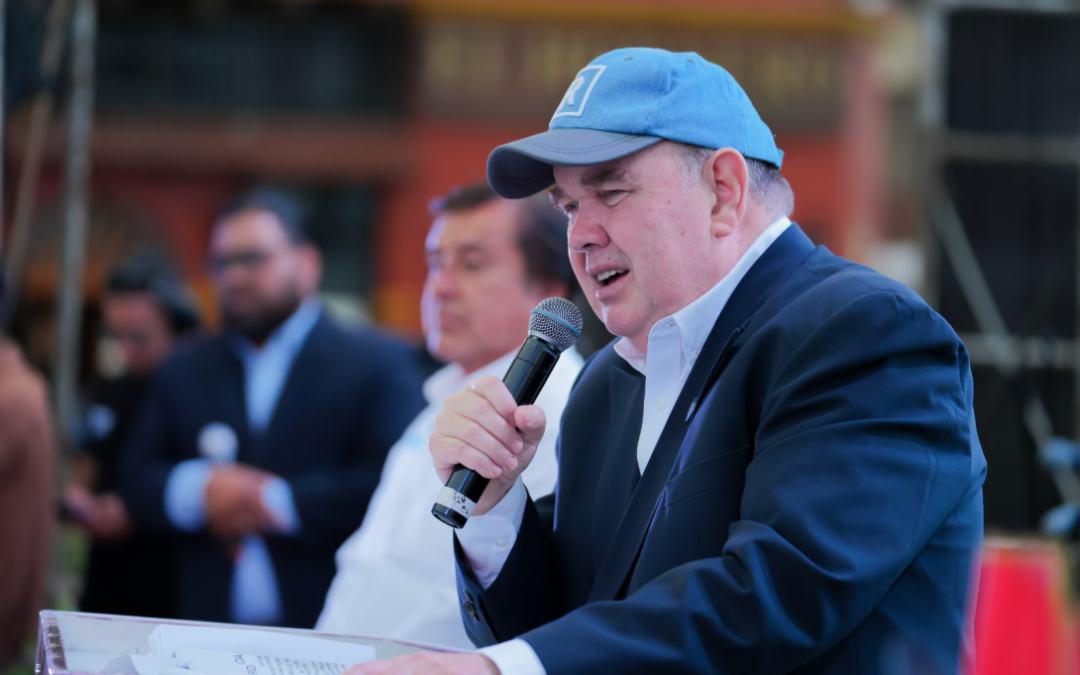
It has spent six consecutive months in first place. Since last August, Rafael López Aliaga has held that privileged position in the long list of presidential candidates with the highest voting intention in the surveys that Ipsos conducts for Peru21. Behind the Renovación Popular candidate, who has also maintained his double digits, continues Keiko Fujimori, his rival from Fuerza Popular. Exactly two months before the general elections, no one is moving them from there for now in a campaign that fails to ignite.
The new national survey carried out on February 5 and 6 has confirmed this trend: López Aliaga appears with 12% – two percentage points more than in the January sample – and the leader of Fujimorism is second with 8%, one percentage point more than the last survey.
The former mayor of Lima largely dominates the preferences in Lima (21%) with an advantage of 11 percentage points over Fujimori, although in the interior of the country he surpasses his rivals only in one of the four regions of the country, the perhaps least thought of: the south (6%).
Behind them, four candidates are in a four-way tie: Carlos Álvarez (País Para Todos), Mario Vizcarra (Perú Primero), César Acuña (APP) and Alfonso López-Chau ( Ahora Nación ) reach 4% in voting intention. The leader of apepismo has managed to get into this platoon after rising two percentage points.
Further back, George Forsyth (Somos Perú), José Luna Gálvez (Vamos Perú), Roberto Sánchez (Together for Peru) and José Williams (Avanza País) with 2%, seem to stand out from the rest of the candidates without visibility in the main table and who for now make up the group of others (14%).
The Ipsos survey also reveals that more Peruvians are defining their preferences. Those who would currently vote blank or flawed or for none of the candidates total 27%, a decrease of two percentage points compared to the last study, and 12 percentage points less than last October, when the country faced a new crisis and a third president in four years.
15% of Peruvians do not specify which party candidate they would vote for if the general elections were held tomorrow.
ANALYSIS
JOSÉ CARLOS REQUENA / Political analyst
The survey does not show many changes at the top and perhaps the main data is the consolidation of the leading cast with two much more consolidated candidates – those of López Aliaga and Keiko – and four who are striving to have a better space – Álvarez, Acuña, Vizcarra and López-Chau -. We will have to wait for the March measurement to see if any of the candidates in the third battalion emerge who can move the balance.
I think everything is still very raw, there is no dispute yet; the election is open. There is little movement between each measurement.
Another relevant fact is the high percentage that is still expressed by the white vote and the null vote, which reaches 27%, which leaves everything much more opaque.
What is striking is the very high percentage in the south of the country of those citizens who do not need it and those who state that they are going to vote invalid, which together exceed 60%, with which, currently, the battle in the south as it is currently proposed is only between four out of every 10 voters. What’s going to happen to those other six? This is what we would have to see in the following weeks, we cannot rule out that this percentage remains this high, which is relevant due to the weight that southern Peru has had in almost all the elections. Let us remember that since 2001, with the exception of Alan García, the candidate who has won in the south has always ended up winning the election.
GUILLERMO LOLI / Director of Opinion Studies at Ipsos
The latest Ipsos survey shows that the trend continues in the first two places, while candidates enter and leave behind. It is interesting how the election is segmented and now we have the candidates divided into four groups with a four-way tie in two of them.
It is also noted that some candidates pass 10% in some regions of the country. Acuña in the north and Fujimori in the east. And reaching double digits for a candidate in this election is significant. López Aliaga is not doing so badly in the provinces, he has 6% in the south, more than expected, he is gradually painting the provinces. The preference of the youngest is also interesting. This may be reflecting all the work that the party does on networks
social.
The survey also reveals that white and tainted votes are decreasing. The 27% is still high, last year it was close to 50%, and reflects the population’s rejection and apathy towards politics. At some point in this process it will have to connect and there many more Peruvians will make decisions.
The last few weeks are going to be crucial in this election to see if the trend that we have seen is ratified or if the famous outsider that has sometimes appeared in our elections appears.
We will see if the trend varies when we carry out the surveys with replicas of the voting card and with the location of the party symbols already defined.
TECHNICAL SHEET: National Urban Rural Survey carried out by Ipsos Peru on behalf of Peru 21. Registration number: 001-REE / JNE. Sampling System: A stratified cluster sample was carried out in the first stage, where they are defined by the intersection of the geographical region and scope variable. In each stratum, a sample of localities was randomly selected and within them areas with random beginning of blocks. Subsequently, a systematic sampling of homes was carried out in each selected block. Finally, within the home, people were searched according to sex and age quotas. The surveys were carried out in homes in person using mobile devices. Sample: 1211 surveys. Places where the survey was applied: 24 departments and the Constitutional Province of Callao. Application date: February 5 and 6, 2026. Margin of error: +/- 2.8%. Confidence level: 95%. Universe: rural urban population over 18 years of age. Website: www.ipsos.com/es-pe. E-mail: [email protected]
Subscribe for free to the most prestigious Gastronomic Guide in the country. SUMMUM, the weekly newsletter. http://bit.ly/4imAPEI