The amnesty bill is questioned for not including reparation mechanisms or guarantees of non-repetition, and for leaving out events that occurred after the deadline provided for in the law. However, experts affirm that the ultimate goal is the freedom of all political prisoners.
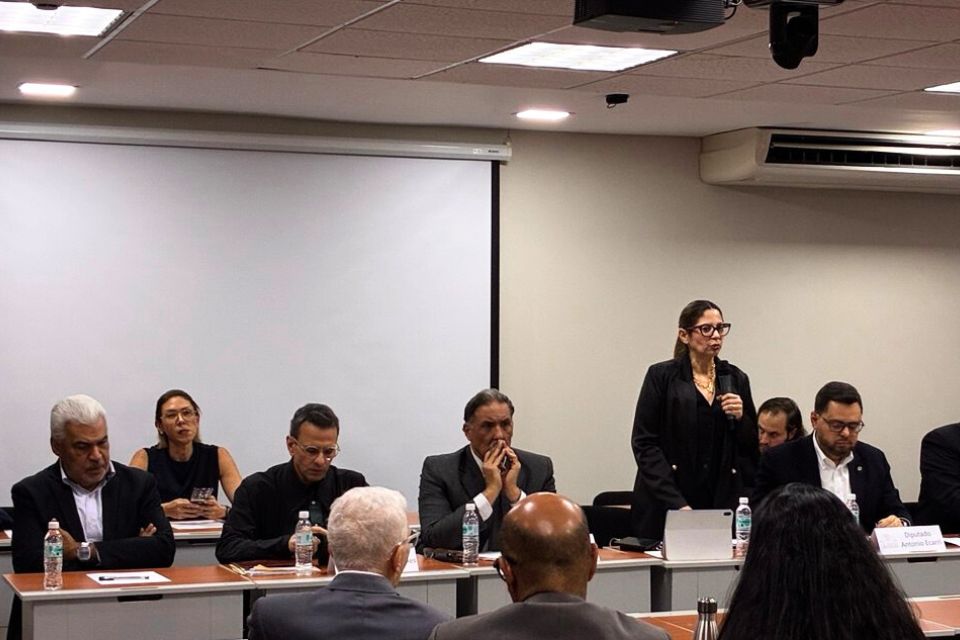
During a public consultation on the amnesty bill for political prisoners, held in Caracas last Monday, February 9, lawyers, experts and representatives of civil society agreed to point out problems of legal indeterminacy, technical gaps and risks in its application; However, they recognized that the initiative is a way to move towards the freedom of those detained for political reasons in the country.
Lawyer Magaly Vásquez, professor at the Andrés Bello Catholic University (UCAB) and doctor of Law, warned that one of the underlying problems of the project is the lack of clarity about What is meant by political crimes?a notion that—he recalled—is not defined in the Venezuelan legal system and has been constructed casuistically by the jurisprudence of the Supreme Court of Justice.
Vásquez maintained that this indeterminacy compromises the application of the law and pointed out that the project does not offer clear criteria to delimit the facts that would be covered. In that sense, he explained that the observations document presented proposes listing the specific crimes eligible for amnesty.
The specialist also questioned the wording of article 1, considering the notion of “events of violence for political reasons” imprecise, as well as the temporality of the norm, which sets the limit on January 30 of this year without explaining why it does not extend until the 31st or until the date of publication of the law.
*Read also: NGOs and victims ask to redo the amnesty bill and warn of exclusions
One of the most critical remarks was directed at article 6, which lists acts of violence for political reasons. Vásquez indicated that, except for the first paragraph—linked to facts already contemplated in the 2007 amnesty decree—the others are so indeterminate that, in his opinion, they would prevent the law from achieving its objective.
In relation to crimes against public property, the specialist warned that as the rule is drafted, people who were charged with this type of crimes would be excluded to prevent their candidacy for popularly elected positions, despite the fact that they are not expressly excluded from the amnesty by article 29 of the constitution.
Vásquez added procedural observations, warning that the project omits the intervention of the execution judges in the extinction of the sentence of the convicted and confuses the effects of the amnesty with the appeal for criminal review. Likewise, he warned that Article 10 attributes to police forces and military authorities the power to terminate criminal investigations, a power that – he stressed – does not correspond to them.
Finally, he recalled that under current standards of international human rights law, a legitimate amnesty law must be linked to reparation mechanisms and guarantees of non-repetition, aspects that are not contemplated in the project.
From civil society, lawyer César Ramírez, a member of the Centrados party, defended the law as a way to move towards national reconciliation and the release of people unjustly detained. He called on the deputies to speed up the debate, considering that the norm represents a hope for political prisoners and their families.
Ramírez proposed eliminating Article 6 of the project, arguing that people detained for political reasons face a variety of charged crimes that, he said, are “invented” and do not constitute real crimes. In his opinion, respect for the due process enshrined in Article 49 of the Constitution would be sufficient.
*Read also: These are some of the contributions of civil society to the amnesty discussed by the AN
He also questioned whether the planned judicial procedure leaves the freedom of the defendants in the hands of the judges, considering that these same judges have been responsible for violations of due process. He proposed the appointment of judges ad hoc or itinerant people who review cases directly in detention centers. In addition, he proposed that the project include the repeal of the Law against Hate, the Simón Bolívar Law and the Control Law against NGOs.
For his part, deputy Henrique Capriles stated that An amnesty law is not needed to release political prisonerspointing out that the recent releases have not been a consequence of the approval of a rule of this type. He insisted that the problem is not legal but political and that respect for due process would have avoided the current situation.
Capriles questioned the lack of political will to dismantle the repressive apparatus and stated that, even with the “best amnesty law,” without political will no real changes would occur. He also spoke about reparation for the victims, asking if the authorities would be willing to include them in an eventual amnesty.
The parliamentarian warned that thousands of people prosecuted in the context of protests keep cases open and that fear prevents many complaints. He also questioned whether the law can serve to dismantle that fear and criticized the project’s time limits, pointing out that future protests would be out of its reach.
Other interventions reinforced the criticism of the text. Lawyer Alberto Arteaga Sánchez recalled that the amnesty is not a pardon, but rather the State’s renunciation of sanctions, and described the project as a “poor law” in the face of the evils accumulated in 27 years. He pointed out that it grants broad discretion to the judiciary and raised the need to designate specific judges to hear these cases, in addition to repealing laws such as the Law against Hate and expressly listing the amnestiable acts.
The lawyer and coordinator of Cecodap, Carlos Trapani, warned that adolescents cannot be excluded from an amnesty law, considering that their inclusion would strengthen the instrument.
From the academic field, a UCAB professor questioned the use of the term “clemency” in the project, considering it a lack of respect for decades of state repression, and suggested that it should be talked about “rectification.” He also pointed out the need for the State to assume responsibilities.
For her part, deputy Nora Bracho, also vice president of the commission for the promotion of the amnesty law project, defended the decision to advance with the project, even recognizing that it has shortcomings. He pointed out that the article-by-article consultation will allow the text to be improved and stated that The central objective is the freedom of political prisoners. He recognized the desperation of the families and maintained that the repeal of laws such as the Law against Hate and the Bolívar Law is necessary, although complex.
Capriles finally recalled that, even without an amnesty law, pardons are still applicable as a mechanism to release detainees.
Delcy Rodríguez announced on January 30 a “general amnesty” law for prisoners who have been detained from 1999 to the present. Previously, the president of the National Assembly, Jorge Rodríguez, announced the release of a “significant number” of political prisoners, after US military forces captured Nicolás Maduro and his wife, Cilia Flores, on January 3.
Although the Venezuelan authorities assure that more than 800 people have been released, the NGO Foro Penal had confirmed 426 releases until the 9th of this month.
*Journalism in Venezuela is carried out in a hostile environment for the press with dozens of legal instruments in place to punish the word, especially the laws “against hate”, “against fascism” and “against the blockade.” This content was written taking into consideration the threats and limits that, consequently, have been imposed on the dissemination of information from within the country.
Post Views: 38