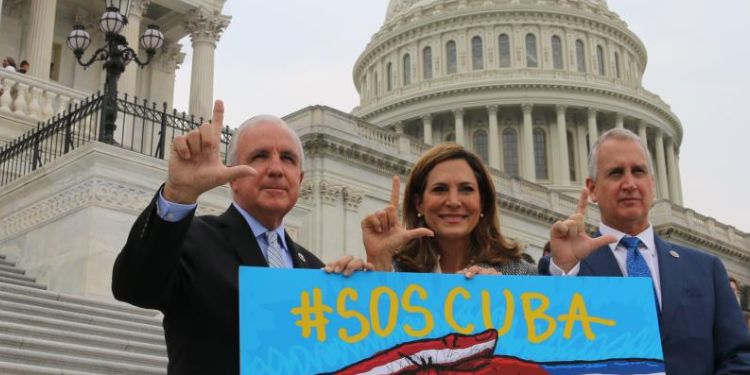
MIAMI.-Republican congressmen Carlos Gimenez, Mario Diaz-Balart and Maria Elvira SalazaThey redoubled their pressure on Donald Trump’s administration to tighten the economic siege against the Havana regime as much as possible. The representatives of South Florida demanded the total closure of commercial operations that continue to serve as a financial lifeline for the dictatorship headed by Miguel Díaz-Canel.
The new legislative offensive comes just days after Washington effectively blocked key oil imports to the island, a measure that has put the Cuban regime in a critical situation. After the capture of Nicolás Maduro, Cuba lost Venezuela as its main trading partner and subsequently the threat of tariffs on those who exported oil to the island has prevented crude oil from arriving from Mexico.
in a letter Sent to the Undersecretary of Commerce, Jeffrey Kessler, and the director of the Office of Foreign Assets Control (OFAC) of the Treasury Department, Bradley Smith, the congressmen requested a comprehensive review of all active licenses that authorize commercial transactions with Cuba. According to them, these licenses exceed 100 million dollars in exports and do not benefit the Cuban people, but end up increasing the coffers of the regime and its conglomerates controlled by the military.
Authorized shipments include luxury cars, hot tubs and other luxury items exported by South Florida companies. Congressman Giménez’s office provided Fox News Digital a document of about 50 pages with cargo manifests approved by the Bureau of Industry and Security (BIS), whose final destinations include addresses in the Plaza de la Revolución, Marianao and other areas under state control in Havana.
“We are extremely concerned about U.S. companies currently engaging in disruptive business activities with entities controlled by the regime in Cuba, a State Sponsor of Terrorism,” the lawmakers wrote in the letter.
The demand to close these licenses is not an isolated event. At the end of January, the congressmen of Cuban origin promoted initiatives to limit flights and block the sending of remittances, controlled mostly by GAESA, the island’s powerful military conglomerate.
The legislators stressed that the current business licenses contradict the spirit and letter of the Cuban Freedom and Democratic Solidarity Law (LIBERTAD Law) of 1996, one of the most severe regulations approved by Congress against the Castro regime. Said legislation establishes that sanctions must be maintained until Cuba verifiably advances towards democracy, the rule of law and respect for fundamental freedoms.
Despite these mandates, congressmen denounced that both OFAC and BIS continue to authorize transactions that directly benefit the regime and its repressive structures.
In the letter, the legislators asked: “Revoke any license that, directly or indirectly, provides economic benefits to entities controlled by the regime, in accordance with the restrictions imposed by the FREEDOM Act, and intensify the scrutiny of future applications for licenses related to Cuba to ensure their full compliance with the letter and intent of US law.”