Article 6 of the bill estimates that a general amnesty will be granted in favor of all those people who have been prosecuted or convicted, for the alleged or proven commission of political or related crimes, from January 1, 1999 to January 30, 2026.
Currently, the Special Commission for the Promotion of Consultation on the Amnesty Bill for Democratic Coexistence is developing the national public consultation process, which is why it is collecting proposals and contributions from the various sectors of the country, unions, political parties, etc., which are estimated to be discussed in the ordinary session of the National Assembly on February 12.
Next, we contextualize the events that occurred in the periods estimated by the standard as a reference for the facts.
1. The Coup d’état of April 11, 2002, including the assaults and attacks against governorates, mayors’ offices, and public and private facilities. In addition to the illegitimate deprivation of liberty of President Hugo Chávez in the early hours of April 12, 2002, there were other events in the interior of the country framed in that coup d’état. One of those events took place that same April 11, 2002 when a group of individuals attacked the Government of Táchira and the house of Governor Ronald Blanco La Cruz whom they subdued by force. While that happened, Rctv broadcast an interview that journalist Ana Vacarella did with former Attorney General Ramón Escobar Salón. “From Táchira we are informed that former governor Ronald Blanco La Cruz refuses to recognize the new Government of Pedro Carmona,” Vacarella asked. “He has to be subdued by force,” responded the interviewee. For those events in Táchira, the following were sentenced: Saúl Lozano, Danny Ramírez and Orlando Pantaleón (6). years in prison; Márquez de Peña, William Forero, Jacobo Superlano, José Neira Celis and Omar Guillén (3 years in prison) while Wilfrido Tovar was acquitted. The norm does not expressly indicate attacks on embassies.
2. The acts of violence for political reasons within the framework of the business and oil strike and sabotage from December 2002 to February 2003. (Carlos Ortega (former president of the Confederation of Venezuelan Workers), Horacio Medina (Unapetrol) and Juan Fernández, among others, were criminally prosecuted for these events.
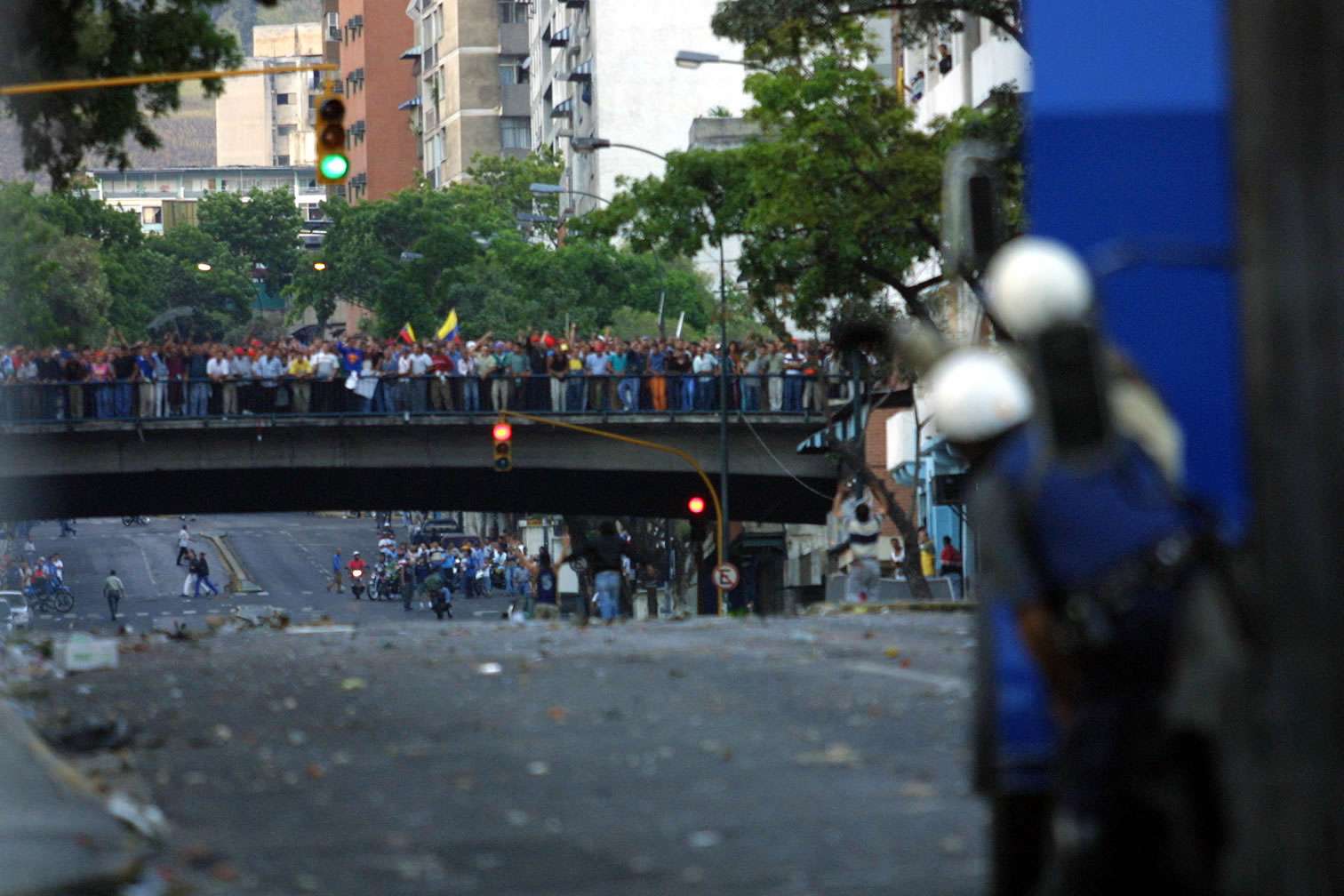
3. The politically motivated acts of violence that occurred in February and March 2004. (Guarimbas widespread in several parts of the country, because the National Electoral Council rejected a batch of 800 thousand signatures with irregularities presented by the opposition to revoke the mandate of then-president Hugo Chávez.
The opposition had to call for a new day of collecting signatures, although the Electoral Chamber of the Supreme Court of Justice had “resurrected” the 800 thousand “Flat Signatures” by ordering the CNE to be included again in those collected. The protests left 14 dead and approximately 200 injured)
4. The politically motivated violence that occurred in August 2004. These violent protests began on August 16, 2004; that is, the day after the CNE proclaimed the defeat of those who called for the revocation of President Chávez’s mandate. The option of those who reaffirmed that mandate obtained 59.1%. Groups of opponents who chanted fraud took over Plaza Francia, located in Altamira, Chacao municipality (Miranda), where Maritza Ron died from projectile impact. Meanwhile, another group took the highway called Francisco Fajardo at the time. The events calmed down when the Carter Center validated the results of the referendum and said that the opposition had run a “lackluster” campaign.
5. The politically motivated acts of violence that occurred in May 2007. (University students, grouped in a movement that the press called Los Manos Blancas, began a series of protests after the government’s announcement not to renew the license of the television station Radio Caracas Televisión. John Goicoechea was leading several protests, among others)
6. The acts of violence for political reasons that occurred in the framework of the presidential elections of April 2013.
After the death of President Hugo Chávez, the CNE called elections which were won by then Vice President Nicolás Maduro. The opponent Henrique Capriles did not accept the results and asked to manually count the votes. Given the CNE’s refusal, Capriles offered a press conference together with Carlos Ocaríz and Ramón José Medina, where he called on his followers to “unload the arrechera.” The balance was 11 dead, 150 injured, as well as attacks on Barrio Adentro facilities, among others)
7. The acts of violence for political reasons that occurred between February and June 2014. These guarimbas were promoted by Leopoldo López, María Corina Machado, Juan Guaidó, Antonio Ledezma and Gabriel Puerta Aponte, among others. This leadership announced in a press conference La Salida, a plan that consisted of taking to the streets “until we manage to remove those who are governing us from Miraflores,” in the words of Leopoldo López.
It all started on February 12, 2014 with a march that started from Plaza Venezuela to Parque Carabobo, where the first three deaths occurred due to projectile impacts. 43 dead and 900 injured is the approximate balance of those protests that lasted until the end of March 2014. Leopoldo López was one of those captured and finally, on September 10, 2015, he was sentenced to 13 years, 9 and 7 months of prison which; paid a portion at the National Center for Military Processing, located in Ramo Verde, Los Teques (Miranda).
Two years after that sentence, that is, on July 8, 2017, López was granted house arrest, which he evaded in the early hours of April 30, 2019 when he appeared at the Altamira Distributor with Juan Guaidó to tell Venezuela that they were already at the Generalísimo Francisco de Miranda Air Base, when in reality they found themselves outside that military establishment. By mid-morning that coup d’état failed and López subsequently flew to Madrid, Spain from where in 2025 he said he supported a United States invasion of Venezuela to remove Maduro).
8. The politically motivated acts of violence that occurred between March and August 2017. The 2017 guarimbas caused the loss of 160 people and approximately 2,000 injuries. In those four months, three operations were attempted to violently overthrow President Maduro:
a) Operation Sword of God, led by General Raúl Isaías Baduel, who was captured. The plan consisted of the assassination of the Venezuelan Head of State.
b) Operation Zamorano Shield. They intended to cause explosions in different parts of the country. One of the executioners was retired colonel Zomacal Hernández, arrested with 32 kilos of C4 explosive. Intelligence agencies detect civilians involved in the coup plot, among them Roberto Enríquez, Oswaldo Álvarez Paz and Julio Borges.
c) Operation David, which consisted of attacking Fort Paramacay, located in Naguanagua (Carabobo). Parallel to these operations, the country entered a spiral of violence between April and July 2017 with street blockades, the placement of explosives, confrontations with the military and protesters, among others. The violence ceased with the elections of the National Constituent Assembly on July 31)
9. The acts of violence for political reasons that occurred between January and April 2019. This block of violence began on January 23, 2019 when the then deputy Juan Guaidó proclaimed himself interim president of Venezuela with the recognition of approximately 90 countries, including the United States, governed at that time by Donald Trump.
A month after that event, there was an attempt to invade Venezuela from Colombia through the Táchira area. The Battle of the Bridges was named that February 23, 2019, the day they tried to sell to the world that humanitarian aid would arrive for the people of Venezuela, with the support of several military Latin American presidents. Three months later, there was another attempt to invade Venezuela along the coasts of Aragua and La Guaira with the so-called Operation Gedeón, for which Guaidó signed a contract with former Americans at a cost of 212 million dollars)
10. The acts of violence for political reasons that occurred within the framework of the presidential elections of July 2024.
In the 2024 electoral campaign there were several (thwarted) attacks against President Maduro; one, on March 11 in Maturín (Monagas) and the other, on the 25th of that same month in Plaza Diego Ibarra, Caracas. But after the elections, the sector that represents María Corina Machado was unaware of the results that gave Maduro victory over Edmundo González.
Thus, between Monday, July 29 and Tuesday, July 30, 2024, a series of acts of violence occurred in several entities, resulting in 27 deaths and 131 injuries, according to figures collected. One of the episodes occurred on Monday the 29th in the afternoon when a group tried to attack the Miraflores Palace, an action that was thwarted on the corner of Santa Capilla, Caracas, a few meters from the headquarters of the Executive Branch, where supporters of President Maduro clashed with those of María Corina Machado.