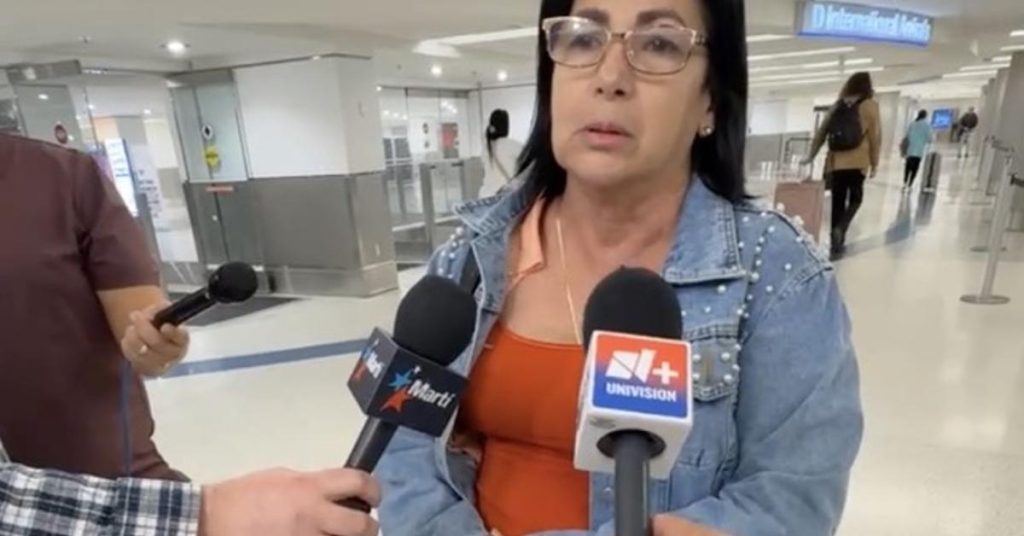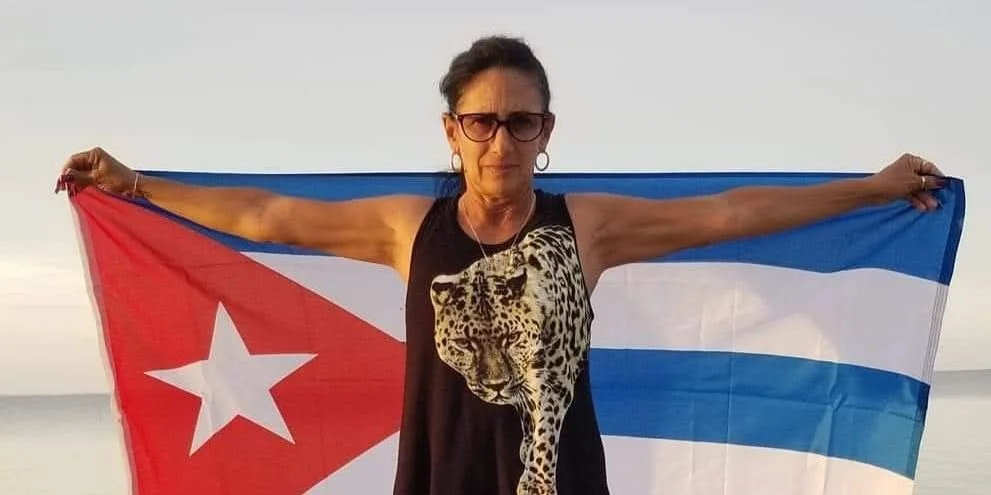
MIAMI, United States. – The Cuban activist of the Ladies in White Leticia Ramos Herrería denounced that authorities at the “Juan Gualberto Gómez” Varadero International Airport prohibited her from entering Cuba this Monday, after arriving on the Island with her mother, an 86-year-old woman.
Ramos Herrería, who had to return to Miami this Monday, assured Martí News that he will try to “exhaust all avenues” to return to Cuba.
Ramos Herrería assured that, when he got off the plane and presented his passport, an Immigration officer told him that “there was a problem with his papers.” “It is unfair that they do not let me enter my own country, that they treat you like an animal, that you have no right to anything, not even to protest,” he said upon arriving at Miami International Airport.
The activist stated that she never intended to remain in the United States. “At no time have I had any intention of staying in the United States, of all the times I have come to this country, because my fight is in Cuba and it is very hard that they did not let me pass,” he added.
Ramos Herrería reported that, after the initial refusal, she was taken to a “little room,” where she once again insisted that her documentation was in order. “There they told me that my documents had problems and I told them that it was a lie, that if they had problems the American Government would not let me go through Immigration in Miami,” he explained.
She also maintained that she argued with State Security officers who arrived at the scene and that, in that exchange, they threatened her: “They told me that if I didn’t keep my mouth shut they were going to sedate me, because they were not going to allow me to continue as I was.”
One of the most sensitive elements of the episode, according to the opponent, was that she was not able to say goodbye to her mother or accompany her after her arrival. “They took me first, straight to Immigration and I had to leave my mother alone in the wheelchair. When I had the exchange of words I asked them to let me give her a kiss and they didn’t allow me,” he declared.
Ramos Herrería is the daughter of Amada Herrería, 86 years old, considered the oldest Lady in White in Cuba.
The activist said that returning to Miami without her mother was especially hard for her. “It is something that has to be experienced, a very strong pain, but it was not a farewell,” he said.
Ramos Herrería insisted that he will try to return to the Island through the available means. “I don’t know by what means or in what way, I am going to exhaust all resources, but I am going to return to Cuba,” he said. “I couldn’t even bring my luggage. It was really frustrating and painful, I see myself in the thousands of Cubans who have gone through a similar situation and I tell them that what one lives is hard,” he said.
According to the report, upon arriving in Miami she was questioned by United States Immigration authorities, who after reviewing the case allowed her to re-enter the country. In that context, the opponent said: “I don’t want to talk about exile and I don’t want to ask for political asylum or refuge here, because I am going to demand and protest for my right to return to my country, because that is where I am going to live.”
Ramos Herrería attributed the entry ban to his “frontal position against the dictatorship” and his activism “in favor of freedom and democracy” in Cárdenas. “They are trying to ensure that everyone who is an obstacle or at a certain moment can face them, keep them out,” he said.
Conversely, in November of last year, State Security officials They prevented the activist boarding a flight to the United States when he had already completed the regulatory check.
“A lieutenant colonel dressed in uniform stopped me. They took me to a small room,” he said in a video posted on Facebookin which he identified several agents and stated that they told him that he could not travel because he planned to “participate in an event that was going to take place in the United States (…) for the Ladies in White”.
The agents specified that, for them, she was not a human rights activist, but a “mercenary.”
The island’s regime uses the euphemism of “immigration regulation” to refer to the discretionary prohibition on leaving the country imposed on activists, opponents, journalists and dissidents in general.
Although Havana eliminated the old “exit permit” in 2013, authorities have maintained discretionary powers to prevent travel by critics and opponents. According to Human Rights Watchthis is a violation of international law.
The regime also uses the same discourse to prevent the entry of activists, journalists and opponents, even if they have left temporarily and have not lost their residence on the Island.