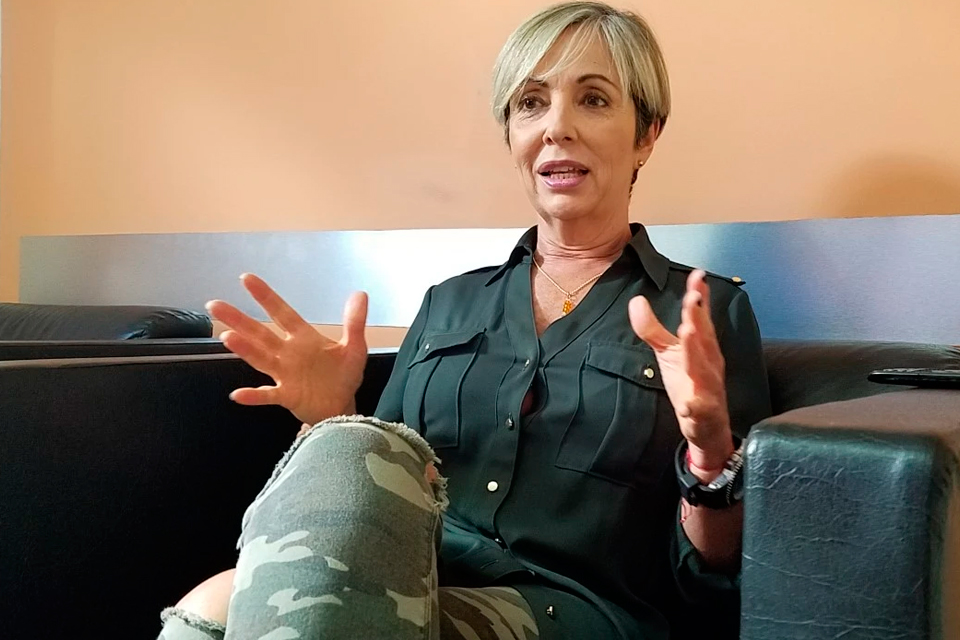
The national vice president of the MAS, María Verdeal, requested that the Amnesty Law under discussion in the National Assembly be the product of consensus and guarantee not only the release of political prisoners, but also the reunion of Venezuelans and the return of exiles. He also demanded the repeal of laws that, in his opinion, make any real reconciliation process unviable.
Within the framework of the approval in the first discussion of the Amnesty Law project in the National Assembly, the national vice president of the Movement to Socialism (MAS)María Verdeal, called to build a legal instrument based on national understanding and consensus, which allows the release of political prisoners, the return of exiles and the definitive reunion of Venezuelans.
From the orange awning they reported that between seven and eight alternative law proposals have been received, prepared by non-governmental organizations, relatives of political prisoners and legal sciences faculties of public universities, which – according to the MAS – must be considered in the consultation process.
Verdeal questioned that, although the project sets its temporal scope since 1999, it limits its coverage until January 30, 2026. In his opinion, the amnesty should be extended until the moment of its publication and entry into force in the official gazette, to avoid new exclusions.
The political leader also demanded that the law include acts and administrative actions of organizations such as the Comptroller General of the Republic, Saime and the National Electoral Council, with the aim of restoring political rights and the legal validity of party organizations. Likewise, he criticized that the text omits civilians and soldiers prosecuted under military jurisdiction. “There are citizens under this jurisdiction due to political events that are not contemplated in the current project and must be included,” he stated.
«This law cannot be approved by a single sector; It must bring the consensus of the majority to heal a country wounded by the events of the last 27 years. We have to heal those wounds, meet again, reconcile and make compensation happen to the victims,” said Verdeal.
The lawyer warned that an amnesty cannot coexist with what she described as a “punitive legal scaffolding” and, in that sense, urged the repeal of the Law against Hate, the Simón Bolívar Law and the Domain Extinction Law. “It is unconstitutional to seek reconciliation while laws that contemplate sentences of up to 30 years and political disqualifications of more than 60 years remain in force,” he said.
The MAS also rejected that the Ministry of the Interior, Justice and Peace is the body in charge of processing and supervising the application of the law. Instead, he proposed that this responsibility fall on the National Assembly, together with the Special Commission of the Amnesty Bill for Democratic Coexistence, with the participation of NGOs and representatives of civil society, to guarantee transparency.
Verdeal welcomed the recent releases of political prisoners and cited statements by the president of the National Assembly, Jorge Rodríguez, who assured from zone 7—headquarters of the Bolivarian National Police in Caracas—that between Tuesday and Friday of this week there would be no political prisoners in prisons.
Finally, the MAS leader described as incongruous the call for Carnival festivities while the External Shock Decree remains in force. “It is disturbing how the administration of Nicolás Maduro intends for the festivities to coexist with a decree that regulates and restricts meetings and crowds, which is why we insist on its repeal,” he said.
*Journalism in Venezuela is carried out in a hostile environment for the press with dozens of legal instruments in place to punish the word, especially the laws “against hate”, “against fascism” and “against the blockade.” This content was written taking into consideration the threats and limits that, consequently, have been imposed on the dissemination of information from within the country.
Post Views: 61