Journalism under pressure manifests itself when power responds with political attacks, legal warnings or access restrictions after the dissemination of journalistic investigations that affect it. Instead of offering detailed explanations of the facts revealed, some governments choose to question the work of journalists. This reaction displaces public debate. The discussion stops focusing on contracts, meetings or official decisions, and focuses on discrediting the press.
This phenomenon does not respond to isolated episodes or spontaneous reactions. These are institutional responses. Official statements, presidential speeches and changes in press protocols are part of a strategy that uses the weight of the State to confront journalism. When the questioning comes from the highest authority, the asymmetry of power becomes evident.
YOU CAN SEE: Congress reaches 62 signatures to call an Extraordinary Plenary Session that will debate censure against Jerí
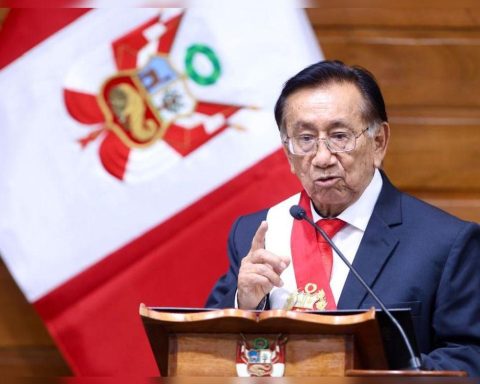
In Peru, the case of President José Jerí showed that dynamic. After a report that revealed that women who They visited the presidential office They subsequently received service orders in public entities, the Presidency published a statement in which it evaluated legal actions against the journalists who disseminated the investigation. The message was removed hours later. The episode generated alert in press unions.
In parallel, the relationship of the former president Dina Boluarte With the media it also marked tension. For months he did not offer open statements. At public events, he questioned the news coverage and announced that he would prepare a “calendar of lies” about publications critical of him. These responses occurred in a context of reports on hiring, official meetings and decisions of the Executive during his mandate.
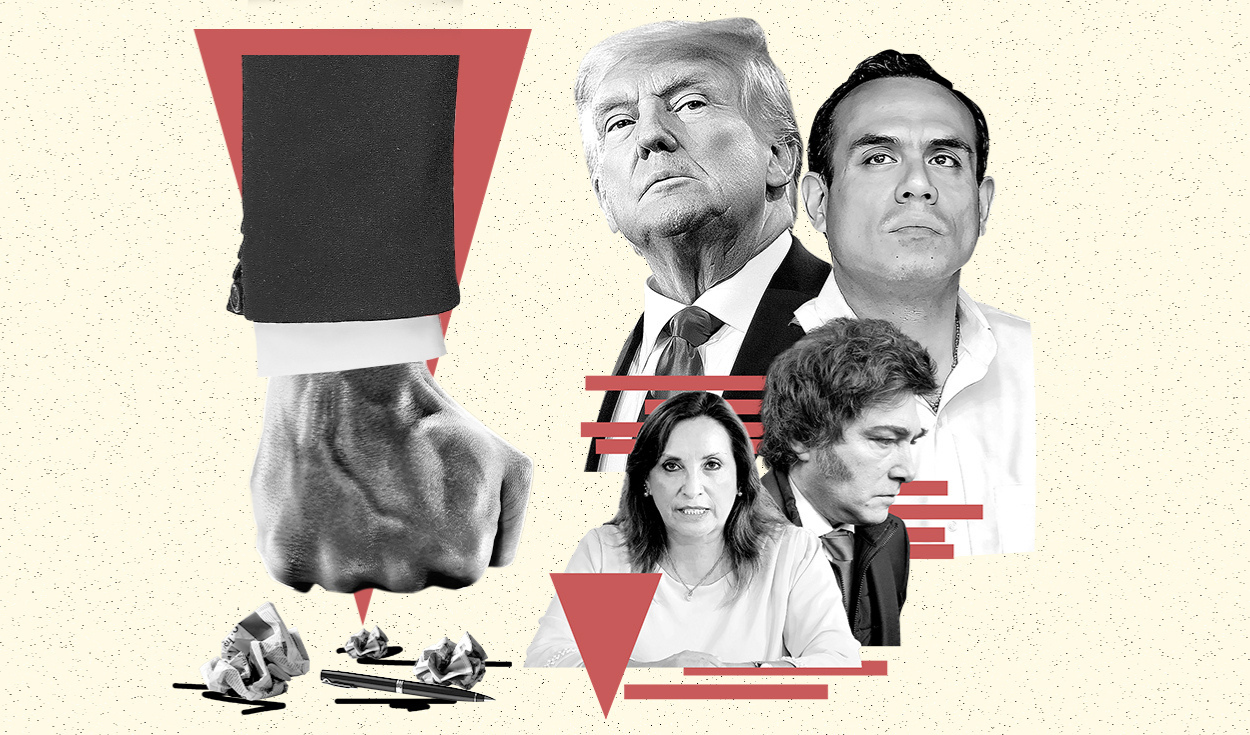
Similar situations are observed outside the country. In Argentina and the United States, Javier Milei and Donald Trump reacted with verbal attacks and restrictive measures after journalistic revelations. The repetition of this pattern allows us to identify a narrative that transcends borders.
YOU CAN SEE: Ministers defend José Jerí: they justify hiring after visits to the Palace and lack of pronouncement
Peru: attacks from the Government Palace after journalistic investigations
The case of José Jerí originated after a report that detailed that five women entered the presidential office and then received service orders in entities such as EsSalud and the Ministry of the Environment. The amounts ranged between S/6,000 and S/11,000 for service orders. The investigation was based on official records of visits and public contracts. The Presidency’s response was not a conference to clarify the facts, but rather a statement warning of possible legal actions against the journalists.
The warning raised questions because it came directly from a state institution. Hours later, the statement was replaced by another that eliminated the mention of complaints. The rollback did not erase the initial message. The possibility of a lawsuit from the Executive branch created a pressure scenario.
During the 3 years of Dina Boluarte’s government, tension with the press had several episodes. The president accumulated more than six months without testifying before the media in open question sessions. In official activities, he avoided answering questions about ongoing investigations. In a public intervention he announced that he would prepare a record of what he considered “lies” spread daily by the press.
YOU CAN SEE: José Jerí’s government imitates that of Bukele: now the prisoners will be shaved and will wear uniforms
Logistical restrictions in official activities were also reported. In July 2025, the National Association of Journalists (ANP) reported that reporters were locked behind bars during a ministerial activity. The fact was interpreted as a limitation on the free exercise of informative work.
Both cases share clear elements. The answers came from the Executive. Institutions were used to confront or limit the press. Each point investigated was not directly answered. The conflict moved to the field of journalism legitimacy.
YOU CAN SEE: Disapproval of José Jerí rises to 70.4% in just two months, according to Imasen
ANP warns of an “inhibitory effect” and normalization of attacks against journalism
For the president of the National Association of Journalists (ANP), Zuliana Lainez, when a president disqualifies an investigation without refuting the facts, it is not a simple political confrontation. “It is a clear impact on information freedoms, because it is stigmatizing the media for doing their job,” he said. The leader maintained that, in the face of a public complaint, what is appropriate is to make the information transparent and not divert attention to those who publish it. “What it should do is make those actions that are being put in the public spotlight transparent, not attack the messenger,” he stated.
Lainez warned that the problem worsens when the disqualification comes from the highest authority in the country. “When this disqualification comes from someone who has the highest government responsibility, it sets a disastrous precedent, because it normalizes the stigmatization of journalists,” he explained. In his opinion, this type of speech places reporters in a situation of greater vulnerability, especially in contexts of polarization and digital attacks. “It ends up stigmatizing a sector that, not only in Peru but in Latin America, is absolutely vulnerable,” he added.
YOU CAN SEE: The law and the trap in the spending of electoral funds
Regarding the possibility of the State evaluating legal actions against journalists after an uncomfortable publication, the president of the ANP was emphatic. “In Peru, judicial harassment is one of the worst attacks against journalists,” he stated. He considered that trying to take reporters to court for information based on public records constitutes a form of institutional pressure. “What they have tried to generate is an inhibitory effect on those who carry out informative activities,” he said. And he added: “What are we looking for? Give a lesson to others to say don’t mess with us?”
Lainez maintained that this scenario is not isolated and responds to a broader trend in the region. “There is a very clear tendency to disqualify the press as a valid actor,” he indicated. As he explained, when those in power cannot deny documented facts, they choose to question the intention of the media and present the government as a victim. “The way they have left is to disqualify the messenger,” he stated. For the leader, in a democracy the approach should be different: “They should assume the work of the press as a contribution to the consolidation of democracy, transparency and accountability.”
YOU CAN SEE: The 15 controversial proposals that López Aliaga has announced to attract attention and win votes
A pattern that is repeated outside Peru: Milei and Trump
In Argentina, Javier Milei has maintained a constant confrontation with sectors of the press. After critical reports about his management and economic decisions, he described journalists as “overstuffed” and stated that society “does not hate” communicators enough. Organizations such as the Committee to Protect Journalists (CPJ) and the Association of Argentine Journalistic Entities (ADEPA) warned that these types of statements can generate a hostile climate against journalism.
The Argentine government also promoted the creation of an office aimed at “unmasking lies” in the media. The measure was presented as an official response mechanism. However, organizations defending freedom of expression warned that the State should not assume the role of arbitrator over the veracity of journalistic work.
In the United States, Donald Trump has engaged in public confrontations with reporters at press conferences. When asked about files linked to Jeffrey Epstein, he disqualified a CNN journalist instead of answering about the content. In other episodes, he questioned the professionalism of female reporters and criticized specific media outlets from the presidential podium.
YOU CAN SEE: Vladimiro Montesinos, in prison until 2037: PJ annulled sentence reduction
In addition, changes were recorded in the access protocols to the White House. The decision to modify the accreditation dynamic generated questions from press associations.
The cases of Javier Milei and Donald Trump show similarities with what happened in Peru. Power responds to investigations with verbal attacks or institutional measures. The idea is established that journalism acts as a political adversary. This pattern is repeated in democracies where media oversight is uncomfortable for those who govern.
From criticism to the narrative of discrediting journalism
When a journalistic investigation reveals sensitive information, those in power can respond with data or move the discussion towards the credibility of the medium. In several of the recent cases in Peru, Argentina and the United States, the official focus was not on clarifying the facts, but on questioning the intention of the journalists. The debate stopped focusing on published evidence and began to revolve around alleged political motivations.
Expressions such as “campaign”, “lies”, “operations” or “media harassment” are repeated in presidential speeches and official statements. This language establishes the idea that journalism does not fulfill a supervisory function, but rather acts as a partisan actor. Thus, the questioning shifts from the content of the journalistic investigation to the reputation of the medium or the reporter.
This scenario has been warned by Reporters Without Borders (RSF). In its 2025 World Press Freedom Index, the organization recorded significant setbacks in Latin America and noted that stigmatizing discourse from political power has become a structural factor of deterioration. RSF identified as a common pattern the public disqualification of media outlets after publications that were uncomfortable for governments.
YOU CAN SEE: Jerí sinks Fujimori and Acuña: Fuerza Popular and APP among the banks with the greatest citizen disapproval
In the case of Peru, the organization warned about an adverse climate for the practice of journalism, marked by verbal attacks and distrust promoted by official sectors. In Argentina, the report recorded a significant drop in the international classification after repeated statements by President Javier Milei against the press. According to RSF, when top authorities present the media as enemies or adversaries, democratic debate is weakened and tolerance for criticism is reduced.
The warning is not limited to a statistical evaluation. RSF has noted that constant stigmatization can create a more hostile environment for journalists, increase the risk of attacks and encourage self-censorship. The impact transcends a specific medium. It affects the entire information ecosystem and conditions the relationship between citizens, institutions and the press.
In this context, the public accusation from power does not constitute only political criticism. It becomes an element that directly affects democratic quality. When questioning replaces accountability, the space for investigative journalism shrinks and public discussion loses depth.