The advance of democracy in Brazil throughout the 20th Century was circuitous and did not occur like the steady evolution of a well-rehearsed carnival parade.
Between these comings and goings, carnival participants, composers and members of samba schools were monitored, censored and even arrested by the repressive forces that operated until after the return of civilians to power. Against the black people who did and still do Rio’s carnival, racism still weighed heavily.
The struggle in this political trench is the research topic of sociologist Rodrigo Antonio Reduzino, who is defending his doctoral thesis this year Plots of Freedom: the cry of Samba Schools for Democracyat the Institute of Philosophy and Human Sciences at the State University of Campinas (Unicamp).
The academic work deals with the plots of the samba schools of the Special Group of Rio de Janeiro throughout the 1980s, when the military dictatorship (1964-1985) ended.
The analysis of sambas goes through the campaign for Diretas Já (1984) and goes up to the election of Fernando Collor to the Presidency of the Republic (1989). The sociologist’s work served as the basis for the documentary Plots of Freedom, available in five episodes in a streaming environment (Globoplay).
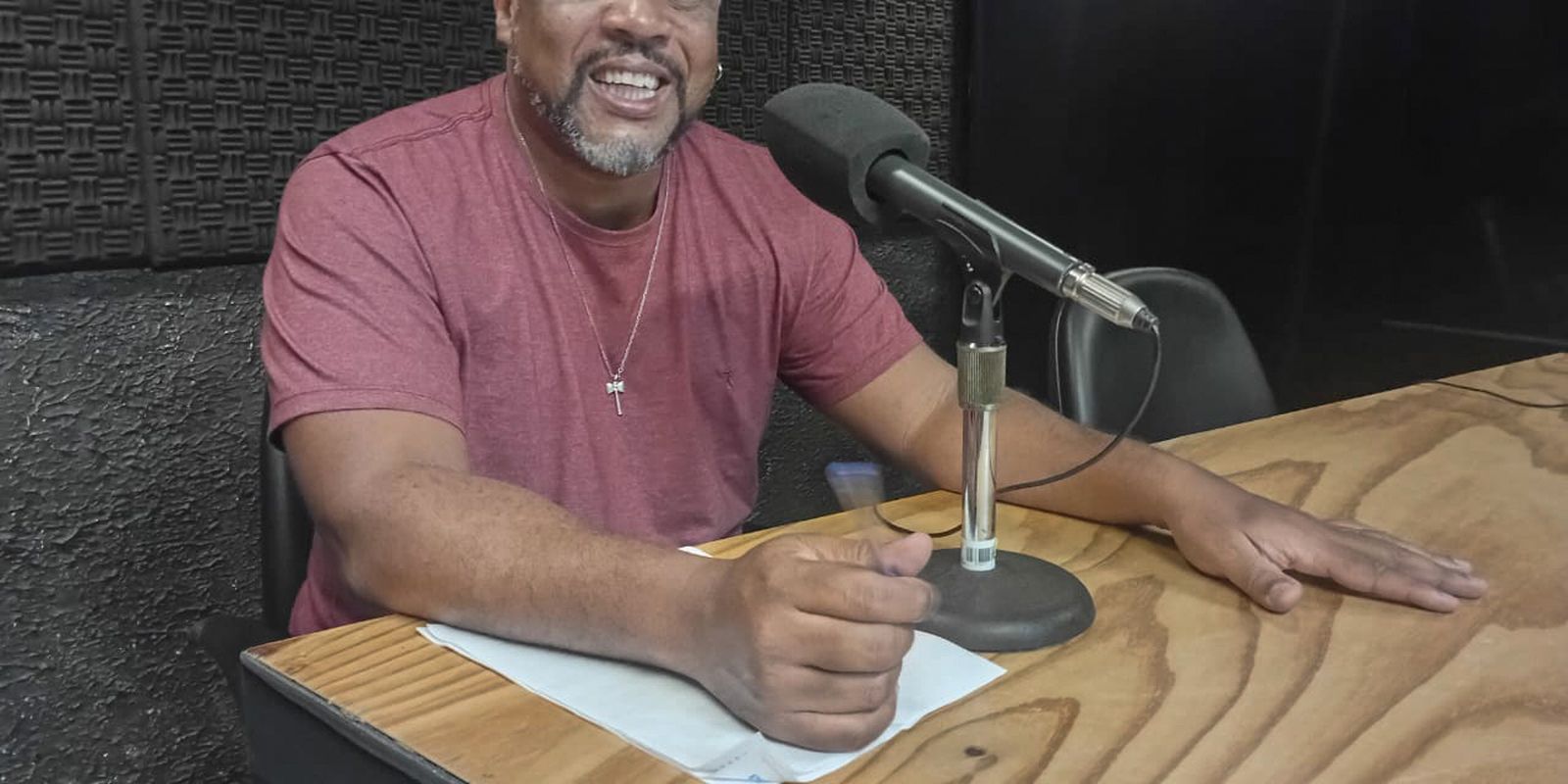
In addition to being an academic researcher, Reduzino works at the Rio de Janeiro State Department of Education and the Cultural Department of Mangueira. Below are excerpts from the interview he gave to Brazil Agency for the program Samba Wheelcarried out in partnership with National Radio.
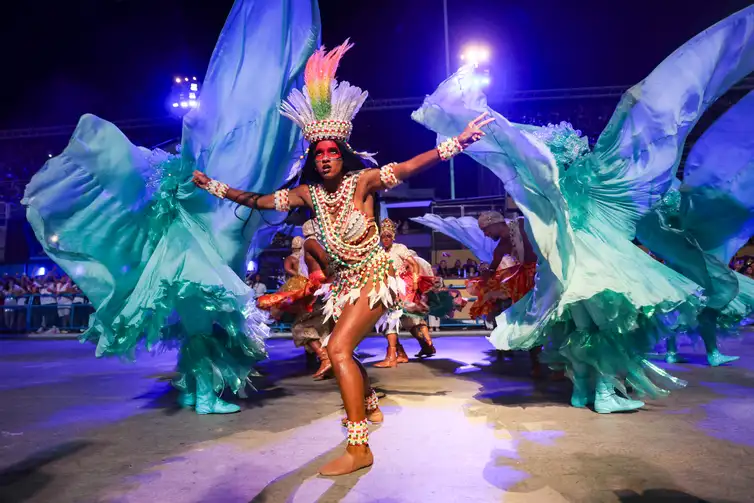
Academics from Greater Rio parade on the third day of the Special group’s carnival in Marquês de Sapucaí, in the central region of Rio de Janeiro. Photo: Tomaz Silva/Agência Brasil
Check out the interview
Brazil Agency: When we talk about resistance in popular music to the military dictatorship, we immediately think of names from the so-called MPB. Little is said about the role of samba schools in the lead years. Why?
Rodrigo Reduzino: We need to do a reflection exercise to be able to understand why, on certain issues within the social process, we always have sectors, segments or even people who consider themselves guardians of a certain topic.
We live in a society historically structured by racism, and one of its dimensions is the erasure of words, intellectuality and humanity. [Mas] the samba school, through samba-enredo, can also speak and provoke. The samba-enredo is a great political statement.
When we observe plots from the 1980s criticizing the dictatorship, we cannot look at it as a parade lasting an hour or an hour and a half. In fact, the creation process took six months, maybe a year, within the community. So, when we see a samba school criticizing torture or shouting ‘freedom’ in the midst of a dictatorial regime, there is a much broader political process.
Brazil Agency: What does the repression against samba schools add to the State’s violence against the popular classes?
Rodrigo Reduzino: I imagine that there may be an additional residue of violence on the part of the State’s repressive apparatus against the popular classes, against the black population, against the peripheral population and, also, against those involved with samba.
Samba is an expression of black culture in Brazilian society, which historically reproduces and maintains its racist structure. We cannot forget the historical processes. We can’t forget the Vagrancy Code [Art. 59 do Decreto-Lei 3.688/1941, a Lei das Contravenções Penais].
Brazil Agency: Did the police use this code to associate a black person with a musical instrument and vagrancy?
Rodrigo Reduzino: If you didn’t have your work permit, you could be charged and taken to the police station.
Brazil Agency: An association with crime, or at least misdemeanor, is always made between samba schools and bankers do bicho.
Rodrigo Reduzino: We began to have, precisely during the military dictatorship, the so-called patrons of the animal game within the samba schools. This is not for nothing. The animal game dates back to the end of the 19th century, but the idea of this business patronage, with visibility, dates back to the dictatorship period. And it’s the same bookkeeper who drinks champagne inside offices with generals or inside the Guanabara Palace [sede do governo do Rio de Janeiro].
Brazil Agency: In the documentary Freedom Plotsthere are images of politicians with book collectors, and there is a case of a book collector who was once a soldier.
Rodrigo Reduzino: That’s a fact. But when we talk about bicheiros, a misdemeanor, the samba school is held responsible, as if the samba school had invented bicheiros. These bicheiros are dialoguing with the public authorities and circulate in the space of the public authorities.
Brazil Agency: Going back to the conversation, you said that samba is an expression of black culture. During the dictatorship prior to the military, that of the Estado Novo (1937-1945), the idea was constructed that samba is Brazilian culture, and this formulation has already been defended as “evidence of our racial democracy”.
Rodrigo Reduzino: The idea of Brazil as a racial democracy, intellectually forged by part of the Brazilian elite, is one of the pillars of the racist structure. And there is nothing more violent than denying reality itself. 80% of young people killed by gunshots are black. The majority of women who suffer from obstetric violence in public hospitals are black. When the myth of racial democracy is reinforced, it is being said that these contradictions in reality do not matter. Keep it as it is, pretend that everything is fine, and we remain in this paradise that they invented at the cost of each other’s existence.
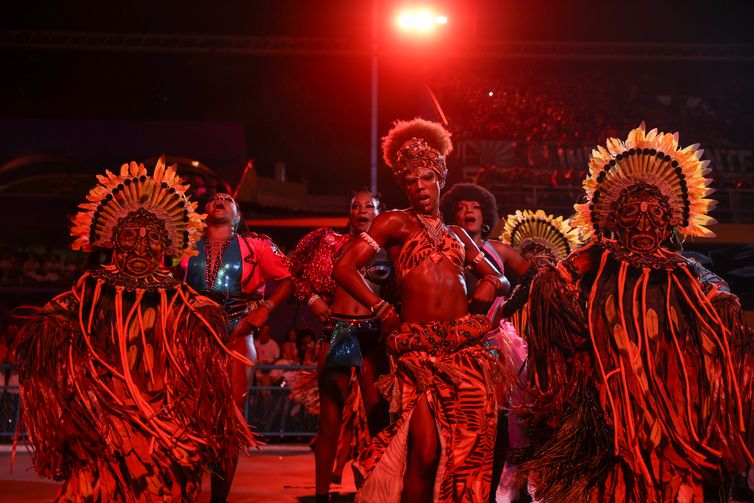
Paraíso do Tuiuti parades on the third day of the Special group’s carnival in Marquês de Sapucaí, in the central region of Rio de Janeiro. Photo: Tomaz Silva/Agência Brasil
Brazil Agency: But the myth of racial democracy is also sung in samba.
Rodrigo Reduzino: Sung in samba, in elegy, to this great Brazil. But if we look inside the Dops files [Departamento de Ordem Política e Social] people were booked who discussed race relations, as happened with [a filósofa e antropóloga negra] Lélia González [1935 a 1964] and with [o sociólogo e jornalista negro] Clovis Moura [1925 a 2003]as well as those who were part of the cultural movement expressing black culture, such as samba schools, because they criticize the idea of racial democracy.
Brazil Agency: There is the criticism that many plots of past carnival parades were based on official historiography, and that thus samba schools would have contributed to a certain alienation from the historical process.
Rodrigo Reduzino: One of the ways to make what you produce smaller is to label, stigmatize, classify, categorize and put you on the sidelines. When we talk about official history or official historiography, it is being told by an academic elite. It doesn’t come out of nowhere. We are talking about an official memory. It is forged, it is incorporated by the Brazilian State.
There’s a guy producing this [historiografia oficial]there is a lot of investment to produce this. But will it just seem like alienation at the samba school? Isn’t it alienation in academia? The institutions that forged and developed this officialdom are not questioned for alienation. And, for the samba school, there is a much heavier cut left, which is linking this process of alienation with a process of supporting the dictatorship.
But if we consider the 1970s, and look at all the plots, we map out four plots out of a total of 140 that will be elegy or boastful about the so-called great Brazil during the period of the military dictatorship. These four plots are limited to three schools. Where does this idea of a samba school that adheres to the dictatorship come from? It’s a way of stigmatizing.