“The Brazilian ruling class understands the State as theirs, it’s not our thing, it’s their thing.” The assessment is from the Minister of Finance, Fernando Haddad, who participated in an event in the capital of São Paulo to launch his book Superindustrial Capitalism. On the occasion, there was a chat with Haddad, Celso Rocha de Barros and mediation by Lilia Schwarcz, at Sesc 14 Bis.
“I defend the thesis that the State was handed over to the farmers as compensation for the abolition of slavery,” stated Haddad. To put it into context, he recalled that the republican movement began on May 14, 1988 – the day after the signing of the Lei Áurea – and a year later it was successful.
Victorious, the republican movement “puts the country’s ruling class to run and, in its place, puts nothing other than the country’s ruling class to take care of the state as if it were its own. We still have this problem today.”
“This ‘agreement’ under the auspices of the Armed Forces, when it is called into question, the reaction is immediate. You cannot touch it, you cannot touch it in any instance. That is why democracy in Brazil is so problematic and so fragile, because democracy is the contestation of this status quo. And, when she stretches the rope, institutional rupture can happen”, concluded the minister.
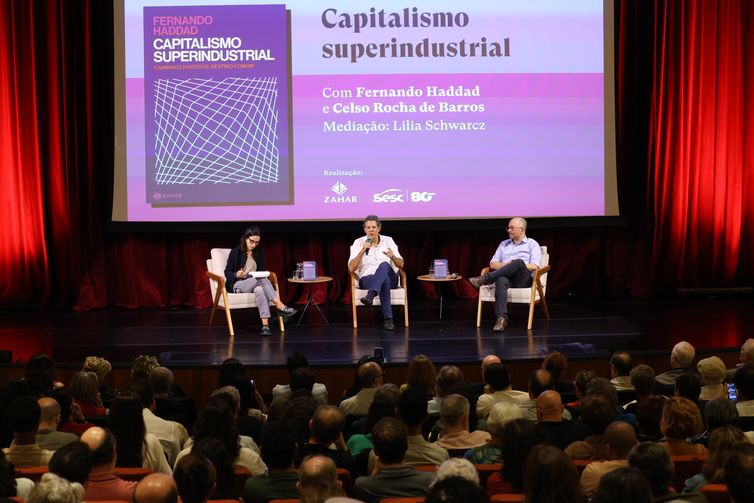
Launch of the book Capitalismo Superindustrial, by Finance Minister Fernando Haddad, by Companhia das Letras, with Celso Rocha de Barros and mediation by Lilia Schwarcz, at Sesc 14 Bis. Photo: Rovena Rosa/Agência Brasil
Superindustrial capitalism
Released this Saturday, Haddad’s book discusses the processes that led to the current global model of what he calls super-industrial capitalism, marked by growing inequality and competition. Haddad addresses topics such as the primitive accumulation of capital in the so-called periphery of capitalism, the incorporation of knowledge as a factor of production and new class configurations.
For the minister, inequality will continue to increase. “Inequality, when the state mitigates the effects of capitalist development and organizes society in terms of moderate inequality, social tensions really decrease a lot, it’s true,” he said.
“But, left to its own devices, this dynamic leads to absolute inequality. And when that happens, you are no longer talking about difference, you are talking about contradiction and contradictory processes. And I understand that we are at this moment, at this stage, in which the contradiction is imposing itself”, he added.
The work brings together studies on political economy and the nature of the Soviet system, carried out by Haddad in the 1980s and 1990s, which were revised and expanded. With this, the work also discusses the challenges posed by the rise of China as a global power.
Processes in the East
“The whole idea was to try to understand what happened in the East that could fit into a specific pattern of primitive accumulation of capital – which cannot be confused with either slavery in America or serfdom in Eastern Europe – but which, in its own way, each in its own way, reached the same objectives”, he explained.
He points out that, unlike what happened in Eastern Europe and America, the revolutions in the East were anti-systemic and anti-imperialist. “Unlike slavery and serfdom, despotism and state violence served industrializing purposes, which did not happen in Eastern Europe or the Americas,” he explained.
“It is curious that, from an internal point of view, they were ultra-violent and coercive forms of capital accumulation, but from an external point of view, they had an anti-systemic power that passionate people in search of freedom and national emancipation, and not human emancipation. In other words, we are talking, yes, about a revolution, but not a socialist revolution and that makes a lot of difference”, he added.
In relation to questions about the success or failure of processes in the East, he assesses that, from the point of view of the development of productive forces and the commodification of land, work and science, there was an advance in these societies. “In relation to the ideas that motivated the revolutionary leaders, then you can say that they did not achieve their objectives”, he said, highlighting the contradiction made clear in these processes.