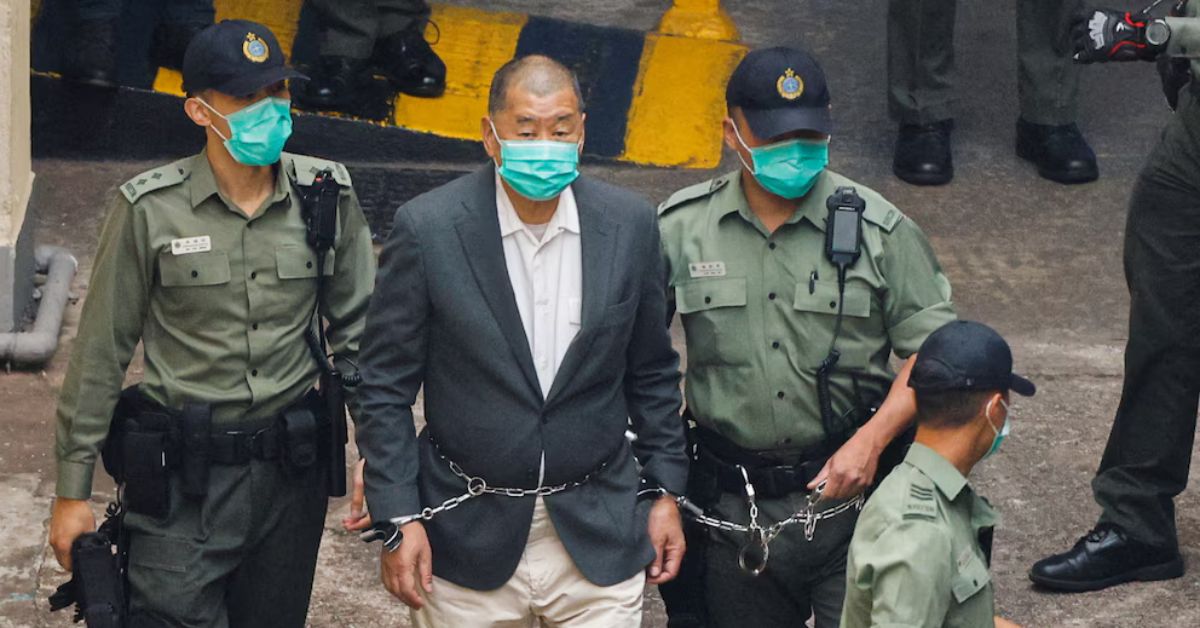
Pro-democracy businessman and media mogul Jimmy Lai He will be sentenced on Monday following his national security trial in Hong Kong, according to the court’s website.
The 78-year-old founder of the now-defunct Apple Daily was found guilty in December of collusion with foreign forces and seditious publication, offenses that can carry a life sentence.
Lai, a British citizen, has been in prison since 2020, and his case became one of the most significant legal proceedings in the city since Beijing imposed the national security law following the 2019 pro-democracy protests.
The legislation broadened the scope of crimes linked to state security. It established severe penalties, including sentences of between 10 years and life imprisonment for collusion offenses deemed “of a serious nature. “
The businessman will be sentenced along with eight co-defendants, including six former Apple Daily executives. All the defendants, except Lai, pleaded guilty, and some testified against him, which could lead to shorter sentences, their lawyers said last month.
In January, the defense acknowledged the “serious nature” of the case after the court determined that Lai had sought foreign sanctions against Hong Kong and China.
Prosecutors cited 161 articles from the Apple Daily newspaper as part of the court file. These articles were deemed seditious under a colonial-era law because they “excited disaffection” against the government.
In their 856-page verdict issued in December, the judges stated that Lai “harbored resentment and hatred toward (China) for much of his adult life” and that he sought the “downfall of the Chinese Communist Party.” According to the ruling, the businessman’s actions were part of a strategy to mobilize international support against the Chinese and Hong Kong authorities.
During the proceedings, Lai maintained that he had never attempted to influence other countries’ foreign policies and defended the newspaper’s editorial role. According to its statement, Apple Daily represented the core values of local society, including the rule of law, freedom, and the pursuit of democracy.
The case sparked international reactions from governments and press freedom organizations. Several Western countries, including the United States and the United Kingdom, called for its release. US President Donald Trump stated at the time that he had asked his Chinese
counterpart, Xi Jinping, to consider the case. “He’s an older man, and he’s not well. So I made that request. We’ll see what happens,” he told reporters.
British Prime Minister Keir Starmer raised the issue during a January visit to Beijing, noting that the two sides did not see eye to eye. Relations between London and Beijing deteriorated in 2020 following the imposition of the national security law in Hong Kong, which curtailed political freedoms in the former British colony.
The European Union declared the conviction “symbolic of the erosion of democracy and fundamental freedoms in Hong Kong since the imposition of the National Security Law .” Amnesty International maintained that the ruling marked “a death sentence for press freedom in Hong Kong,” while the Committee to Protect Journalists called the proceedings a “sham.”
From Beijing, authorities rejected international criticism, claiming it was an attempt to “smear Hong Kong’s judicial system.” The local government insisted the case “has nothing to do with freedom of expression and of the press.”
The verdict, to be announced on Monday, will determine the sentence for Lai and the other defendants. The crime of sedition carries a maximum sentence of two years in prison, while the serious charges of collusion with foreign forces can result in ranging sentences from 10 years to life imprisonment.
The case continues to garner international attention and is considered a pivotal trial within the legal framework established after the 2019 protests.