The balance after a month of the capture of Maduro and Flores shows that there is still no transition process in place, although some steps are being taken in that direction. The director of Transparency Venezuela, Mercedes de Freitas, said that Delcy Rodríguez has been part of the mismanagement of money in the government and the president of the Federation of University Centers of the UCV, Miguelangel Suárez, asserted that he will not rest until he sees the freedom of all political prisoners.
More than 80 people dead, the appointment of Delcy Rodríguez as head of the national Executive, rearrangement of the ministerial cabinet, release of some political prisoners, arrival in Venezuela of Laura Dogu as head of the US diplomatic mission, the announcement of an Amnesty Law and the closure of El Helicoide in Caracas are some of the effects that the capture of Nicolás Maduro and his wife Cilia Flores, on January 3, has had.
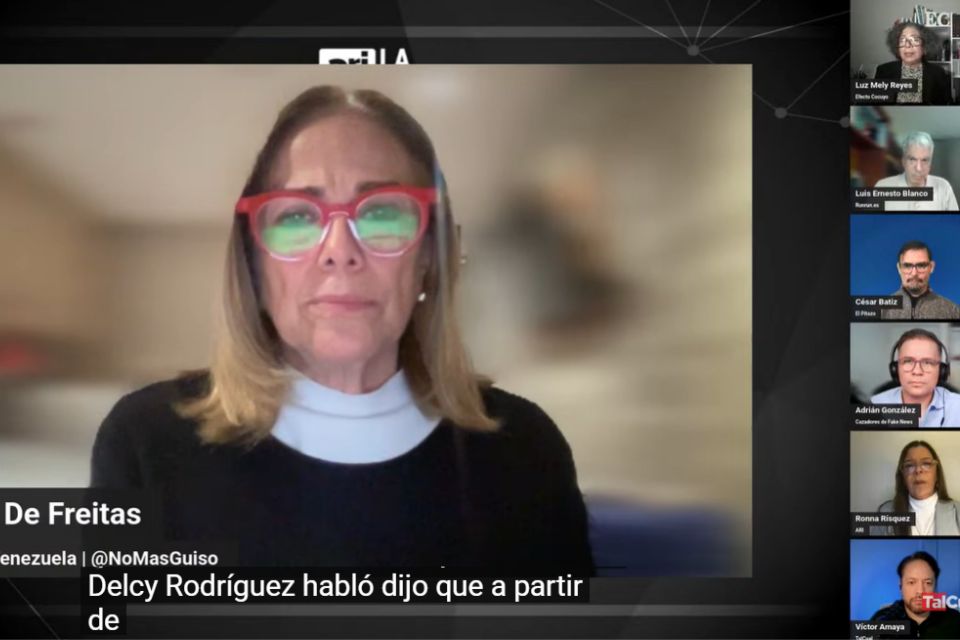
A month without Maduro was the title of La Conversa con la Luz of the Rebel Alliance Investigates (ARI) made up of Runrunes, The Pitazo and SuchWhich in accordance with Cocuyo Effect and Cazadores de Fake News, where the transit of Venezuela was analyzed after the operation carried out by the US armed forces at the beginning of the year.
In the program that featured the participation of Ronna Rísquez, director of the Rebel Alliance Investigates (ARI); Victor Amaya, director of SuchWhich; César Batiz, director of The Pitazo; Luis Blanco, director of Runrunes; Luzmely Reyes, director of Cocuyo effect, and Adrián González, director of Cazadores de Fake News, all agreed that it is not yet possible to talk about the beginning of a democratic transition in Venezuela, however some steps have been taken towards there.
Batiz explained that the fact that Diosdado Cabello continues to head the Ministry of the Interior, Justice and Peace suggests that the repression will continue against members of civil society in the country.
Rísquez indicated that despite the announcements of an amnesty law and the eventual closure of El Helicoide, there is no reliable sign of dismantling the repressive structure that surrounds the Venezuelan State.
For González, what exists at this moment is a tactical withdrawal of Chavismo, while Amaya asserted that the population has taken advantage of the situation to rekindle the protest and demands for full freedom for political prisoners and salary adjustments.
*Read also: La Conversa | Mariano de Alba: “Chavismo is undergoing a tactical rearrangement”
The manager has to see
In the opinion of Mercedes de Freitas, director of Transparencia Venezuela, Delcy Rodríguez is not a moderate figure of Chavismo as some sectors inside and outside the country want to make him out to be.
“There are several things that make me think that Delcy is not a moderate because she herself said that her arrival in the government was a kind of personal revenge,” said de Freitas.
De Freitas indicated that Rodríguez has had responsibility in high positions where a lot of public money is handled and decisions made so that some become richer and others become poorer.
Batiz added that since she was sworn in as president, Rodríguez has not mentioned the word corruption.
“For us it is clear that there is direct responsibility of Rodríguez in a large part of the corruption cases that have been known since 2015. She was in charge of Petróleos de Venezuela (Pdvsa), which is the mother of corruption,” stated the Venezuelan historian and activist.
De Freitas expressed that Transparencia Venezuela has identified 142 companies that have access to privileges linked to the current person in charge of the Executive responsible in sectors such as gold, hydrocarbons and sports, specifically the Venezuelan Football Federation (FVF) through its president, Jorge Giménez.
“There are a number of people who have made a lot of money because of their connection to power,” de Freitas said.
The founder of Transparencia Venezuela also maintained that Rodríguez has responsibility in the National Development Fund (Fonden), where according to the NGO more than 174 billion dollars were diverted in opaque and unfinished projects and in the Economic and Social Development Bank of Venezuela (Bandes), in which financial abuses were committed such as overpricing in service contracts and equipment acquisition.
De Freitas also explained that Rodríguez’s time in the Foreign Ministry served to wash the autocratic face of the Chavista regime.
The activist indicated that public opinion needs to know where the $300 million in oil sales went, after energy relations between Venezuela and the United States were reactivated in January of this year.
De Freitas assured that Transparencia Venezuela has recorded 178 cases of corruption that are being investigated in other countries.
He considered it difficult for the money to return to Venezuela.
“We are working in an anti-kleptocratic system, in all sectors there are people who have been creating companies with the backing of the government, these people cannot continue to have control of the country, own the media, finance parties and enter politics after having stolen.”
For de Freitas it is essential that the Amnesty Law announced by the government includes a section to punish corruption.
“It is time to resume the case of Alex Saab because I think he lost power, let’s see what the Italian justice system does with his case.”
Less repressed, but just as watched
Once again, Venezuelan students became involved in the fight for demands regarding human rights and precisely this Tuesday, February 3, a rally was held in the rectorate square of the Central University of Venezuela (UCV) to demand the release of all political prisoners.
The president of the Federation of University Centers (FCU) of the UCV, Miguelangel Suárez, stated that the national agenda has placed political prisoners at the forefront.
“We left the rally quite satisfied because in addition to the student community, the event brought together people from civil society and members of political parties. Unfortunately the point was not discussed in the National Assembly and that shows the little will of some to move forward in that regard.”
Suárez emphasized that the student movement has been persecuted by the Chavista regime and that is why there is solidarity with those who are behind bars today for the simple fact of thinking differently.
The student leader said that today those who go to universities feel less depressed compared to 2017 and the days after the 2024 elections, but just as under surveillance.
He reported that on Saturday, January 31, when they made a collection for political prisoners, they expelled from the university campus six officials of the Bolivarian Intelligence Service (Sebin) who were incognito taking photographs of the participants.
He announced that they are preparing a special activity for February 12, Youth Day.
“We are not going to stop defending political prisoners, even though some of us have never lived in democracy, we are still a generation with a voice.”
Claims injustice with his son
Evelis Cano, mother of a political prisoner, who has been stationed for more than 20 days in front of the Bolivarian National Police (PNB) headquarters in Zone 7 of Boleita, reported that she has suffered mistreatment due to misinformation coming from alleged government agents.
Cano assured that they wanted to link her with a criminal who is in the same detention center as her son.
“My son’s name is Jack Tantak, he is not a murderer, he was arrested on November 27 and accused of terrorism and treason,” Cano said in La Conversa.
Cano maintained that his son’s only crime was negotiating a truck with the former deputy of the National Assembly, Fernando Orozco, who is also imprisoned.
“After I was chained, they let me see my son. At first they didn’t tell me he was here, I visited all the detention centers and no one gave me an answer.”
Cano said that after the president of the National Assembly, Jorge Rodríguez, announced the release of a significant number of political prisoners, he went to Zone 7 along with other mothers and wives.
“The only thing they tell us is that they are waiting for orders, no one knows if they are orders from Miraflores or from Donald Trump.”
*Journalism in Venezuela is carried out in a hostile environment for the press with dozens of legal instruments in place to punish the word, especially the laws “against hate”, “against fascism” and “against the blockade.” This content was written taking into consideration the threats and limits that, consequently, have been imposed on the dissemination of information from within the country.
Post Views: 386