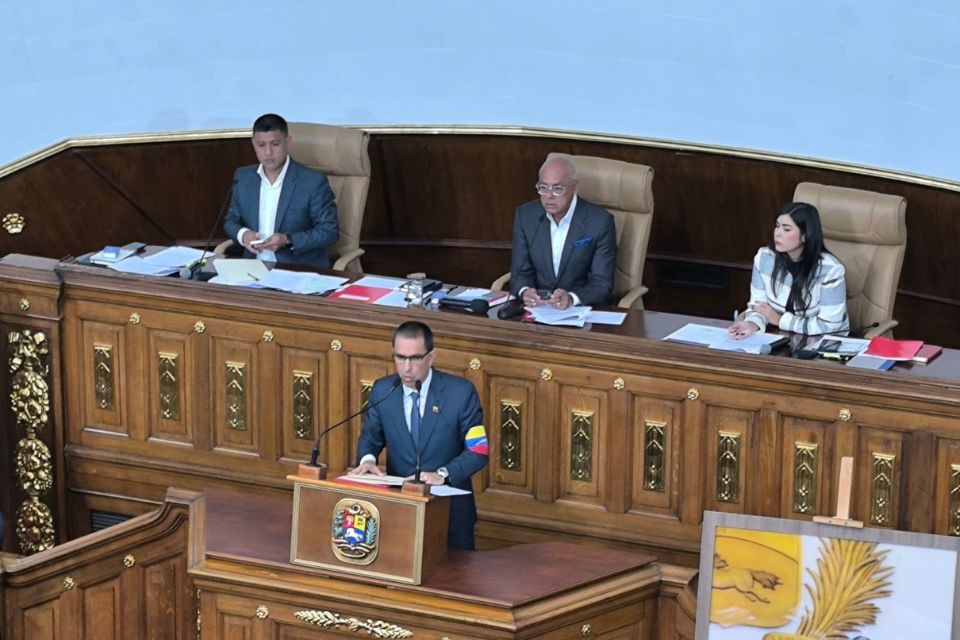
During the first discussion of the amnesty bill, pro-government and opposition deputies agreed that the initiative seeks to promote national reconciliation, guarantee international standards and open a new political stage in the country. After the first discussion, the text of the document is still unknown
The National Assembly held the first discussion of the amnesty bill for democratic coexistence this Thursday, February 5, and it was approved unanimously.
Jorge Rodríguez, president of parliament, asked for speed from the commission that will be in charge of bringing the project to consultations. «We don’t have much time. Celerity. Speed must be our currency at this time,” he said at the end of the session.
«We ask for forgiveness and we have to forgive too. “I don’t like prisoners,” said Rodríguez, who said that sometimes they must be necessary due to penal codes, political realities and the specific situation of a society.
Even though argued the amnesty bill, the content of this document is still unknown. In this session, the explanatory memorandum of the regulations was not even read.
For Rodríguez, the path of this law will be full of obstacles and disappointments, of advanced positions and unfair positions; But he emphasized that it is not only necessary to swallow thickly, but also to “swallow the frogs that must be swallowed for coexistence, reconciliation, peace and embrace.”
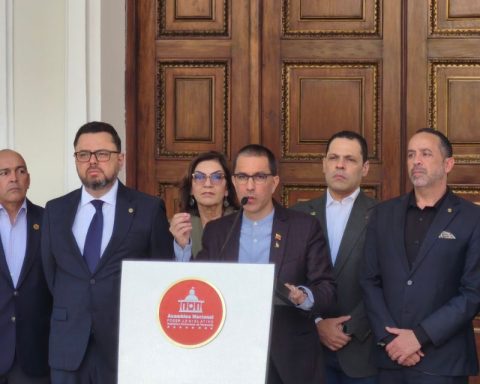
The person in charge of presenting the project was the deputy Jorge Arreaza (PSUV), who assured that Delcy Rodríguez, now at the head of the Executive, “is willing to make the decisions where there is room for the country to follow the paths of peace and prosperity.”
He added that in the country the “recognition of the parties” is essential, as he indicated that ignorance has led “to demonization, invisibility, contempt, not speaking to each other, not meeting each other, not building bridges.”
He insisted that we must “humanize and create coexistence with differences,” but in order to continue working. He reiterated that we must be responsible “heal wounds, recognize each other, understand each other.”
Arreaza assured that the events of January 3, which led to the capture of Nicolás Maduro and Cilia Flores by US military forces, “helped us mature even faster. “We are mature enough to assume this new moment and this new stage.” For this reason, he asked that “no one take this law as a sign of weakness, that no one use it to feed hidden agendas, pettiness, partial political calculations, no one, neither in Chavismo nor in the opposition.”
“It is also not impunity and white cards,” he emphasized about the amnesty bill, while adding: “Let us make with the amnesty law the sum of all the goods for the people of Venezuela, who deserve it so much.”
The Special Commission to Promote Public Consultation of the Amnesty bill for democratic coexistence will be chaired by Jorge Arreaza. Nora Bracho (UNT/Zulia) will be vice president. Other deputies also make up the commission.
*Read also: Explanation of reasons for the amnesty law proposal admits political persecution
Requests for national reconciliation
Deputy Luis Augusto Romero (Avanzada Progresista) considered that this initiative of the amnesty law is an opportunity to initiate the change towards “national reconciliation”, despite the complexities experienced in the country.
He also urged the commission to convene the largest number of actors in the country (civil society, deans, NGOs, unions, churches) for an “open, fruitful, honest and sincere debate”, with the ultimate objective of achieving peace.
Likewise, representative Carolina García (PSUV-Lara) described the amnesty bill as “important” and said that it invites national unity, resolving “differences in peace. “Tolerating each other, coexisting in the midst of diversity, but with respect and height.”
He asked the different parties that make life in the country to commit to never again imposing extremism, that “the guarimba does not exist, that no one else calls for sanctions, for interventions and that a dawn like that of January 3 never occurs again.”
«This is a law for reunion, for reconciliation, for the well-being of Venezuelans. With the purpose of consolidating peace,” emphasized Deputy García.
For his part, deputy Tomás Guanipa, sent a message to the relatives of the political prisoners and assured them that with the discussion of the bill, that “cry for hope and justice” that they have wanted to have to reunite with their family, “from today can become a reality.”
In his opinion, the existence of an amnesty law “can mark the beginning of a new historical stage in this country, a stage of encounter between all Venezuelans.”
For Guanipa, in addition to an opportunity for mutual recognition, the amnesty law should have all the guarantees and cover international standards so that “it is a law for everyone equally.” He explained that so that all detainees can be released and join public life and so that those in exile can also return, “but also those who, being free, cannot have a normal life.”
The parliament received the members of the Commission for Peace and Coexistence, headed by Ernesto Villegas, Minister for Culture; Rep. Genesis Garvett; Francisco Garcés, head of the Presidential Commission of the Central University of Venezuela; Michael Penfold, academic and university professor; Ricardo Cusanno, former president of Fedecámaras; a justice of the peace from January 23, a representative of Ridery, Indira Urbaneja, among others.
In addition, a general commission was created made up of deputies Stalin González, Luis Augusto Romero, Jorge Arreaza, Pedro Carreño, Tania Díaz, Tomás Guanipa, América Pérez, Antonio Ecarri, José Brito, Iris Varela and Nicolás Maduro Guerra.
*Journalism in Venezuela is carried out in a hostile environment for the press with dozens of legal instruments in place to punish the word, especially the laws “against hate”, “against fascism” and “against the blockade.” This content was written taking into consideration the threats and limits that, consequently, have been imposed on the dissemination of information from within the country.
Post Views: 419