He speeding and ignorance of the permitted limits continue to be two of the main causes of road accidents In the Dominican Republic and in the National District, where the maximum speed varies depending on the type of road, many drivers are still unaware of them.
Law 63-17 of Mobility, Land Transportation, Transit and Road Safety establishes the maximum speed limits, and in the National District the permitted speed is 60 kilometers per hour on avenues such as 27 de Febrero, John F. Kennedy and Máximo Gómez.
In the George Washington is 30 and 35 kilometers, while in Francisco Alberto Caamaño or Port Avenue It is 45 kilometers per hour. The elevated speeds should not exceed 60 kilometers per hour, although in some such as the one on 27 de Febrero it is 45 kilometers per hour.
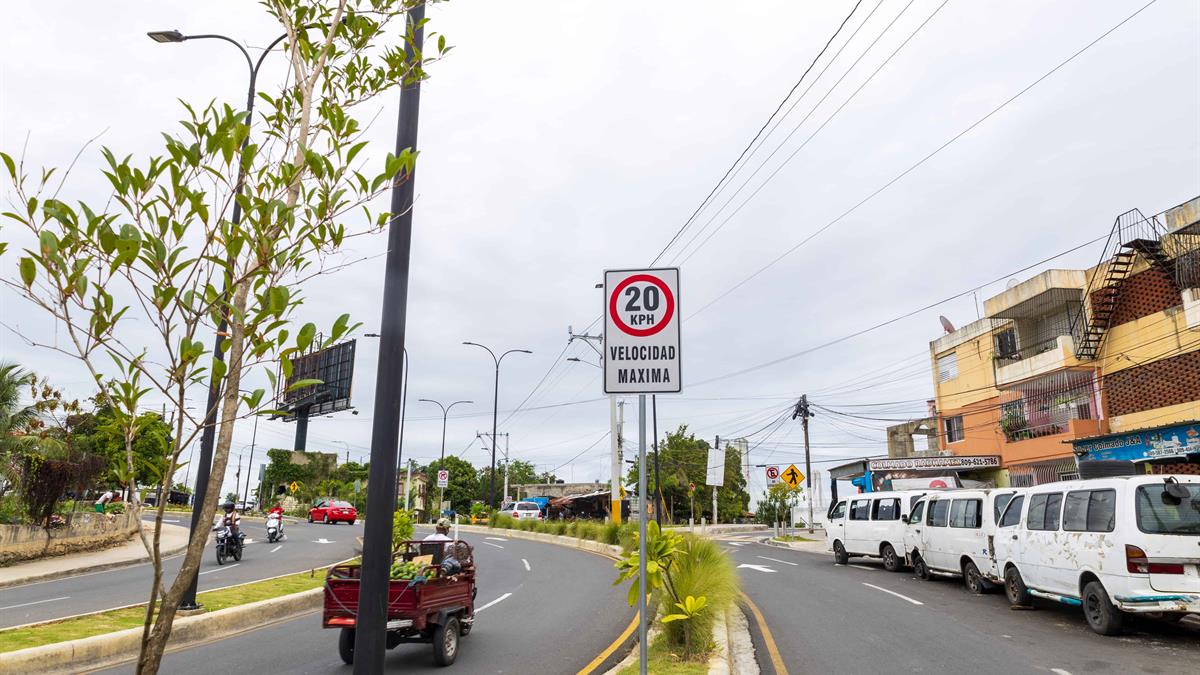
In tertiary streets such as Backing 17, in Los Guandules, the permitted speed is 20 kilometers per hour, as are those within urban sectors, mainly if there are schools or churches, colleges, however, there are few drivers who respect the limits and, in places like the Malecón, the speeding They double and even triple it without any legal consequences.
There are avenues that do not have signage of the maximum speed of circulationbut there were many ‘do not park’ signs such as Máximo Gómez, Winston Churchill, Rómulo Betancourt and on Luperón only a single sign was observed from the Duarte Highway to 30 de Mayo.
Given the situation and in compliance with resolution 1-2023, the Mayor’s Office of the National District, together with the Healthy Cities Alliancepromotes an ambitious speed reduction project under the motto “Not a chin faster“, an initiative that seeks save lives by changing driver behavior.
The program arises as part of a proposal from the Healthy Cities Alliancemade up of Bloomberg Philanthropies, Vital Strategies and the World Health Organization (WHO), and is supported by scientific evidence that shows that speed is the main factor of severity in road accidents.
-
The objective is that the avenues where traffic travels at 60 kilometers per hour be limited to 50. Elizabeth Mateo, general secretary of the Mayor’s Office of the National District, explains that reducing the speed to 50 kilometers per hour on large avenues has been one of the biggest challenges of the project, but also one of its most important bets.
“It is the speed established by the World Health Organization as the most favorable for save lives on avenues. At 50 kilometers per hour we still have time to brake, react and avoid a tragedy,” he points out.
The project formally began with the ordinance that reduced the speed limit and ordered the execution of a pilot plan. The process included socialization, approval by the Council of Aldermen, technical studies and, subsequently, a citizen awareness campaign launched in 2024.
“It’s not just an advertising campaign,” Mateo emphasizes. “We are talking about a behavior change program, and that takes time. But if we sow the seed todaywe will see results in the next years”.
Excess speed
The communications expert Juan José Castilla emphasizes that there is not only the “speedingwhen the legal limit is exceeded, but also the inappropriate speedwhich occurs when, even though you are within the limit, the surrounding conditions (rain, visibility, traffic) require you to go slower.
“If a pedestrian is hit at 30 kilometers per hour or less, the probability of death is very low. Above that speed, the risk increases considerably. That is why in school zones it is even recommended to reduce to 20 kilometers per hour.
He also highlighted the role of technology to control speed, such as the use of tachographs (devices that record and store information about the driving of a vehicle) in trucks and public transportation, and pointed out the need to strengthen the control of legal limits, which is currently not always met.
Castilla warned about the so-called “tunnel effect” in the vision of drivers: “At higher speeds, the field of vision is reduced, increasing the risk of accidents…given the state of our roads, speeds greater than 90 kilometers per hour would not be allowed,” the specialist concluded, recommending that stricter measures be taken to protect all road users.