The pressure caused by high interest rates caused Brazilian industry to lose pace in the last months of the year and close 2025 with growth of 0.6%. Despite the slowdown in the final stretch of the year, the result marks the third consecutive year of expansion in Brazilian industrial production.
The data is part of the Monthly Industrial Survey, released this Tuesday (3) by Brazilian Institute of Geography and Statistics (IBGE).
In 2024, the increase was 3.1%; and in 2023, 0.1%. The loss of pace in 2025 is easy to see when data from the first and second semesters are compared.
Until June, industrial production accumulated growth of 1.2% compared to the same period of the previous year. In the last six months of the year, the variation was zero (0%) in this same type of comparison. Specifically from September to December, the result was a decline of 1.9%.
IBGE found that in December the country’s industrial production fell 1.2%, the worst result since July 2024 (-1.5%). Of the last four months of the year, three were falls and one (October) had zero change.
The 2025 performance places the industry at a level 0.6% above the pre-covid-19 pandemic period (February 2020) and 16.3% below the highest point ever reached, in May 2011.
Sectors
Last year, the industry showed growth in two of the four major economic categories:
- durable consumer goods: 2.5%
- intermediate goods (components or processed products used to manufacture other goods): 1.5%
- semi- and non-durable consumer goods: -1.7%
- capital goods (machinery and equipment): -1.5%
Of the 25 activities surveyed by IBGE, 15 showed progress, with emphasis on extractive industries (4.9%) and food products (1.5%). In 2025, an increase in production was recorded in 49.6% of the 789 products surveyed by IBGE.
Effect of interest
According to the research manager, André Macedo, the reason for the industry to slide at the end of the year is the restrictive monetary policy, that is, the high level of the economy’s basic interest rate, the Selic.
“High interest rates tend to reduce the intensity of the economy, and the industrial sector is in this context”, he analyzes.
Macedo explains that with high interest rates, companies’ decisions to make investments are postponed.
He adds that the restrictive monetary policy also has an impact on family consumption, which meant an “important slowdown” in the durable goods segment in the last months of 2025.
“It affects, on the part of families, decisions regarding consumption”, he points out.
The research manager also draws attention to the rise in default levels, since high interest rates make loans more expensive.
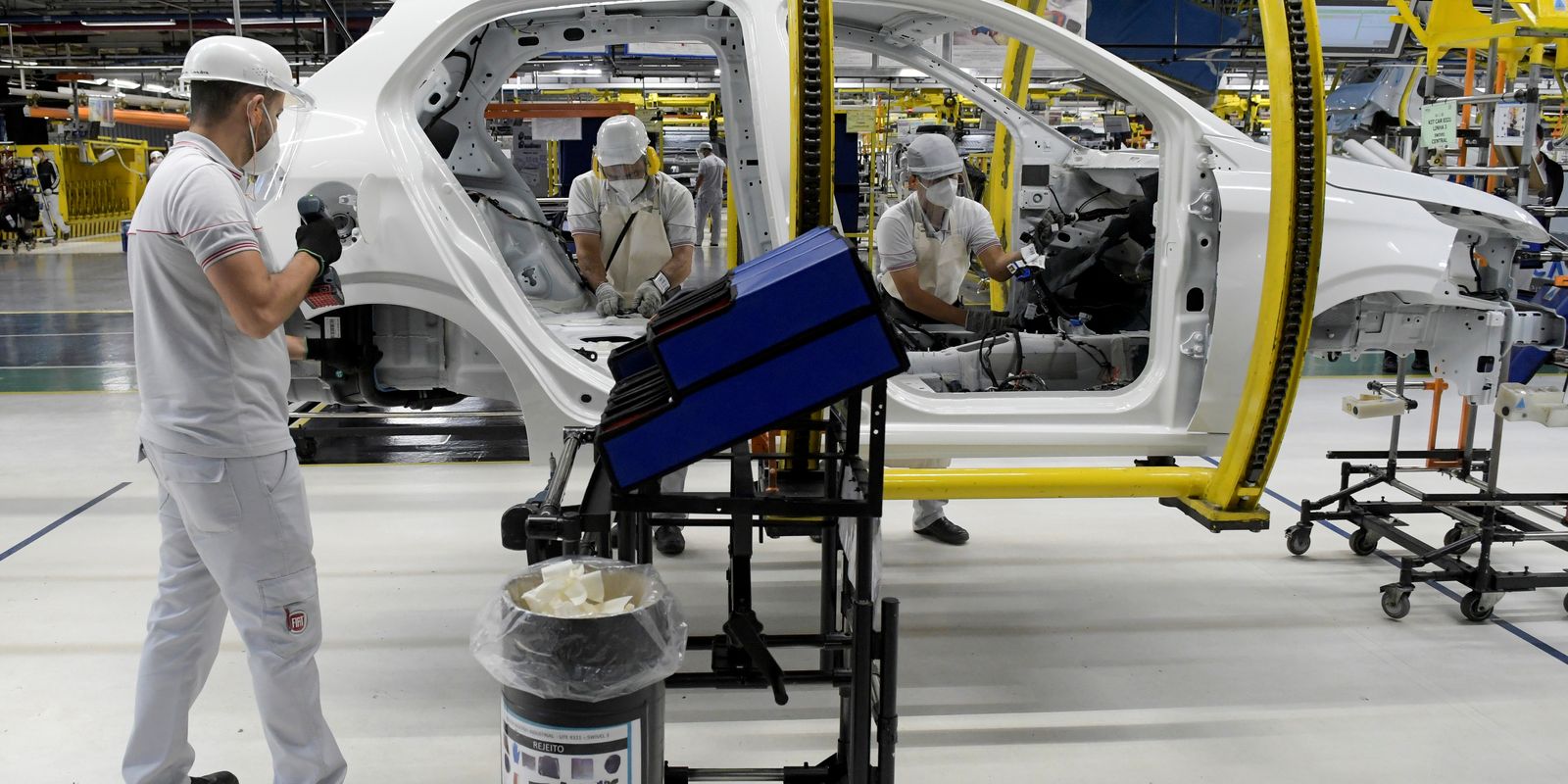
A snapshot in December was the production of motor vehicles, which fell 8.7% – greater negative pressure from November to December. It indicates that the last month of 2025 had a greater presence of strikes and collective vacations in factories.
Concern about inflation
In September 2024, concerned about the growing trajectory of inflation, the Monetary Policy Committee (Copom) of the Central Bank (BC) began an escalation of the economy’s basic interest rate, the Selic, then at 10.5% per year, raising it to 15% in June 2025.
The government’s inflation target is 3% over a 12-month period, with a tolerance of 1.5 percentage points (pp) higher or lower.
The official inflation index (IPCA) lasted 13 months outside the tolerance rangepractically all of 2025.
>> Read here: BC maintains basic interest rates at 15% per year for the fifth time in a row
Selic influences all other interest rates in the country and, when high, acts restrictively on the economy, that is, it makes credit operations more expensive and discourages investment and consumption.
The expected impact is lower demand for products and services, cooling inflation. The side effect is that a slow economy tends to reduce job creation.
Despite the restrictive pressure, 2025 ended with the lowest unemployment rate ever recordedas announced by IBGE last Friday (30).