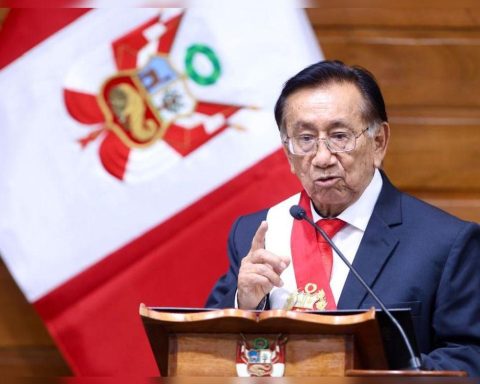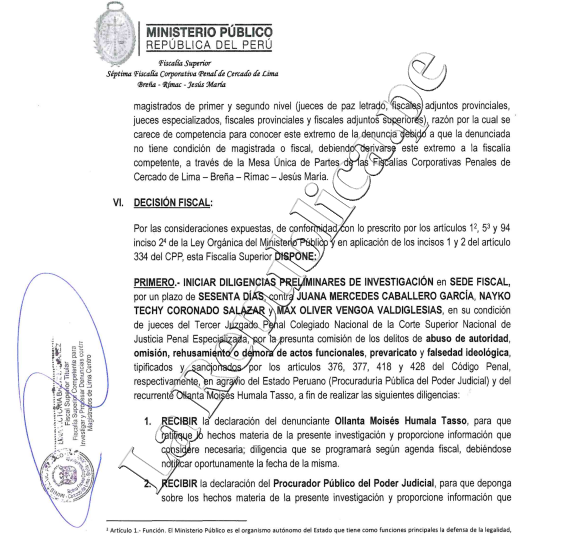
The former president of the Republic, Ollanta Humala Tassofiled a complaint against the judges who sentenced him to 15 years of imprisonment along with his wife Nadine Heredia for the crime of money laundering in April of last year. The lawsuit includes the magistrates Max Vengoa, Juana Caballero and Nayko Coronado for the alleged crimes of abuse of authority, omission, refusal or delay of functional acts, prevarication and ideological falsehood.
In that sense, the Seventh Superior Criminal Corporate Prosecutor’s Office ordered the beginning of preliminary proceedings against the aforementioned judges, such as the taking of statements from Humala Tasso, the public prosecutor of the Judiciary and of the magistrates. Likewise, it was requested from the National Control Authority (ANC) of the judicial system to send all the information on the functional complaints that the former president presented against the orders to administer justice between April 2025 and the present.
YOU CAN SEE: Delia Espinoza: “The president is as Peruvian as anyone, he is not untouchable”
The measure also covers the record of complaints, procedures and sanctions of the aforementioned judges. In addition, the Third National Collegiate Criminal Court of the National Superior Court of Specialized Criminal Justice was required to report on the current status of File 249-2015-78 (sentence against the Humala Heredia).
The complaint also reaches the legal specialist of said jurisdiction, Katherine Flores Velarde, for the same alleged crimes.
YOU CAN SEE: Ciro Castillo goes to Gore Callao to resume his position after preventive detention was annulled
Ollanta Humala and Nadine Heredia: the reasons for the complaint
According to the complaint to which he had access The RepublicHumala’s complaint is based on the fact that he was detained in the Barbadillo prison when the verdict of his sentence had only been brought forward on April 15, 2025. The former president recalled that the Constitutional Court (TC) established that the ruling advances are not executed until the reading of the full sentence, which was made on the 29th of the same month.
However, on that date the sentence was not notified in full, “because it had not been read and a copy of it was not given, as established in paragraph 3 of article 396 of the Code of Criminal Procedure.” For this reason, a complaint was filed with the ACN of the Judiciary and the complete document was notified until May 2.
“Regarding the crime of abuse of authority, the complainant maintains that the arbitrary act materialized when the immediate deprivation of his liberty was ordered without there being a motivated and express mandate such as the criminal sentence,” the document reads.