Iván Evair Saldaña
La Jornada Newspaper
Monday, February 2, 2026, p. 7
After five months of work of the renewed Supreme Court of Justice of the Nation (SCJN), its president, Minister Hugo Aguilar Ortiz, affirms that it is already consolidated, although he recognizes controversies, political costs and challenges. But also pressures: this month the legal deadline expires to resolve 48 tax lawsuit appeals for billions of pesos that are even larger than the debts of Ricardo Salinas Pliego’s companies.
“We are going to comply fully… The Court will not allow itself to be pressured, it will not respond to interests or forces of any kind. We will make decisions with complete freedom,” he says in an interview with The Day.
Aguilar Ortiz maintains that the Court is no longer oblivious to national and international events that occur beyond its jurisdictional work. In this context, he gives his opinion on the eventual electoral reform and warns of “difficulties” for the 2027 judicial elections, as they could be “contaminated” by partisan overtones; Therefore, he suggests that a possible solution is to postpone them for a few months or even one or two years.
He also maintains that State institutions must form “a common front” to defend the country, in the face of the decisions of the US president, Donald Trump, that have impacted the world.
“We are doing very well”
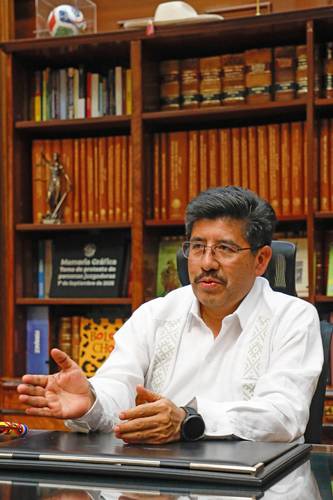
From the office occupied by his predecessors at the SCJN – from which he removed armchairs to install a large rectangular table and now convert it into a work area – the lawyer of Mixtec origin affirms that “the Court is going very well”, as he increased his work pace (up to 70 matters resolved weekly, on average) and adopted a new, more public and collegial methodology.
Now it is an open Court, with social dialogue and institutional changes, such as new academic areas and greater contact with communities, he comments.
“The impact is beginning to be noticed and people are already recognizing it. I could say that even at the lowest levels of the social scale – villages, indigenous and Afro-Mexican communities – the impact is of the greatest magnitude. It is historic,” he explains.
“Like a fish in water”
On his desk, the judge of the country’s highest court displays an ornate gavel, a gift from the Wixárikas of Jalisco. He says he feels “like a fish in water” spending from morning to night resolving legal issues, interpreting the law and in daily contact with people, even under a scenario that – he assures – he anticipated before taking office.
“We are the product of a popular election. I knew that we were going to have permanent surveillance of the citizens. In fact, that’s how we offered it,” he says.
Last week, the high court was involved in a strong controversy over the acquisition of nine armored Jeep Cherokee trucks, at a cost of 2.4 million pesos per unit, one for each minister, which were finally renounced after public annoyance. Aguilar maintains that it was a collegiate decision of the plenary session, supported by technical opinions and for safety reasons, not a luxury like the Suburbans of the past, although he admits that he underestimated the reaction.
“I did not think that this would be seen with this magnitude. It may be that we did not have the full perspective there. I understand that, in public opinion – especially among the most recalcitrant -, there was talk of inconsistency in my approach. I do not see it: I have reviewed my speeches and I never spoke of austerity at the expense of the functioning of the Court,” he points out.
Pressure from legacy tax issues
Last November, the Court resolved eight tax lawsuits of Grupo Salinas and confirmed credits for almost 49 billion pesos. However, there are still 48 tax issues inherited since September 1, which the new plenary session must resolve before February 28, when the six-month period set by the judicial reform expires.
Among the most important matters are lawsuits brought by companies against tax credits linked to the Manufacturing, Maquiladora and Export Services Industry Program (Immex). In this regard, the SAT maintains that between 2019 and 2023, these operations reached a base close to 279 billion pesos, with an estimated non-perceived collection of around 44 billion pesos for VAT.
▲ The minister is aware that there is now permanent surveillance of citizens regarding the acquisition of vehicles that they finally had to give up due to social discontent.Photo Jorge Ángel Pablo García
There are also lawsuits promoted by companies such as Risen Manufactura and Operadora de Centros Comerciales Opción, among others, that seek the highest court to endorse the obligation of the SAT to pay interest on the refunds of tax credits declared null, which would imply million-dollar losses for the federal treasury.
The minister president reveals that in the last five months, “fortunately we have not had any pressure, neither from authorities nor from company lawyers. We have received everyone, yes.”
He assures that, as in the Salinas Pliego cases, the resources were processed through institutional channels. “Many appeals were filed and all the ministers were being challenged, but everything was done through institutional channels,” he summarizes.
Another controversy was the resignation of Judge Lorena Josefina Pérez Romo from the new Judicial Administration Body, in charge of managing the resources of the Judicial Branch of the Federation. The Court appointed her last September, so she must fill the vacancy, an appointment scheduled for this week.
“I was also surprised. He presented his resignation to me for personal reasons and I sent it to the Administrative Body. I asked if there was any problem and they told me no… Now we need someone who knows the jurisdictional function, the functioning of the bodies and the needs of judges, magistrates and staff,” says Ortiz.
In the plenary debates there have been frequent moments of tension, mainly between Lenia Batres Guadarrama and Yasmín Esquivel Mossa, and on the other hand, between Giovanni Figueroa Mejía and María Estela Ríos González. However, the minister president denies that there are internal divisions.
“There are no lines, no groups, no forms. There is authentic debate. If someone raises their voice a little, makes an additional reflection, gives an example or makes a joke, it is part of what the debate involves. But the plenary session is united, it is aware that it is not theater. We no longer come out with agreements made,” he clarifies.
2027 elections, at risk of partisan contamination
Given the progress of work in Congress for an electoral reform, Hugo Aguilar sees difficulties in holding the 2027 judicial elections in which the second half of the judges and magistrates of the Judicial Branch of the Federation will be renewed, due to their coincidence with partisan votes. He believes that an adjustment to the calendar could be analyzed, although he has not yet established a definitive position.
“Yes, I rather detect the difficulties that the election is going to have – or that it already has -, but I have not yet sat down to reflect on the solutions. That is, what is the main difficulty: there is going to be an electoral process of political parties and, at the same time, an electoral process of the Judiciary, which must be without parties. Out there, in the field of facts, how can we distinguish one from the other?
“So, are we going to set up a scenario for one to contaminate the other, or for them to contaminate each other? I see it as more delicate for the Judiciary, because it is the one that must remain without political parties. That is the greatest difficulty that I observe.
“Until today I have not sat down to reflect on what the solution could be, although one of them would be to postpone it. I don’t know if it would be a year or, perhaps, one or two months, because the expense is also involved: if you maintain already trained electoral officials and postpone the election for a month or two, you take advantage of that already created human capacity,” he says.
For the lawyer, the Court should not isolate itself from society or from national and international events. He defends that his expressions are not political, but rather general reflections, such as when he expressed his concern about the international scenario and, without directly alluding to the United States intervention in Venezuela, warned that the “law of the strongest” cannot be imposed on international law.
“At the very least, let it be known that we are not immune to these world events and that we, like Mexico, are determined to form a common front,” he concluded.