Anything goes to win votes in the next elections on Sunday, April 12. And, in the same style as the Argentine president, Javier Milei, a large part of the candidates for Pizarro’s chair have decided to opt for the reduction of ministries. under the promise that state bureaucracy and public spending will be reduced.
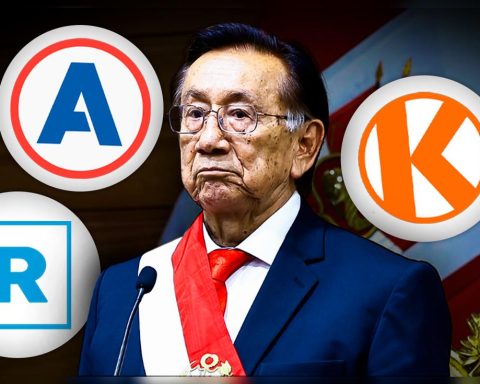
Through a review of the government plans of the 36 political groups enabled by the National Election Jury (JNE), The Republic has been able to detect that 14 propose reducing the current figure of 19 ministries because they consider it too large.
The list highlights Popular Renewal, Alliance for Progress (APP), Avanza País, Podemos Perú, APRA, National Unity and the Purple Party. Added to these are new political parties, such as Sí Creo, Perú Moderno, Unidos Perú, Perú Acción, Integridad Democrático, Un Camino Diferente and the Regionalist Party of National Integration (PRIN).
YOU CAN SEE: Chinese Embassy denies President José Jerí: Peru-China Friendship Day was organized with the Ministry of Culture
The MIMP in the spotlight
All of these organizations that support this measure come from the right or center-right. But that’s not all.
What is striking is that At least half of the 14 groups seek to extinguish or merge the Ministry of Women and Vulnerable Populations (MIMP) with other portfolios, as the Government of Dina Boluarte intended at the time, with the endorsement of Congress.
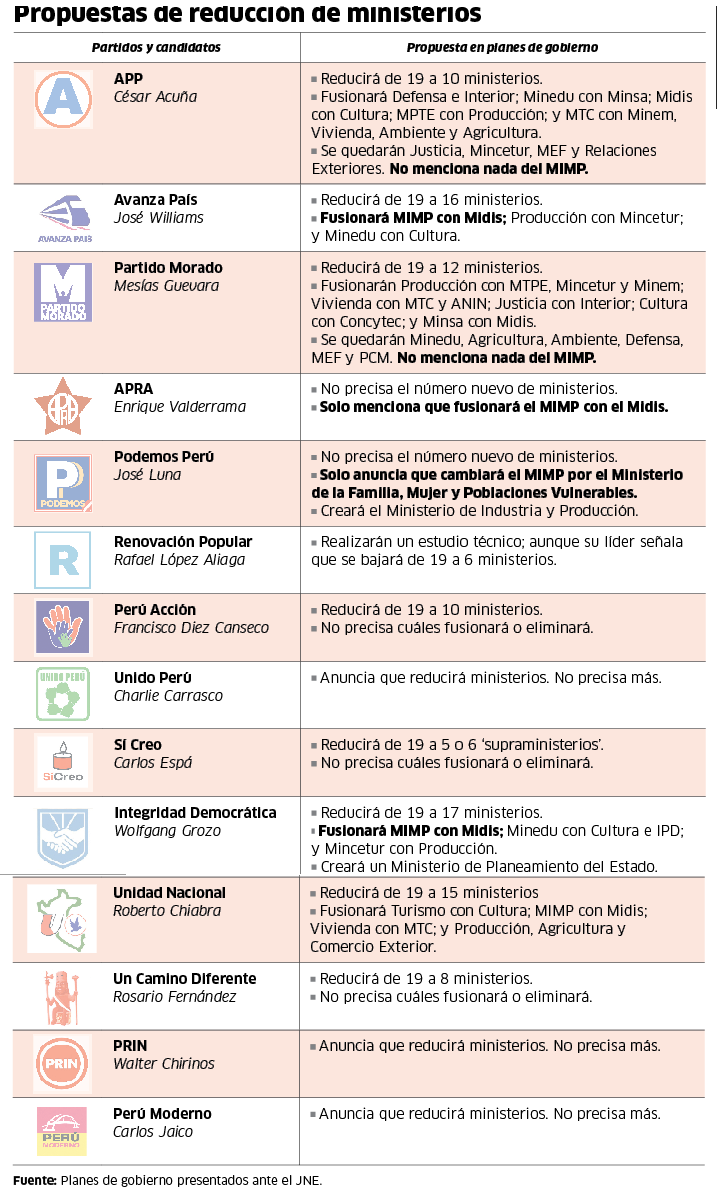
For example, the merger of the MIMP with the Ministry of Development and Social Inclusion (Midis) is proposed by Avanza País, APRA, Podemos Peru, Democratic Integrity and National Unity. Meanwhile, APP and the Purple Party do not consider the MIMP in the new Executive structure. Likewise, the other seven do not give more details in their government plans.
“We will create the Ministry of Human Protection after the merger of Midis and MIMP,” states Unidad Nacional. “We will create the Ministry of the Family, Women and Vulnerable Populations”, Podemos proposes. “We will unify the MIMP and the Midis and it will be called the Ministry of Development and Social Inclusion,” offers Democratic Integrity (see box).
Conservative attack
For the former Minister of Women, Diana Miloslávich, this new intention to merge the MIMP with the Midis is worrying because responds to a predominantly conservative and anti-rights political context which is not only happening in Peru but also in other countries, such as Argentina, Ecuador and the United States.
“It is a message that these parties, many with seats in the current Congress, are not going to prioritize the rights of women, children, older adults and people with disabilities,” said Miloslávich after adding that they also It is an example of machismo and ignorance of the State.
The former minister explained that there is no basis for merging the MIMP with the Midis because their mandates are different.
“The objective of Midis is to reduce poverty with the implementation of social programs; while the MIMP has under its leadership not only the policies linked to the prevention of violence and gender equality, but also the leadership in matters of children, people with disabilities and older adults. They want to go back 30 years of progress,” he said.
In the opinion of the public management specialist, Karla Gaviño, the reduction of ministries should be based, mainly, on solid technical foundations and not on ideological positions.
“For the best provision of State services, what has to prevail is technicality and the search for efficiency rather than ideological or personal positions,” he stated.
New ministries
But what does each of these political organizations that seek votes propose?
Alliance for Progress, which has César Acuña as its presidential candidate, offers to reduce from 19 to 10 ministries merging and extinguishing attached portfolios and offices, “in order to eliminate duplication and crossed procedures, generate less unproductive current spending and have a State close to the population.”
In this way, APP proposes the Ministry of Defense and Internal Security, the Ministry of Basic Strategic Services (merger of Minedu and Minsa), the Ministry of Socio-Economic Development (merger of MTC, Minem, Agriculture, Housing and Environment), the Ministry of Infrastructure, among others. The ministries of Justice, Economy, Foreign Relations and Mincetur would still remain. APP would remove the MIMP because it does not appear in its structure.
In the case of the Purple Party, whose presidential candidate is Mesías Guevara, it proposes reducing ministries from 19 to 12 “to avoid duplication of efforts and waste of resources.”
Thus, the Ministry of Economic Development and Employment (merger of Production, Labor, Mincetur and Minem), the Ministry of Infrastructure (merger of MTC, Housing and ANIN), the Ministry of Knowledge (merger of Culture and Concytec), the Ministry of Security and Justice and the Ministry of Health and Social Development would be created. With these the portfolios of Education, Agriculture, Environment, Defense, Economy and the PCM would remain. The Purple Party also does not take the MIMP into account in its structure.
“These mergers would occur via supreme decree, with a transfer plan of 6 to 12 months and with labor guarantees. For this, an investment of 365 million soles and savings of 825 million per year are estimated,” he responds.
More mergers
In the Avanza País government plan, which has José Williams as its candidate, it promises to reduce ministries from 19 to 16 “to avoid bureaucracy, expense and instability due to the constant rotation of ministers.” For that, I would merge the MIMP with the Midis; the Ministry of Production with Mincetur; as well as Minedu with Culture.
Likewise, Unidad Nacional, whose candidate is Roberto Chiabra, offers to reduce from 19 to 15 ministries “to achieve a managerial economy and also empower disjointed sectors.” Thus, the Ministry of Tourism and Culture, the Ministry of Public Works (merger of Housing and MTC) and the Ministry of Production and Foreign Trade (merger of Production, Mincetur and Agriculture) would be created.
On the other hand, Renovación Popular, which has Rafael López Aliaga as its candidate, intends to reduce from 19 to 6 ministries. Although he has not specified which ministries he will eliminate in his government plan; Its leader has announced that the MIMP will be the new Ministry of the Human Being.
Sí Creo, by Carlos Espá, also promises to reduce from 19 to 6 ‘supra ministries’. A Different Path, by Rosario Fernández, proposes lowering the figure to eight ministries and Perú Acción, by Francisco Diez Canseco, to 10. The other parties indicate that they will reduce the ministerial portfolios, but do not give details.
Let sanity prevail
According to the public management specialist, Karla Gaviño, The proposal to reduce ministries has become the ‘workhorse’ of political parties who participate in elections. However, this should not be an empty electoral promise but should be based on a technical analysis that is grounded in our reality to prevent basic services from being neglected.
“If we think about having fewer ministries to reduce the state payroll, we are starting from a wrong premise. It is a risk to have a small State for a large population if a plan has not been developed that quantitatively and qualitatively improves the efficiency, spending and quality of the bureaucracy. The objective is to have sufficient capacity to comply with State policies. and the services provided to citizens are optimized,” he said.
In turn, the former Minister of Women, Diana Miloslávich, regretted that, in the middle of the electoral campaign, 14 political parties generate concern instead of hope by attempting to adapt the Peruvian State to their interests.
“From Congress, many of these parties, especially Renovación Popular and Fuerza Popular, have already boycotted policies in favor of women and vulnerable populations with bills that were approved. Now, they seek to do the same and more from the Executive. We cannot allow this, I hope the voters know how to choose well because the outlook cannot be discouraging.”the former minister responded with great concern.
Attempts of the Executive and Congress
On July 28, 2024, former president Dina Boluarte announced the creation of the Ministry of Infrastructure and the merger of four ministries, including Midis and MIMP. However, it did not prosper.
At least four bills have been presented since Congress to eliminate, merge or change the name of the MIMP.
In February 2022, the legislator Américo Gonza presented an initiative to change the name of the MIMP to the Ministry of the Family and Vulnerable Populations.
Between December 2023 and February 2025, your colleague Milagros Jáuregui presented two projects for the MIMP to be the Ministry of Family, Development and Social Inclusion.
In January 2024, Congresswoman Katy Ugarte proposed reducing ministries from 19 to 9.