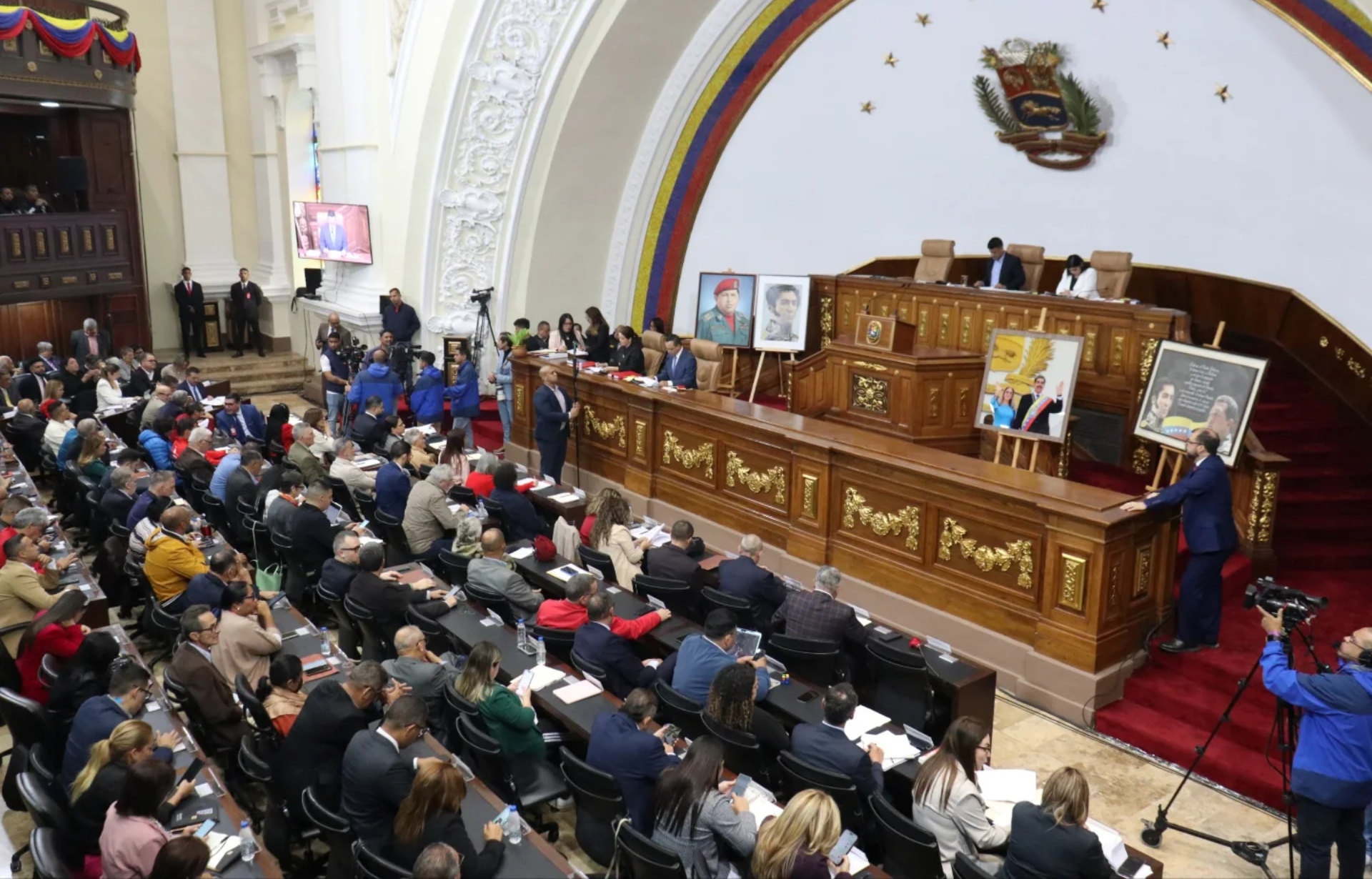
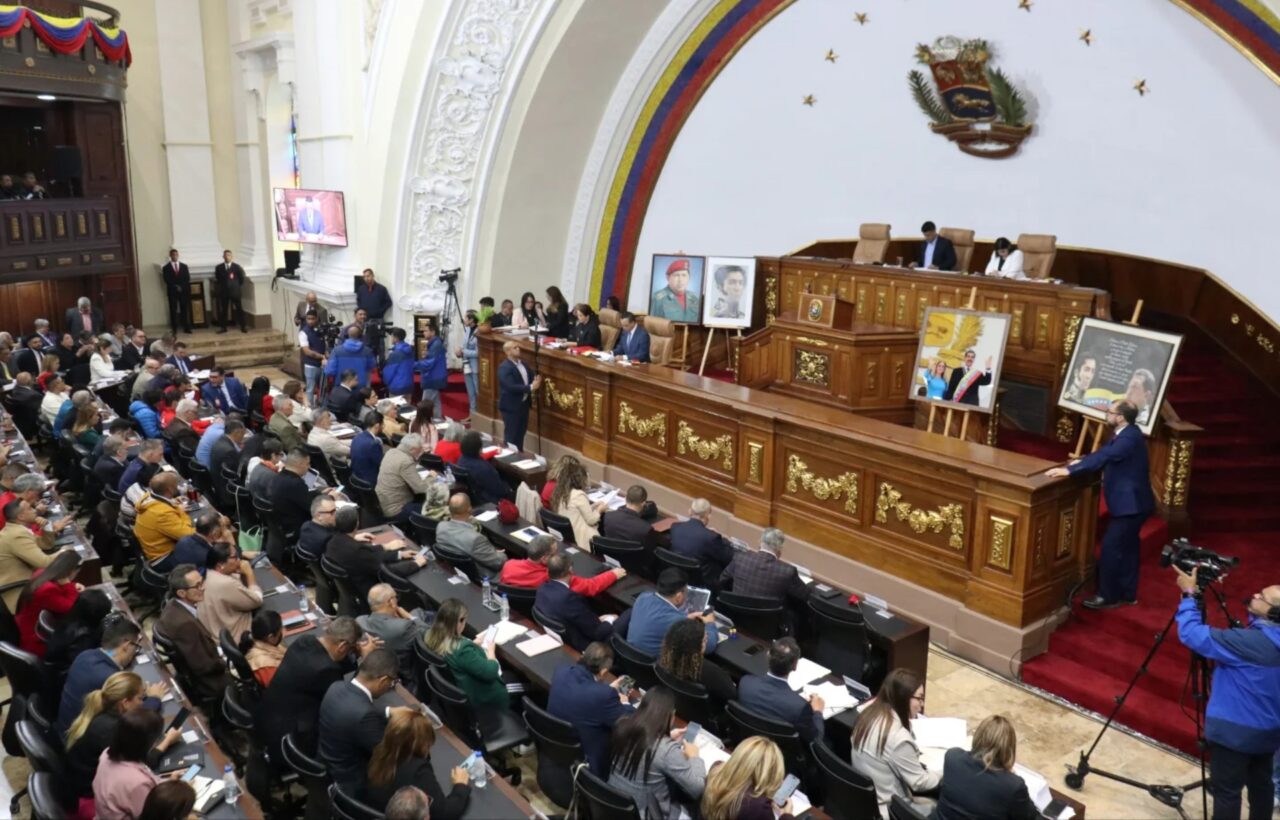
In the midst of a country exhausted by the political and economic crisis, legal security has become a commodity as scarce as it is essential. The parliamentary election of May 25, 2025 not only formally renewed the National Assembly, but also opened a substantive debate: can we speak of valid laws when the body that dictates them is born from a flawed electoral process, neither free nor competitive?
About the democratic and legal implications of this “new” Assembly, and about the impact that this has on contracts, investments and on the Venezuelan Rule of Law itself, we spoke with Dr. Carlos J. Sarmiento Sosa, coordinator of the Spain Chapter of the Constitutional Block of Venezuela.
—Dr. Sarmiento Sosa, you have stated that the parliamentary elections of May 25, 2025 cannot be considered free or competitive. What are, in your opinion, the most serious defects that mark the origin of this process?
—The most serious thing is that we are not talking about isolated irregularities, but rather about structural fraud. There was systematic repression before, during and after the process: more than 70 detainees among politicians, activists, journalists and lawyers, persecution, temporary disappearances, incommunicado detention and reprisals against family members and property of opponents and table witnesses. This creates a climate of fear that is radically incompatible with the free exercise of the right to vote.
—Beyond the repression, what technical and institutional irregularities affected the integrity of the electoral process?
—There were delays and failures in the application system, selective disqualifications of opposition candidates, elimination of the QR code in the minutes — which was a key independent verification mechanism — and a strong presence of State security forces in the voting centers. This entire framework undermines the guarantees of transparency, citizen control and real competition between political options.
—One of the most controversial points has been the official participation figure. What does this discrepancy tell us about the nature of the process?
—The CNE speaks of 42.63% of “active voters”, but opposition estimates and experts place the real participation between 12% and 25%. The category of “active voters” does not even exist in Venezuelan electoral regulations; it is an artificial construction that allows participation to be inflated. If we add to this doubts about the method of allocating seats and the correspondence between votes and seats, what is reinforced is the idea of a fraud designed to produce an Assembly tailored to the regime.
—With this picture, how do you rate the legitimacy of the National Assembly that emerges from those elections?
—That Assembly lacks democratic legitimacy of origin. It is not the result of a genuine election, but the product of a flawed process, designed to perpetuate the regime in power. There was no real competition, there was no equal conditions, there were no minimum guarantees. From a democratic point of view, it is an illegitimate body.
—Let’s move on to the legal field: if the Assembly is illegitimate in its origin, what validity do its legislative acts have? I am thinking, for example, of a possible reform of the Organic Hydrocarbons Law.
—In strictly constitutional terms, we are facing a spurious body that usurps the functions of the Assembly provided for in the 1999 Constitution. The Constitution itself establishes that any usurped authority is ineffective and its acts are null (article 138), and that any act of public power that violates the Constitution is null and void (article 25). Applied here, its laws are not only debatable due to their content: they are null at the root because they emanate from a body whose legal existence is flawed.
—Could we say then that the so-called “AN 2025-2030” is not, legally, the National Assembly of constitutional article 186?
-Exactly. If the parliamentary process is held under repression, exclusion, manipulation of norms and results, that “AN 2025-2030” does not meet the conditions of article 186: it is not representative, it does not arise from a free, universal and competitive vote. It is a de facto body that takes the place of the constitutional Parliament without an authentic popular mandate. That is usurpation of powers.
—But in practice, the TSJ, the Executive headed by Delcy Rodríguez, apply the laws approved by that Assembly. How is this reality reconciled with the idea of nullity?
—Here we must distinguish between legal validity and de facto effectiveness. At the internal level, under the control of the regime, TSJ, Executive and administration will treat these laws as if they were valid: they will apply them in contracts, concessions, regulation of the oil sector, etc. That gives them effectiveness, but not legitimacy or true constitutional validity. They are rules that are imposed by force of fact, not by force of law.
—And what happens if we look at the problem from constitutional law and international law?
—From that perspective, the conclusion is different: coming from a usurped authority and a legislative procedure controlled by an illegitimate body, these laws can and should be reviewed in a future democratic transition. Let’s think about a reform of the Organic Hydrocarbons Law: a contract can be signed today under that reform, but tomorrow, in a framework of constitutional restitution, the very foundation of that norm can be declared non-existent.
—What implications does this have for economic actors, especially in the oil sector, who can benefit from these reforms?
—The main implication is legal risk. Whoever is contractually linked to the Venezuelan State on the basis of norms emanating from a spurious body – despite all the advertising hype that favors it – must know that they could be building on sand. Today it may have support from the de facto state apparatus, but tomorrow it may face the review or annulment of those acts in a transition scenario. From a public law perspective, there is no lasting legal security based on laws produced by a usurping Assembly. This is so real that even a transnational oil giant has publicly expressed its reservations about legal security in Venezuela.