After the announcement of an amnesty law and the “closure” of Helicoide by Delcy Rodríguez, relatives of the more than 700 political prisoners who still remain behind bars maintain vigils in Caracas. Between hope and skepticism, they demand full freedom and denounce the lack of information about whereabouts after years of torture and judicial opacity
“My faith is stronger now than before,” says Maira Morales, sister of Ricardo Fonseca, political prisoner. He claims this on the outskirts of Helicoide, a detention center designated as a “torture center” by international organizations such as the UN Fact-Finding Mission.
Morales releases these words simultaneously with the announcement of Delcy Rodriguez of an amnesty law and the closure of police stations to be converted into a sports center. Rodríguez, who was left in power after the United States military intervention and the capture and extraction of Nicolás Maduro, shared this information in the afternoon of January 30, during his speech at the Supreme Court of Justice on the occasion of the beginning of the judicial year.
Mothers, sisters and relatives of political prisoners have been on vigil and spending the night in detention centers for 22 days. Since January 8 to date, just over 300 political prisoners have been released, little by little.
Non-governmental organizations point out that more than 700 people are yet to be released. They warn that the number could be higher, because there are arrests that were never reported for fear of reprisals from the government.
*Also read: Delcy Rodríguez announces general amnesty law and orders the “closure” of Helicoide
Morales remains in Helicoide, even though his brother is not there. Ricardo Fonseca Mosquera, retired first lieutenant of the Navy, was arrested in April 2020 and spent five years and two months there. Six months ago he was transferred without his family knowing until now which prison he is in.
Morales says that he has spent 22 days crying, asking God and praying for his brother’s freedom.
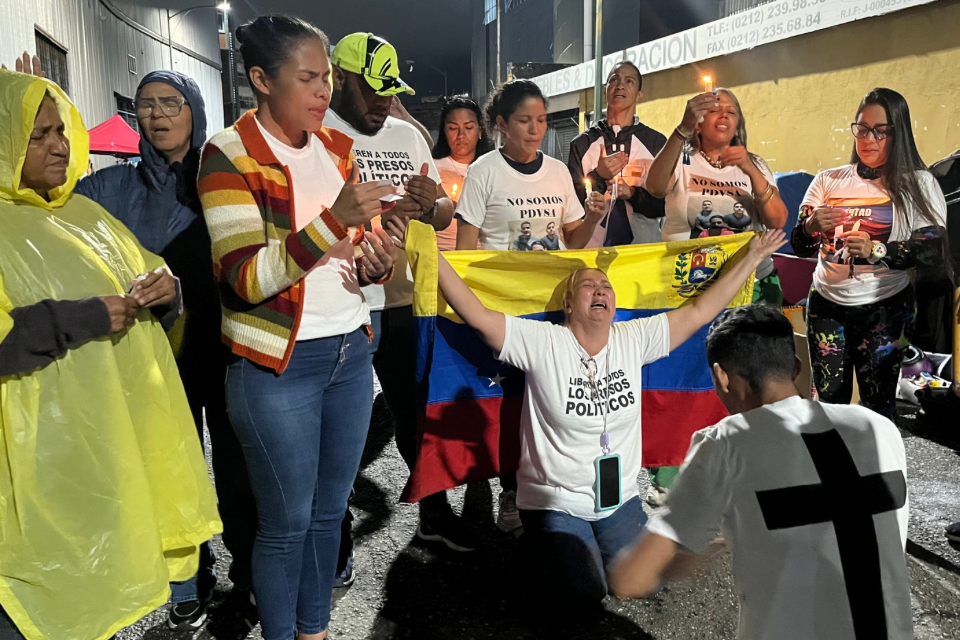
“We have no faith in their lives. We, as family members, want their immediate release. This struggle has been great, but it has been worth it,” says Morales, wrapped in a Venezuelan flag, accompanied by other relatives of political prisoners.
El Helicoide is in the south center of Caracas. It is located between the San Pedro and San Agustín parishes, on a hill that connects the extension of Nueva Granada Avenue with Presidente Medina Avenue (Victoria).
It was originally designed by architect Jorge Romero Gutiérrez as a luxury shopping center. The idea proposed that cars go up its spiral ramps to the premises. Salvador Dalí offered to decorate it.
Due to economic and political problems after the fall of Marcos Pérez Jiménez, the work was paralyzed for decades. For years, it has functioned as one of the headquarters of the Bolivarian National Intelligence Service (Sebin) and has been denounced by various NGOs and human rights organizations as one of the largest detention and torture centers in Latin America.
The Independent International Fact-Finding Mission on Venezuela has issued reports detailing that systematic torture is practiced in Helicoide. They have documented methods such as electric shocks, suffocation with plastic bags and sexual violence. Amnesty International (AI), for its part, has repeatedly denounced arbitrary detentions and the inhumane conditions at the site, describing it as a symbol of state repression.
Relatives of Zone 7 prisoners
About 10 kilometers from Helicoide, east of Caracas, relatives of political prisoners detained in Zone 7, located in Boleíta Sur, also celebrate Rodríguez’s announcement, but without failing to highlight that “they should never have been detained.”
There are tents and mattresses on site. Since January 8, when the president of the National Assembly (AN), Jorge Rodríguez, announced the first releases, the relatives have remained in the place day and night, despite the presence and pressure of security officials.
After what Rodríguez said, the relatives hold a vigil. They accompany their loved ones’ demand for freedom with candles and prayers. They wave the flag of Venezuela while shouting “freedom!”
Edward Ocariz was a political prisoner. He is part of the Committee for the Freedom of Political Prisoners. He asks to read the instrument “very well” because “we have to understand that we have had political prisoners for 23 years. The first were the metropolitan police and they are still prisoners today.”
Ocariz is emphatic in saying that none of the people should have been imprisoned. “We have to go to the bottom, look for those responsible: they are each and every one of those who continue in power, the causes of all this barbarity.”
The human rights defender points out that in the country there have been more than 19,000 people prosecuted since 2011 and that in this same time 26 people have died in the hands of the government.
He describes the releases in recent days as “tortuous.” He points out that the granite releases have caused more suffering for political prisoners but also for their families.
“We revictimize these people. This is the fault of those who have control. It is not fair that after a poorly run mechanism, in which we lack due process and the rule of law, all these people are paying for an impact that they did not cause. The important thing is what are we going to do now to repair the psychological damage that those in power have caused them,” he expresses.
Evelis Cano is the mother of Jack Tantak. He was arrested in November 2025, accused, among other things, of terrorism and treason. The 49-year-old woman says that her son’s arrest occurred under the argument of having sold a truck to an opposition leader.
“We want her (Delcy Rodríguez) to fulfill what she said today,” Cano says while holding a Venezuelan flag. Minutes before, he had chained himself to the outskirts of Zone 7 as a symbolic form of protest.

The 49-year-old woman recognizes that Venezuela needs change, but emphasizes that this could not happen until all the men and women who remain imprisoned “without any fault” are released.
“There cannot be a transition if Venezuela does not have those innocent people free to progress in the economy, in work and for a better future,” he says.
Tantak’s mother, who is 31 years old, says that in the days that the vigil has been maintained, some security officials have tried to expel them from the place. The officers also accused her of being paid to “put on a show and cry” in front of the prison.
“A man who has a mother, who has a grandmother who gave birth to him in pain, should not say those things. These 22 days have been of pain and suffering of psychological torture for both us and our prisoners,” he mentions.
Cano, like dozens of mothers, calls for the absolute freedom of all political prisoners and affirms that she will continue to fight for this to be achieved.

Post Views: 60