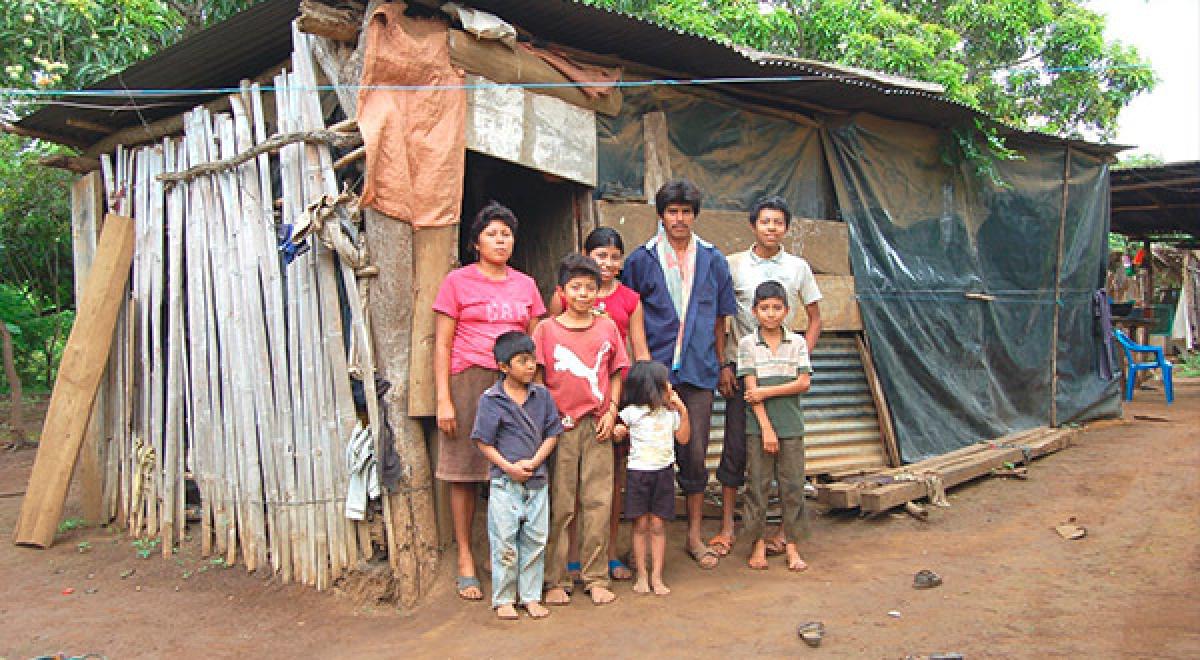
The poverty In rural Peru, it shows a significant gap when taking into account the set of deficiencies that prevent the population from having quality of life.
According to the Multidimensional Poverty Index presented by the University of Lima, 69.3% of the rural population faces at least one structural deficiency that affects their well-being, while monetary poverty in the same area reaches 39.3%. The results are part of “The Economic, Financial and Social Observatory” of said study house.
Guillermo Boitano, director of the Economics program at the University of Lima, explained that this difference reveals the limits of evaluating poverty solely based on spending. “The fact that I have enough income to buy my basic basket does not necessarily ensure that I am not poor,” he noted.
Unlike the monetary measurement, the multidimensional index incorporates variables linked to health, education, housing, basic services, connectivity and employment.
According to Boitano, the divergence between both measurements is especially clear in rural areas, where structural deprivations are deeper.
“It is true, we have a significant number of monetary poor, but there are much stronger and more important structural deficiencies,” he indicated.
Among them he mentioned inadequate access to water and sanitation, the poor condition of housing, the lack of Internet and telephone, unemployment, low monetization and non-attendance at educational centers.
Loreto and Puno
The territorial analysis of the index confirms that these deficiencies do not occur in a homogeneous manner. When comparing regions, Boitano pointed out that Loreto and Puno lead multidimensional poverty, although with relevant differences.
“While, in the case of the jungle, services and connectivity are the central elements, in the case of Puno what we have is habitability and health as important factors,” he explained, highlighting the diversity of deprivations faced by the rural population.
This heterogeneity is also observed when analyzing departments with similar levels of monetary poverty, but with very different incidences of multidimensional poverty.
Boitano cited the cases of Pasco and Huánuco, both with monetary poverty close to 39%, but with multidimensional poverty of 39.1% and 59.8%, respectively. “Not only does the level change, the composition of deprivation also changes,” he said.
The index also allows us to identify different poverty profiles in the country. Approximately 14% of Peruvians are poor both monetarily and multidimensionally, while around 18% are not poor by income, but do face structural deficiencies.
RECOMMENDED VIDEO