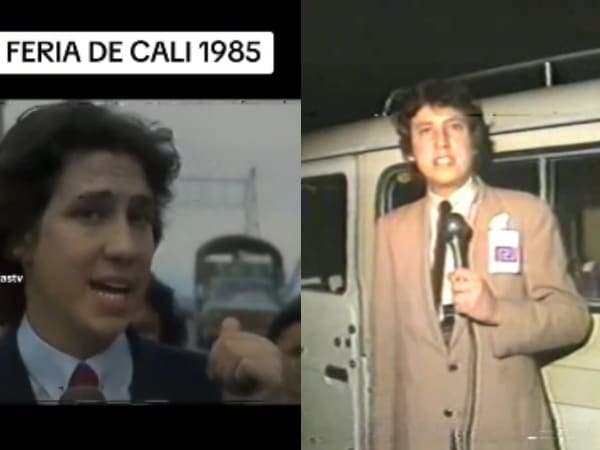
For many young people, Raúl Benoit reappears today in viral videos as the face shown by Cali at the fair, Juanchito and the street; But behind those images there was a journalist who narrated the city without filters and who later paid a high price to investigate the deep country.
News Colombia
Before social networks existed, Raúl Benoit was already building audiovisual memory of Cali. His path, which began as an urban chronicle, later led him to investigative journalism, forced exile and a life marked by risk, truth and craft.
Also read:
For the new generations, Raúl Benoit reappeared as a familiar face in videos that today circulate on networks: the Cali of the fair, the Juanchito bridge as a symbolic border, the rumba, the street, the popular language.
But his story was much more than that of a reporter who showed a city: it was that of a journalist who understood Cali, told it without filters, and then paid the price of investigating the deep country, until he was forced to leave Colombia due to threats.

In the years when there were no social networks or phones recording every corner, Raúl Benoit was already doing something that seems natural today: showing a city with an identity. From Cali, and especially from Juanchito, Benoit narrated a culture that many knew but few knew how to explain.
He told of the fair as a social phenomenon, music as language, the “bridge over there” as a symbol of a Cali that lived night and day, with contradictions, joy and reality.


Those records that resurface today on digital platforms have become a living archive. For young people who did not live through that time, Benoit is today a window to a city that was transformed, but that preserves features that he left forever recorded.
Without intending to, he became an urban chronicler, a narrator who helped establish the memory of Cali when there was still no talk of storytelling or digital identity.
Journalism for the world
Raúl Benoit’s career did not remain on the postcard. As the years went by, his journalism took a turn toward uncomfortable topics: drug trafficking, violence, power, corruption and armed conflict.
That transition took him to national and international stages and to work with Univisión, where his investigative work reached a continental audience.
It was at that point where his life changed forever. Investigations, denunciations and truths told out loud brought real threats. Benoit had to face high-risk episodes that marked his personal and professional history.
The pressure was such that he ended up leaving Colombia and settling in the United States, not by choice, but by survival.

From exile he continued practicing journalism, convinced that telling the truth had costs, but also meaning. Years later, his health was seriously affected by a stroke, which forced him to move away from the cameras and face a long, silent physical battle.
Impeccable work in journalism
This January 30, 2026, Raúl Benoit passed away, closing a life filled with work, risk and memory.
Today, when his name circulates again among young people who discover him in clips of the Cali of yesteryear, his story takes on a new meaning.
Raúl Benoit was not only the man who showed Juanchito, the fair or the street; He was a journalist who understood that counting a territory is also a political act, and that investigating a country can cost exile, health and peace of mind. At Tu Barco, we say goodbye to Raúl Benoit not only as a reference in Colombian journalism, but as a man close to our director, Wilson Barco, with whom he shared vision, conversations and deep respect for the profession.
His legacy is part of the history of journalism that is done from the street, with risk, with context and with memory. Condolence Tu Barco To his family, friends and colleagues, from Tu Barco we send a message of solidarity and respect.
Raúl Benoit will be remembered for what he was: a journalist who told Cali, told Colombia and left his mark on the world.