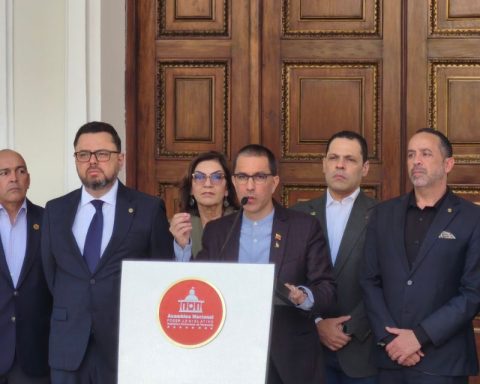
Capriles proposed a payment for pensioners, a salary increase, a review of the tax burden and the elimination of the Hate Law. «Nor you can be afraid of freedom of expression. Let’s show what a new political moment means,” he said.
The parliamentarian of Unión y Cambio, Henrique Capriles, asked for clear signals about the use of income from the sale of oil and assured that the role of the opposition will be to audit and control where the oil revenue will go to avoid corruption.
Capriles Randoski urged the authorities in charge of the national Executive to work in parallel on economic stabilization and the re-institutionalization of the country, democracy, respect for citizen freedoms and the cessation of persecution.
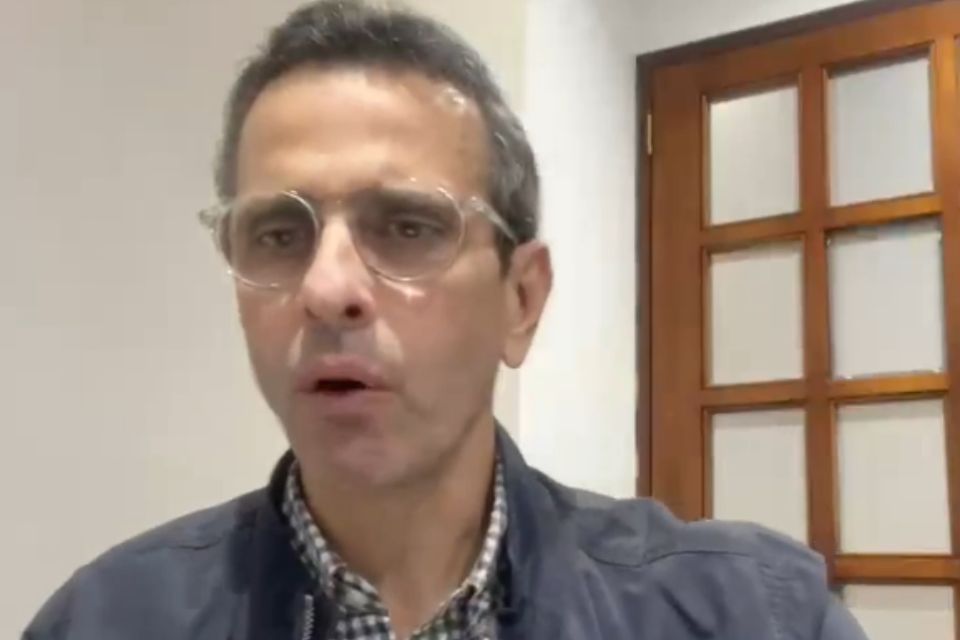
“You can walk and eat gum at the same time,” he said in a live broadcast on his social networks, this Friday, January 30.
Capriles, who has been proposing improvements in income, insisted on the issue in light of the approval of the reform of the Organic Hydrocarbons Law. “What is going to be done with the oil income? Where are those incomes going?” the politician asked himself.
In this sense, he raised four proposals to be considered by public opinion and by the authorities in charge of the national Executive:
-Make a compensatory payment at the end of February for pensioners of the Venezuelan Social Security Institute in the amount of 150 dollars payable at the exchange rate. According to Capriles, they have already drawn up the accounts based on the projection of income that the country is receiving and it is enough to make that payment.
-Immediately adjust, via decree law, the Minimum salary of 150 dollars per month. His proposal contemplates the salaryization of the bonuses provided by the Executive and an indexation clause that protects income from devaluation. This is, he said, an initial adjustment.
-Review fiscal burdens, taxes. It specifically proposes lowering the VAT by two points and leaving it at 14%.
-Eliminate the Large Financial Transactions Tax (IGTF) applied to foreign currency payments. «The time has come to eliminate it, we must give signals beyond reforming the Hydrocarbons Law.
The deputy reported that they are workingcreating a law on a decent and fair salary for Venezuelans that will be presented to the National Assembly for discussion.
Capriles also proposed the elimination of the Law of Hate. «Nor you can be afraid of freedom of expression. Let’s show what a new political moment means,” he said.
Deputy Henrique Capriles pointed out that there is a great expectation in the country that must be heard and attended to.
The proposals denied in the reform
Regarding the discussion and sanction of the reform of the Organic Hydrocarbons Law, held this Thursday the 29th in the National Assembly, Capriles clarified that although they voted for its approval, there were proposals they made in some articles that were denied by the official majority.
“We voted on the law, but we do not agree on all aspects of the law,” he said.
He pointed out that the observations made by the Libertad bench pointed to less discretion of the national Executive and that the control of the National Assembly be incorporated as is done with public interest contracts. «TAll legislation on oil matters always has to go through the approval of the National Assembly,” he commented.
«“These two things did not want to change it,” lamented the parliamentarian, who questioned the discretion and lack of transparency with which Chavismo has managed the oil industry in the country.
«Chavismo destroyed the oil company. “We should be producing 5 million barrels a day and look where we are.”
Despite his accusations, he affirmed that the approved reform is “better than what existed” and, furthermore, “We have to continue working on it because it can be improved.
The opposition reunion
Given the new political reality that the country is experiencing as of January 3, Capriles stated that the democratic opposition must rediscover itself. He condemned the campaigns of attacks within the opposition because they only benefit the ruling party.
“Democratic forces have to meet again because at some point the re-institutionalization process will come so that this ends in a free, agreed upon and respected election…”
In this sense, he pointed out that we cannot continue with positions that weaken the democratic alternative. “The country is different after January 3…There is a whole different expectation here…”
He defended the presence of a sector of the opposition in the National Assembly. “AND“It is very important to have a voice where things are discussed and approved,” said Capriles, alluding to criticism about the illegitimacy of the parliament elected on May 25, 2025.
*Journalism in Venezuela is carried out in a hostile environment for the press with dozens of legal instruments in place to punish the word, especially the laws “against hate”, “against fascism” and “against the blockade.” This content was written taking into consideration the threats and limits that, consequently, have been imposed on the dissemination of information from within the country.
Post Views: 14