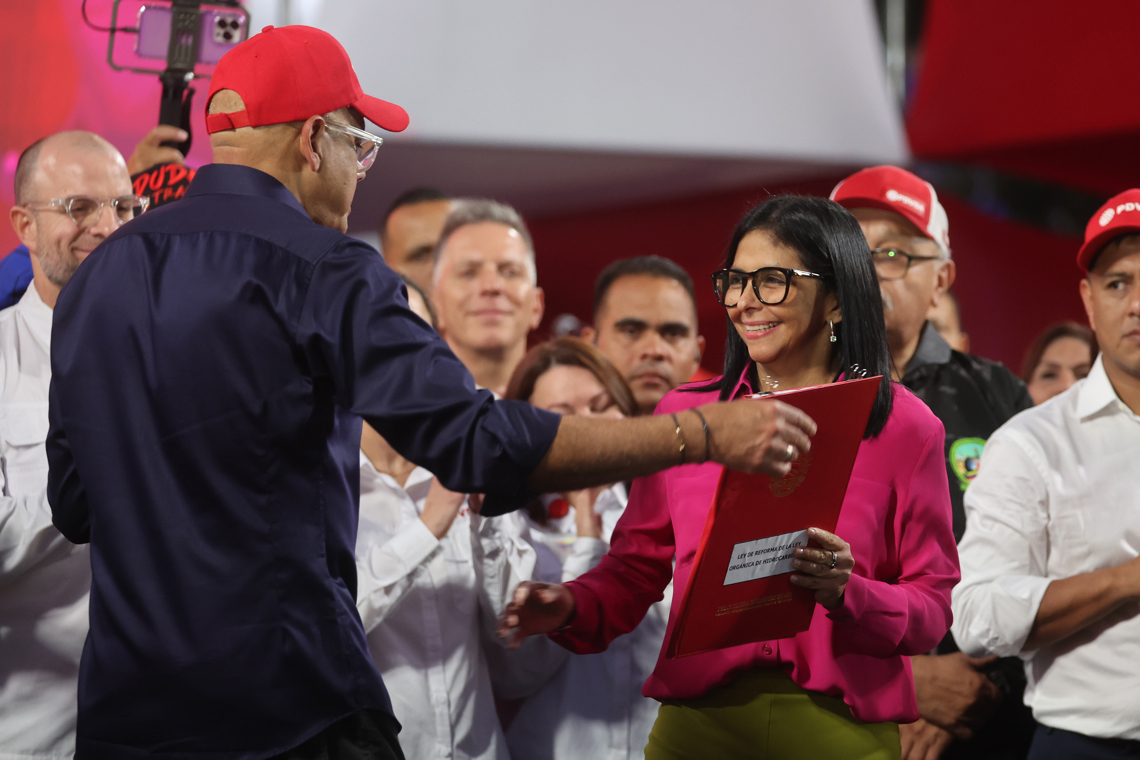
In a session marked by speed and unanimity, the National Assembly of Venezuela, with a large pro-government majority, approved this Thursday the partial reform of the Organic Hydrocarbons Law, a turn in oil policy that significantly contracts state controls over the industry and opens generous facilities to private and foreign capital.
The measure, promoted by the acting president Delcy Rodríguez, seeks to revitalize the ailing crude oil production —now only or less than one million barrels per day— and attract international investment, even with the recognition of international arbitration in investment disputes, which curtails the country’s sovereignty over its key industry.
“Oil under the ground is useless,” says Rodríguez, the parliamentary leader
In the streets, thousands of oil workers paraded through Caracas, in support of the reform, since they expect a rebound in production and an improvement in their meager family economies. “This law will promote the guarantee for our country to be that power that we have always wanted,” said the young worker Jesús Batista during the mobilization.
The ruling party celebrated the approval as a decisive step to reactivate the country’s main source of foreign currency. “Surely there will be a positive explosion of investment, oil production,” said the president of Parliament, Jorge Rodríguez Gómez. “The oil under the ground is useless; what is useful is the oil that is extracted for the well-being and prosperity of all.”
The reform establishes a royalty limit of 30% and grants the Executive the power to set differentiated percentages according to the investment needs and competitiveness of each project. In addition, it makes the direct payment of royalties more flexible and repeals taxes that for two decades had reinforced state control. The investor will assume the operating costs and financing risks, while the State maintains ownership of the deposits.
Interim President Rodríguez has insisted that the new legislation will be “respectful of national sovereignty”, although adapted to international practices in the sector. “It is a clear law, with legal certainty, with standards, adapted to international practices,” he stated in his message on the state of the nation on January 15.
“A blow to oil sovereignty”; “A historical setback,” some critics allege
Not everyone celebrated the reform. The former Minister of Petroleum and former president of PDVSA, Rafael Ramírezdescribed the approval as the “eradication” of Hugo Chávez’s oil policy and the repeal of the 1976 nationalization. “It is about erasing with one blow the national achievements of almost 70 years and aims to cancel the country’s oil nationalist thinking,” he wrote in his account on X.
Carlos Andrés Pérez, president of Venezuela between 1974 and 1979, carried out the nationalization of oil in 1976 and created the state-owned Petróleos de Venezuela SA (PDVSA), thereby putting an end to the direct exploitation of transnational companies. Although the measure is usually associated with socialist policies, Pérez was not a left-wing leader, but rather a leader of the social democratic Democratic Action party that promoted nationalization as a project of modernization and economic sovereignty.
Ramírez, who directed the state company between 2004 and 2013 and is now in exile accused by the Chavistas of corruption and bribery by embezzling millions of dollars, maintained that the reform eliminates state control over the Orinoco Oil Belt and allows private companies to directly market crude oil, which was previously reserved for the State by the Constitution.
He also criticized the inclusion of international arbitration, considering that jurisdictional sovereignty is “ceded.” “We now need to know to whom the Venezuelans’ oil is delivered,” he warned.
For its part, the Communist Party of Venezuela (PCV), which is being intervened by the Supreme Court of Justice, agreed to point out the reform as a “historical setback.”
In Venezuela, the “judicial intervention” of parties has been used to neutralize organizations critical of the ruling party, reducing their capacity for action and effective opposition.
In a statement, the PCV denounced that the new law “dismantles oil sovereignty” and violates article 302 of the Constitution by allowing private companies to operate directly in primary activities—exploration, extraction, transportation and storage—without state participation.
The training also warned about the possibility of compensating companies in kind, through volumes of hydrocarbons for direct marketing, which would mean an “effective transfer of oil revenue and a loss of economic sovereignty to the benefit of private capital.”
The PCV also questioned whether contractual disputes can be resolved outside of Venezuelan courts, exposing the country to international arbitration proceedings.
“It limits itself to requiring a simple notification, emptying Parliament’s control and audit functions of their content,” said the party, which considers that the management of joint ventures will be subordinated to criteria of business profitability and not to the national interest.
US Treasury Ban
The reform occurs in a scenario of intense pressure from the United States, which acts as an extraterritorial power controlling Venezuela. In this sense, the Treasury Department issued a general license that prohibits Venezuelan oil transactions with Russian, Chinese, Iranian, North Korean and Cuban companies.
The document establishes that any entity that sells or supplies Venezuelan oil to countries other than the United States must submit periodic reports and prohibits the use of sanctioned vessels to transport crude oil.
Treasury Secretary Scott Bessent stated that Washington will manage the sale of oil and “other resources” from Venezuela, following the capture of former President Nicolás Maduro by US troops.
President Donald Trump declared that his government now controls the Venezuelan oil industry and manages revenue distribution. According to the president, the arrival of large energy companies will allow the Caribbean country to generate “unprecedented profits.”
A historic turn in oil policy
The reform approved by the National Assembly represents a radical change with respect to the nationalization policies promoted by Chávez in 2006 and 2007, when mixed companies were created under majority control of PDVSA and the Orinoco Oil Belt was nationalized.
At that time, companies such as ExxonMobil and ConocoPhillips left the country and went to international courts, while Chevron accepted unfavorable conditions to partner with the state-owned PDVSA.
Today, the interim government is committed to reversing that policy and offering guarantees to the major American oil companies, which until now had hesitated to return to the country.
With reserves estimated at 303 billion barrels, Venezuela has one of the greatest oil wealth in the world, but faces a prolonged economic crisis, aggravated by falling prices, external debt and international sanctions.