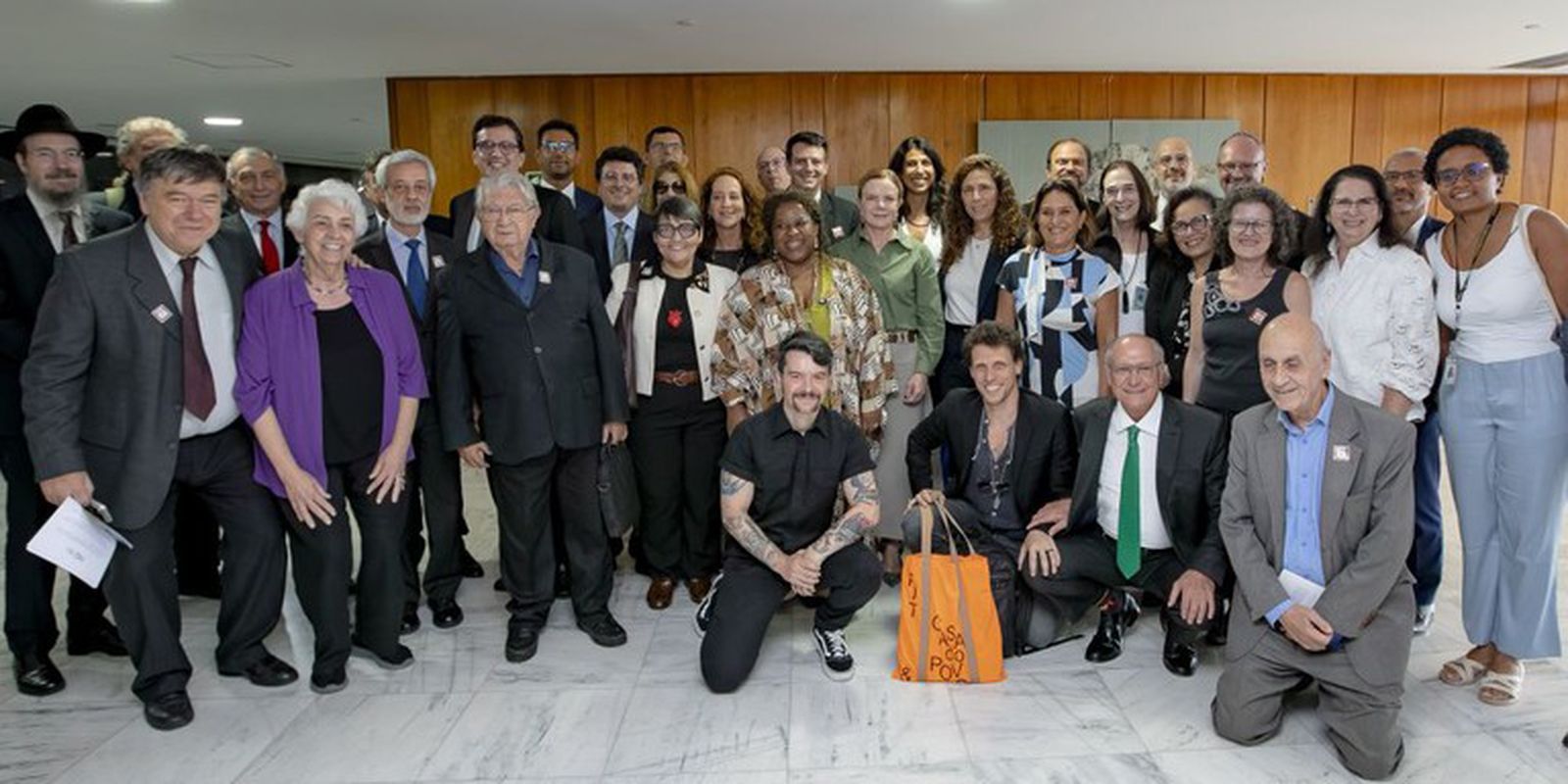
Representatives of the Executive Branch and different segments of the Jewish community met this Wednesday (28), at Palácio do Planalto, to discuss strategies for combating anti-Semitism in Brazil, with an emphasis on the role of education as a fundamental instrument for preventing hate crimes and strengthening democracy.
The meeting brought together researchers from universities in five states, rabbis, representatives of institutions such as the Curitiba Holocaust Museum and social movements, including Jews for Democracy and Casa do Povo, as well as several members of the federal government.
The acting President of the Republic and Minister of Development, Industry, Commerce and Services, Geraldo Alckmin, highlighted the importance of dialogue and the construction of concrete proposals to combat all forms of discrimination and hatred. According to him, the contribution of the Jewish community to the country’s development is broad and historic, covering areas such as science, culture, medicine and business activity.
“We will work so that we can advance even further, providing not only justice to the Jewish community, but mainly promoting values that are essential to civilization,” he stated.
>> Follow the channel Brazil Agency on WhatsApp
The Minister of the Secretariat of Institutional Relations, Gleisi Hoffmann, highlighted that the fight against anti-Semitism is part of the Lula government’s commitment to confront all forms of prejudice and discrimination. She also recalled that President Luiz Inácio Lula da Silva was the first Brazilian president to make a state visit to Israel, in 2010, and that Brazilian diplomacy defends peace and the coexistence of two sovereign states, Israel and Palestine.
The Minister of Human Rights and Citizenship, Macaé Evaristo, highlighted the direct relationship between the preservation of democracy and combating expressions of hatred, warning of the risks that intolerance poses to democratic institutions.
For the president of the Israeli Confederation of Brazil (Conib), Claudio Lottenberg, the government’s initiative occurs at a critical moment, marked by the growth of anti-Semitism in several parts of the world. He classified the meeting as essential to give visibility to the problem and reinforce the need for coordinated actions between the State and civil society.
At the meeting, among the various points raised, education and the importance of work in combating hate crimes were at the center of the debates. Minister Gleisi Hoffmann highlighted that comprehensive educational policies are fundamental to confront the current scenario of intolerance. “An educational proposal can be broad and transformative,” he stated, highlighting that the meeting had already been planned since the previous year and was not motivated by recent episodes.
Professor at the University of São Paulo, writer and historian Lilia Schwarcz, who participated remotely, reinforced that education is one of the most effective tools in combating anti-Semitism. For her, although reporting and judicialization are fundamental, they are insufficient without structured educational policies. “Education is a powerful force in terms of producing literacy”, he stated, criticizing the fact that the topic appears occasionally in school curricula, generally restricted to the study of the Holocaust in elementary school.
According to Lilia Schwarcz, confronting anti-Semitism must be understood as a challenge to Brazilian democracy, and not just as an issue that affects the Jewish community. She defended the expansion of debate in schools and coordination with the Ministry of Education to build public policies based on empathy and recognition of diversity.
Brazil maintains a historic commitment to repudiating anti-Semitism and all forms of ethnic, racial and religious discrimination. This position is supported by the Federal Constitution of 1988, which guarantees religious freedom, and by Law No. 7,716/1989, which criminalizes practices of discrimination and prejudice.
In addition to national legislation, international treaties to which Brazil is a signatory, such as the Universal Declaration of Human Rights (1948) and the International Convention against Racial Discrimination (1965), reinforce the legal framework to combat anti-Semitism and other forms of discrimination.