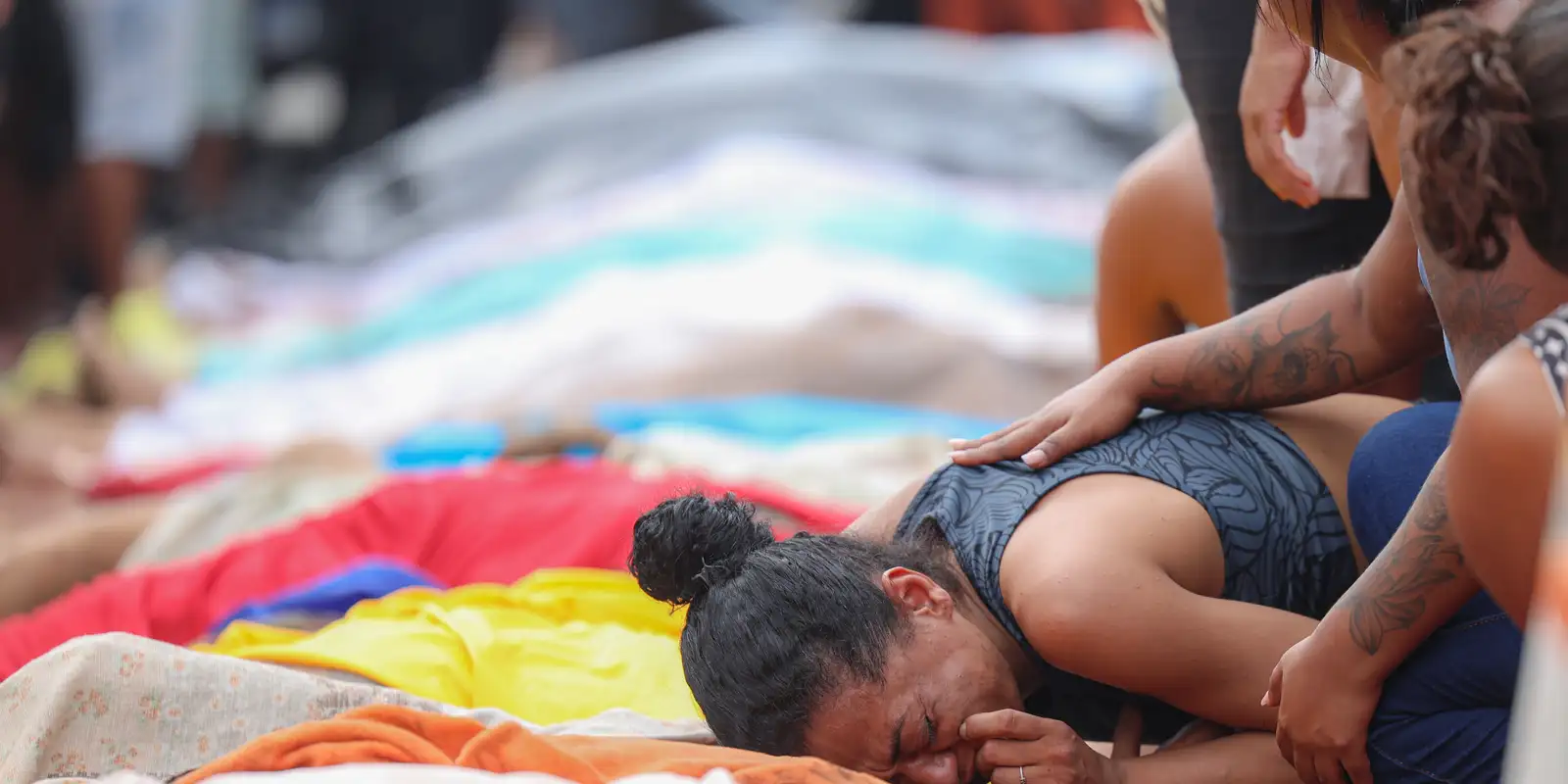
The woman photographed while closing her eyes on her husband’s corpse amid a line of bodies has a name: Fernanda da Silva Martins.
The image of the photojournalist Brazil Agency Tomaz Silva, with the tears of his 35-year-old widow, traveled the world and was republished in newspapers and websites in the country and abroad to portray the most lethal police operation in the history of Rio de Janeiro.
Launched by the government of the state of Rio to comply with warrants and curb the criminal faction Comando Vermelho, Operation Containment left 122 people dead between October 28 and 29, 2025, including five police officers.
The confrontation had repercussions throughout the city and extended into the early hours of the morning in Serra da Misericórdia, an uninhabited region between the Alemão and Penha complexes, where relatives of dead and human rights activists report that there were signs of execution.
Police authorities claimed, at the time, that the dead were criminals who reacted and made attempts on the lives of their agents. For the governor, Cláudio Castro, the incursion was a success.
After the action, residents of Complexo da Penha removed around 80 dead people from a forested area and lined them up on a street in Vila Cruzeiro, where they remained for hours, in front of neighbors and family, until they were taken to the Legal Medical Institute, in the city center.
>> Under factions and operations, the favela population experiences trauma and falls ill
Out of respect for Fernanda’s condition, at the time of the photo, the Brazil Agency preferred to avoid approaching relatives of the victims, following the editorial policy from the Brazilian Communication Company (EBC). After these three months, the report found her again in the Complexo do Alemão community where she lives with three of her four children, aged 15, 11 and 8.
Her image made by Brazil Agency It depicts his greatest moment of grief, he says. Despite the conditions in which she was photographed, she said that “her pain gained importance” with the repercussions.
“There, they felt my pain. Many people [me] crucified, but others called me and were moved. The photo had a very real feeling,” he said.
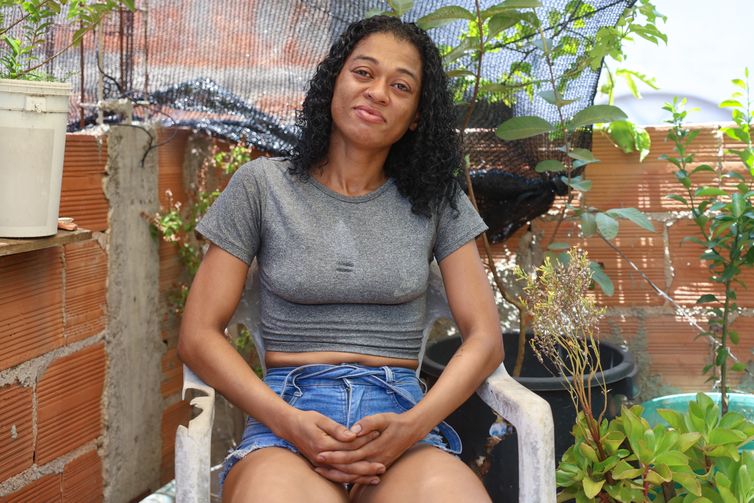
Fernanda da Silva Martins during an interview with Agência Brasil, in Complexo da Penha, in the north of Rio de Janeiro. Photo: Tomaz Silva/Agência Brasil
“It doesn’t matter if they thought I was his mother. I lost the love of my life, the father of my children, the man who gave me hope.”
When remembering the moment, she is saddened by the state of the body she said goodbye to. She says that her husband was a member of the faction, but the corpse had signs that went beyond what was expected in an exchange of gunfire.
“He didn’t die [só] of shooting. He was stabbed in the arm and his neck was broken. They hit me later, in the back”, he revealed. “But I didn’t turn to anything or anyone, I have no support”.
Depression and hunger
Since losing her partner of 14 years, her first challenge of the day is waking up. Fernanda suffers from depression and panic syndrome and was hospitalized after a suicide attempt since becoming a widow.
“I went from a size 44 to a 36. I go days without eating, I cry, I faint, it’s been difficult,” he said.
It is her two youngest children, Anna Clara, aged 11, and Ivan, aged 8, who keep her on her feet, she says. The eldest daughter, aged 18, lives with her grandmother, and the second oldest, aged 15, lives with her father.
“Today, [juro] By God, I rose by the strength of mercy. The boy had nothing to eat. He woke me up: ‘Mommy, I’m hungry’. I haven’t slept for two days, I live on medication.”
What little the family has comes from Bolsa Família, but, with two children at home, the food runs out quickly.
“My husband, before, paid for everything. Now, we live more on noodles, because I really don’t have any.”
In order to support her family, the fact that Fernanda only has seven years of study, with incomplete primary education, and has never had a formal job, also weighs heavily.
“But I’ve worked. I looked at an elderly lady, I worked in a cafeteria, I worked as a day laborer with my mother. I worked at carnival, selling beer. This year that I’m not going, I still can’t face the world, you know?”, he explains. “I also had four children and always took care of them.”
Without lunch for her children during the school holidays, money became even shorter and one of the solutions was to send Clara to her paternal grandmother’s house, in São João de Meriti, in Baixada Fluminense.
The boy who remained, Ivan, takes a bath in a barrel to alleviate the feeling of the latest heat wave in the city and begs to go to the beach.
“He asks: ‘Mom, how much is the ticket for me to go?’ I answer: ‘it’s expensive, there are four tickets, I can’t afford it'”.
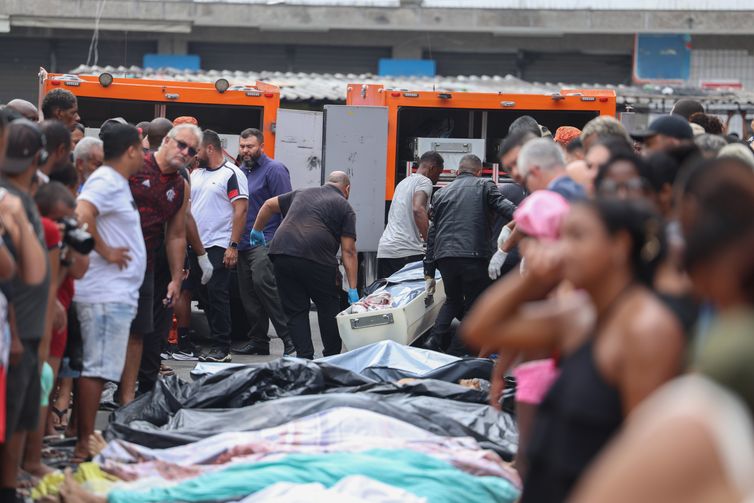
Dozens of bodies in Praça São Lucas, in Penha, north of Rio de Janeiro. Operation Containment. Photo: Tomaz Silva /Agência Brasil
Relationship
When she started having a relationship with her ex-husband, Leonardo Fernandes da Rocha, she says she didn’t know he was part of the faction’s chain of command. Over time, the family began to depend on this income.
“I worked at the bakery and earned a salary. But everything was mine. From the gate onwards, it was all him. He put food in the house, paid the bills, treated my older children well. There was nothing missing. Internet, food, gas, clothes, it was all him, I spent it on myself”.
The most difficult time they went through was Ivan’s cancer diagnosis, aged 3 at the time. Fernanda says that, together, she and Leonardo tried to draw up plans for him outside of crime, but were unable to find any other way to guarantee sufficient income for survival and treatment.
“My husband wanted to get out of that life. He sold his motorcycle, he sold his rifle, he wanted to sell our house to pay for Ivan’s treatment, but it wasn’t possible. The doctor told him: you can even sell your soul, but it won’t work. [para custear o tratamento]. So, he became [no tráfico]and I was overlooking [o tráfico e as traições]. I prayed,” he lamented.
After a long wait and even legal action, she says that the case was finally forwarded to the National Cancer Institute (Inca), and surgery saved her son’s life.
“My son was hospitalized for months. Leonardo [o pai]despite him jumping up and down, calling me crazy, crazy, crazy, because I went after him, he supported me, paid for the medicine and, on the day of the operation, he arrived [ao hospital] in ten minutes”, he recalled.
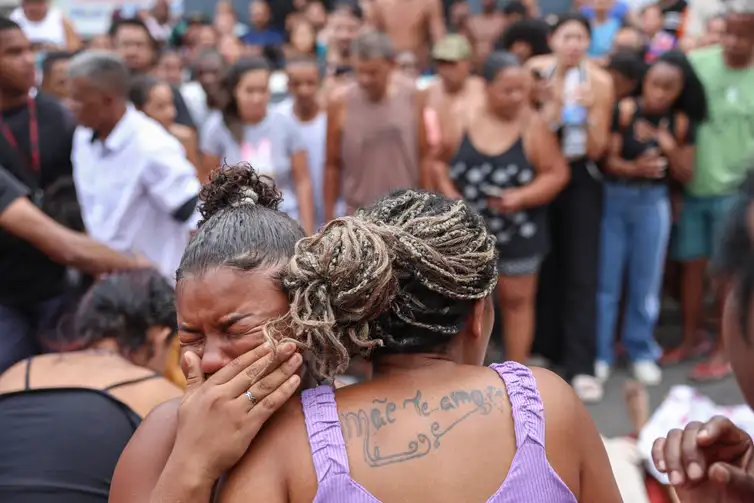
A woman cries in front of dozens of bodies in Praça São Lucas, in Penha, north of Rio de Janeiro, after Operation Containment. Photo: Tomaz Silva /Agência Brasil
Parental support
Fernanda received the report on the roof of her parents’ house. With passion fruit trees, a banana tree and scented with herbs, such as basil and mint, the space is the coolest in the house, maintained by Fernanda’s father, Jocimar, a 55-year-old salesman.
“There are no birds here, but a butterfly comes all the time”, she jokes, as she tries to protect herself from the intense sun.
Her parents’ house is one of the simplest on the street, she says. “Our house is the poorest on the street because, for a long time, my father was a drug addict.”
“Nothing stopped here. He sold everything. He took credit from Casas Bahia and sold furniture, television, tiles… Mine [primeira] daughter was going to have a birthday party. Then, he sold her entire outfit, a little denim outfit and a pair of gladiator sandals. Afterwards, I believe, because of this story, about my daughter, he regretted it and stopped.”
What happened is almost 20 years old, and Fernanda has long since forgiven it. It is her father and mother, Sônia, a 59-year-old day laborer, who help her when there is no food on the table.
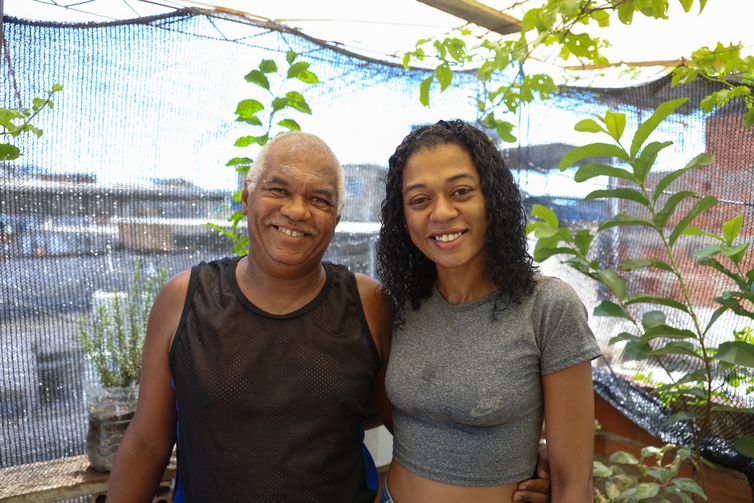
Retiree, Jocimar Martins and his daughter, Fernanda da Silva Martins, during an interview with Agência Brasil, in Complexo da Penha, in the north of Rio de Janeiro. Photo: Tomaz Silva/Agência Brasil
“If it weren’t for my family, I wouldn’t be here anymore. And they help as much as they can.”
Regarding the future, Fernanda dreams of leaving Alemão.
“I wanted to give my children a better life. It’s not that it’s bad here, but I wanted my children to advance, to have a future that I didn’t have,” he said.
She would also like to set up a small salon, “do manicures and pedicures.”
“I’ve already taken an eyelash and eyebrow course, I have a diploma, I just need to put it into action.” Today, the concern is living one day at a time and putting food on the table while the holidays last.