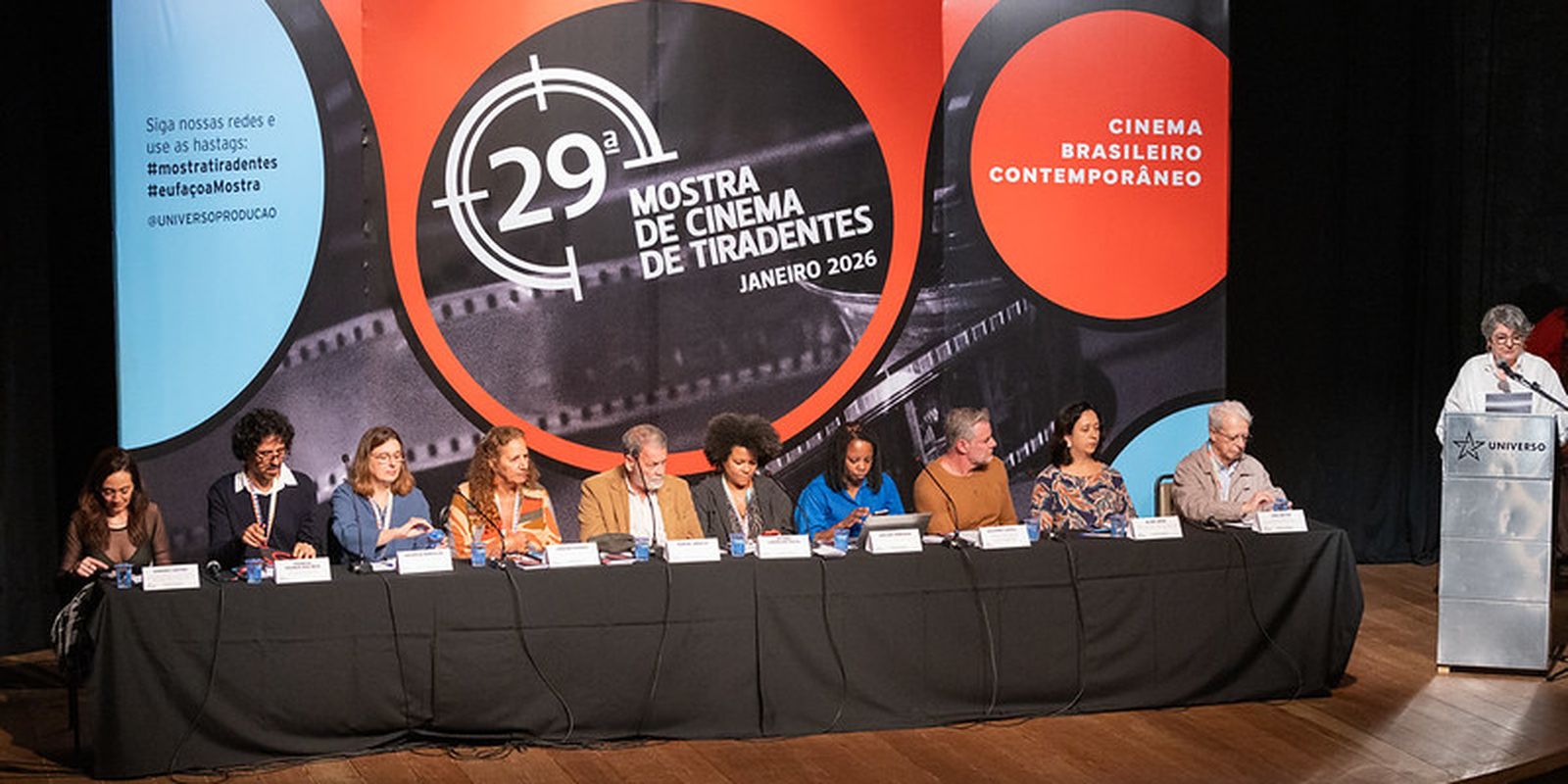
The Fourth Tiradentes Forum ended this Wednesday afternoon (28), during the Tiradentes Film Festival, with the public reading of the Tiradentes Charter, a document that summarizes consensus, urgency and priority guidelines for the Brazilian audiovisual sector. Among the 16 topics that make up the letter, the regulation of video on demand (VOD) platforms appears as the main urgency, reflecting a debate that spanned the forum’s entire programming.
The reading of the document marked the end of four days of meetings that brought together audiovisual professionals, representatives of public authorities, researchers, students and cultural agents from different regions of the country. For the general coordinator of the Tiradentes Exhibition, Raquel Hallack, the letter expresses a collective accumulation built over the forum’s editions.
“The Tiradentes Charter is the result of a process of listening and maturing of the sector. It is not born from a single debate, but from years of dialogue. VOD regulation comes first because it is a historic demand and because we understand that, without it, many other policies are weakened”, said Raquel.
According to her, although the document lists 16 guidelines, there is a clear recognition that some points need to move forward more quickly given the current political and economic scenario. “The letter does not disperse the fight. On the contrary, it organizes priorities without losing the complexity of the sector”, he added.
The coordinator of the Tiradentes Forum, Tatiana Carvalho Costa, highlighted that the discussion on streaming has advanced by incorporating the reality of Brazilian independent platforms, which are often invisible in legislative debates.
“There are two central points. One is how independent platforms enter into the regulation of streaming, which is a specific discussion within this umbrella of consensus that we managed to build. The other is to think, together with this regulation, what is possible to do based on the federative pact and existing public policies”, he explained.
Tatiana highlighted that, unlike large global platforms, independent platforms play a strategic role in the circulation of Brazilian cinema.
“These platforms are the guardians of independent Brazilian cinema. They are a fundamental showcase for short films, for films that play in Tiradentes and for the formation of diverse audiences. Many are free or have lower prices, which makes them more accessible. That’s why we defend a coalition around them”, he stated.
The Tiradentes Charter also points out ways for mechanisms such as the Aldir Blanc National Policy (PNAB) and state and regional funds to consider independent streaming platforms as a structuring part of diffusion policies.
“Today, when talking about streaming, everyone only looks at the big companies. Brazilian platforms are outside this radar”, observed Tatiana.
Training
For producer Débora Ivanov, also coordinator of the Forum, the meeting has a role that goes beyond the formulation of proposals and is consolidated as a space for political and institutional formation in the sector.
“The forum also collaborates with the training of new generations, so that they have a purposeful role in building the future of audiovisual. It is these generations that will continue the policies and develop the sector in the coming years. It is very beautiful to see all the generations gathered here. This is unique in Tiradentes”, he said.
Other themes
The Tiradentes Charter reaffirms, among its priority guidelines, the urgency of voting on bills that deal with the regulation of streaming in the National Congress, the defense of the intellectual property of Brazilian works, the strengthening of the Audiovisual Sector Fund, the decentralization of public policies and the integration of cinema into education.
According to Raquel Hallack, the letter is an instrument of pressure, but also of proposition. “It points to the future that the sector wants to build, and that needs to start now”, he concludes.
Check out the full Film Festival schedule at event website.
*The reporter traveled at the invitation of the event organizers