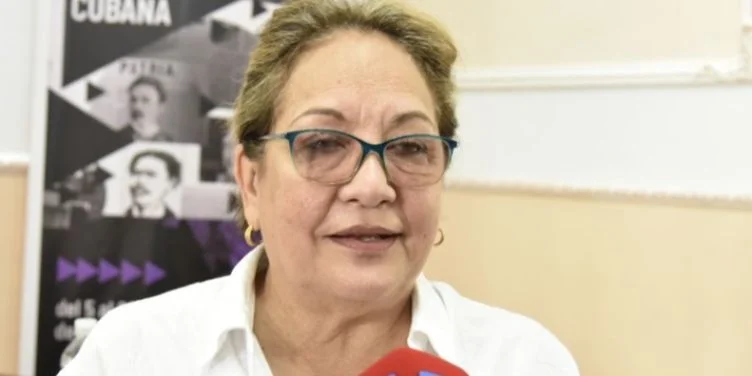
Rodríguez Derivet acknowledged his recent historic mistake, but evaded the center of the criticism: his statements called “cynical.”
MIAMI, United States. – Cuban official media journalist Arleen Rodríguez Derivet, deputy director of the space Round Table and close friend of the Cuban ruler, Miguel Diaz-Canelreacted this Tuesday to the controversy unleashed by his statements about José Martí and electricity with a partial apology and a discursive turn towards political confrontation.
Although He stated in a Facebook comment Having apologized this morning on her radio program, the official spokesperson avoided focusing on the content of the public criticism and, instead, portrayed the episode as a hate operation by political adversaries, whom she accused of insulting her and “dragging” her name and whom, in addition, she subjected to an ideological interrogation.
In his publication, Rodríguez Derivet stated that he was not coming to defend himself “because there is plenty[ba] try”, but he immediately placed himself on a level of justification, emphasizing that his phrase was “more like a comment in an informal conversation than a statement.” According to his version, what he said was that Martí “who did not know electricity, wrote without it things that we would not even write with all the light in the world.”
Rodríguez Derivet recognized the historical error, but evaded the center of the criticism: his statements called “cynical” due to the serious energy crisis that the Island is going through and his alleged “contempt” for Cubans, who endure up to 20 hours or more of blackouts a day, depending on the region of the country where they live.
The central movement of the reaction is political: it turned a controversy over rigor and public discourse into a dispute between sides. To those who “love” her, she offers an explanation and apology; To those who “hate” her, she attributes the criticism “for no other reason than the unreason of being a soldier on the opposite side of her political ideas.”
From this framework, the controversy stops being a debate about a specific statement and becomes, in its version, an expression of partisan hostility. In the same tone, he criticized the “debate fueled by hate,” which he says he “hates,” but at the same time he asks a battery of questions that do not seek to clarify the original fact, but rather to place his critics in the dock: “Have you already spoken out (…) against the assault on Venezuela (…)?”; “Have you even published anything to denounce how Trump and Rubio (…)?”; “Have you already spoken out against the ICE murders (…)?”
The strategy is obvious: move the center of the controversy towards a list of causes and enemies, and suggest that those who criticize it have no moral authority if they do not share those positions.
The publication also suggests a theory about the late circulation of the fragment: “Why now if the program was broadcast several times on RT [Russia Today] three months ago?” Without providing evidence, he insinuated that there is intentionality in the rescue of the phrase. Later he reinforced that idea by linking the episode to the Torch March: “Or could it be (…) that we have to divert the conversation against us so that we do not see (…) the Torch March, anti-imperialist like Martí (…)?” In that formulation, the criticism would not only be unfair: it would be functional to an operation “against us.” The effect is twofold: It victimizes and, at the same time, shields itself from questions, because it frames them as part of a campaign.
With his comment, Rodríguez Derivet was responding to the publication of a colleague of his, the journalist, also an unofficial spokesperson for the Cuban government, Abdiel Bermúdez Bermúdez, who published this Tuesday a backup message which, on the one hand, seeks containment and, on the other, preemptively attacks critics.
Bermúdez admitted the error—“Arleen was wrong”—but focused the emphasis on the lynching: he spoke of “murder of reputation” and even resorted to disqualification (“the flatulence of other people’s hatred”). His defense relied more on loyalty and the epic nature of the siege than on a journalistic evaluation of the event.
A relevant point of her support is the normalization of closeness to power as part of the communicator’s public file: “Arleen has not kept quiet about her friendship with the president, long before 2018.” In a media ecosystem where editorial independence is a key indicator of credibility, “friendship with the president” is not a minor detail; and Bermúdez presents it not as a conflict of interest, but as proof of personal transparency.