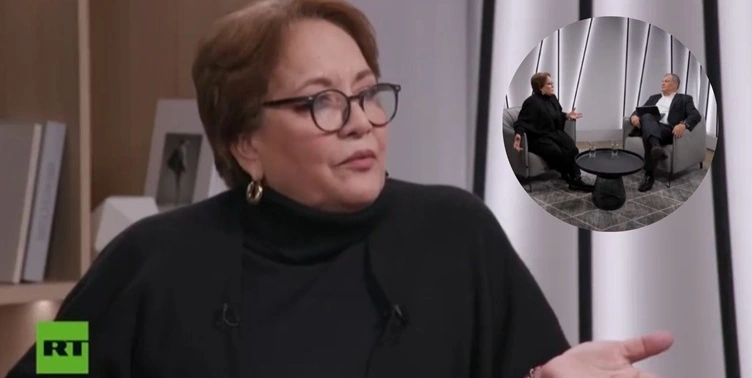
The regime’s journalist tried to put the blackouts in Cuba into perspective, in the midst of an electricity crisis marked by prolonged outages that have affected millions of people for years, and received a surprised response from Rafael Correa.
MADRID, Spain.- A fragment of a television interview between the official journalist Arleen Rodríguez Derivet and the former president of Ecuador Rafael Correa circulates on social networks and has caused indignation among Cubans, by evidencing the cynicism and disconnection of one of the main spokespersons of the regime in the face of the reality experienced by the population subjected to prolonged blackouts for years.
The exchange occurred on the program Talk to Correabroadcast by RT en Español last November, and has gone viral this week, at a time when large areas of the country endure daily power outages that frequently exceed ten and even twelve hours, with small children, the elderly and the sick exposed to extreme heat, and with serious effects on access to water and cooking of food.
During the conversation, when referring to complaints about the lack of electricity in Cuba, Rodríguez stated:
“Someone told me: ‘the blackout is terrible’. I said: look, José Martí did not know electric light and he was a genius, he wrote like the gods; I wish I could write a line like Martí with the light on.”
Correa’s response showed surprise at the approach: “But, Arleen, we are in the 21st century.”
The phrase of the conductor of spaces like Round Table It was interpreted by numerous users as a sign of contempt for the daily suffering of millions of people who live without refrigeration to preserve food or medicine, without ventilation in the middle of summer, without regular water pumping and with enormous difficulties in preparing food in their homes.
The comment has also been questioned for its historical inaccuracysince José Martí lived in cities like New York when electric lighting began to expand and left a record in his writings of the technological development of his time.
There are direct references in the work of José Martí himself that refute the claim that he did not know electric light. In a chronicle published in The Nation from Buenos Aires on August 15, 1883, the Apostle wrote: “Beautiful electric light! They do well, since it is the law that analogous symbols go together, to illuminate the Brooklyn Bridge with the light of the stars! Enter those aerial avenues, when everything rests, and with the soft light of the stars the electric lamps shine on the subtle wire ropes.” The text, collected in Volume 9 of his Complete Works by the Martí Studies Center, confirms that Martí not only knew electricity, but was a witness and chronicler of the technological advance of his time.
Among the numerous reactions of denunciation on social networks is that of the theater director Ulises Aquino Guerra, who described the comparison as offensive and manipulative. “You have to be very cynical, very evil and stupid, to justify the blackouts by turning to the Apostle and his genius. Written with candlelight. You have to be very abject and very pusillanimous to take Martí out of context,” he wrote. In his publication, he added that “nothing justifies what we Cubans are experiencing.”
However, the problem goes beyond factual error. The comparison is an attempt to minimize a structural crisis caused by decades of mismanagement, disinvestment and abandonment of the national electro-energy system, the direct responsibility of a government that has not guaranteed a basic service and that has normalized precariousness.
Rodríguez Derivet is one of the staunchest defenders of the Cuban regime. To defend “the so-called historical leaders of the Revolution” or the most anti-popular measures of the regime, as well as to launch diatribes against opponents, independent journalists and other agents of Cuban civil society, she has used practically all the media at her disposal: the newspapers, radio, television and official propaganda websites.
The reappearance of the video has revived the debate about the role of state media and figures such as Arleen Rodríguez, perceived by large sectors of citizens as spokespersons for a narrative that justifies the collapse and seeks to turn into resignation what is actually the result of inefficiency, abuse and the lack of political will to offer solutions.