The president José Jerí publicly assured that his government would evaluate the so-called procrime laws through a commission of specialists. However, official documents of the Ministry of Justice (Minjus) reveal that, almost two months after that announcement, no technical team has been formed, there is no resolution to support it and there are no progress reports or work minutes to support said process.
The information was provided in response to a request for access to public information presented by lawyer Marie Ayasta. In official memoranda, he himself Ministry of Justice acknowledges that it has not participated in any technical evaluation of the questioned standards and that it does not have documents proving the existence of a commission.
YOU CAN SEE: José Jerí loses citizen support: his approval falls to 33%, according to the IEP
The contrast is direct with the statements of José Jeríwho in December admitted having supported these laws when he was president of Congress and stated that he was willing to correct them. Along the same lines, he maintained that his management would promote a review with experts to determine possible modifications.
So far, the only thing that the Justice sector records are two academic conferences held at the end of 2025. There was no formal formation of working groups. Nor guidelines, official conclusions or regulatory proposals. For the State, the evaluation process that the president announced simply does not exist.
YOU CAN SEE: Company related to Zhihua Yang won contract with presidential office: supplier visited the Palace 3 times
Minjus documents confirm the lack of a commission to evaluate pro-crime laws
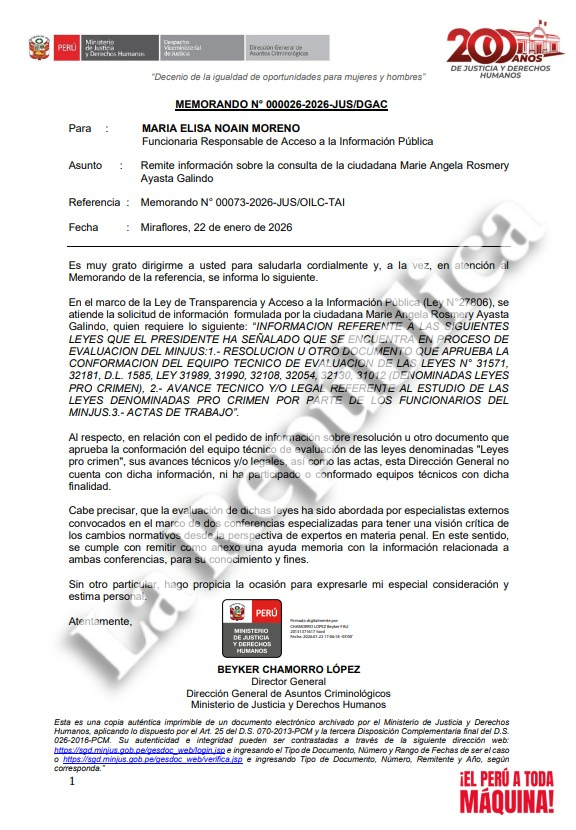
Memorandum No. 000026-2026-JUS/DGAC, signed by the general director of Criminological Affairs, indicates that there is no “resolution or other document that approves the formation of the technical team” in charge of reviewing the procrime laws. There are also no technical or legal advances prepared by sector officials.
In the same letter it is stated that the General Directorate has not participated in any evaluation group and that no work minutes, preliminary reports or institutional recommendations have been produced. The response was issued within the framework of the Transparency Law.
YOU CAN SEE: Government of José Jerí postpones for the second time the creation of the National Citizen Security Plan
As the only precedent, the Minjus mentions two specialized conferences held in November and December 2025. Both were academic in nature and had a hybrid modality. They were not part of an official commission nor did they generate administrative decisions.
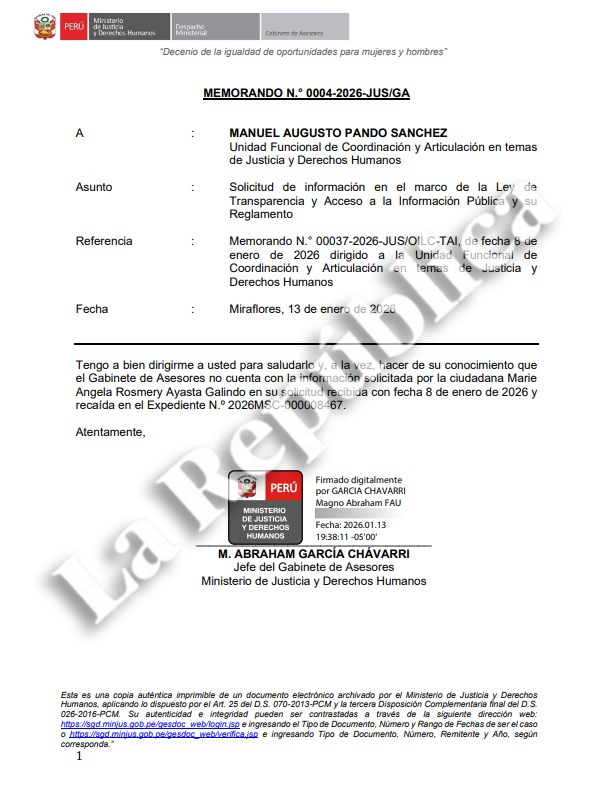
Another memorandum, No. 0004-2026-JUS/GA, confirms that the Cabinet of Advisors also does not have information about the alleged commission. This document states that no ministry office has records of a formal evaluation process of the questioned standards.
YOU CAN SEE: Vice Minister of Justice Shadia Valdez assumes the temporary presidency of the INPE
Merie Ayasta, lawyer: “Minjus is not making progress in the in-depth evaluation of these so-called pro-crime laws”
Lawyer Marie Ayasta explained that her request to Ministry of Justice arises directly from what was announced by José Jerí on the formation of a commission to evaluate the so-called procrime laws. “As a result of what the president pointed out, I do believe (…) that there is an aspect that must be developed internally in the modification of this type of laws,” he said, specifying that the president himself stated that specialists would be summoned to review said regulations.
According to him, he requested the information to find out if that announcement had gone from the political level to the administrative level. “I requested the document to know what the progress of this initiative was,” he indicated, after remembering that Jerí said that the evaluation would be in charge of the Justice portfolio. The answer, however, was that there is no commission or formally constituted technical team, as indicated in the sector memoranda.
YOU CAN SEE: José Jerí’s unreal figures: statistics on citizen security are biased
Ayasta stressed that what has been held are conferences, but that these are not equivalent to an institutional evaluation process. “Yes, a series of conferences have been held that are reflected in the documents that have been given to me, but what surprised me is that it has remained there,” he stated. He added that there is no record of results or a subsequent route: “There has to be consistency in carrying out and looking for what the objective is, what the result of these conferences is.”
From his point of view, the absence of a formal commission shows that the Minjus has not started the review of the standards. “On this issue specifically, which had been transferred to the Justice portfolio, there is no progress in the in-depth evaluation of these so-called pro-crime laws,” he said. And he concluded that this lack of action should be explained by the Executive: “This result that the specialists have reached should be material so that positive action can be initiated by the government.”