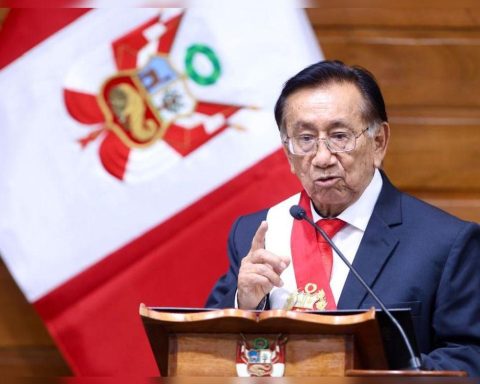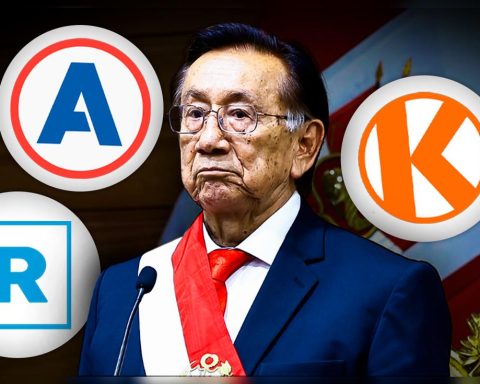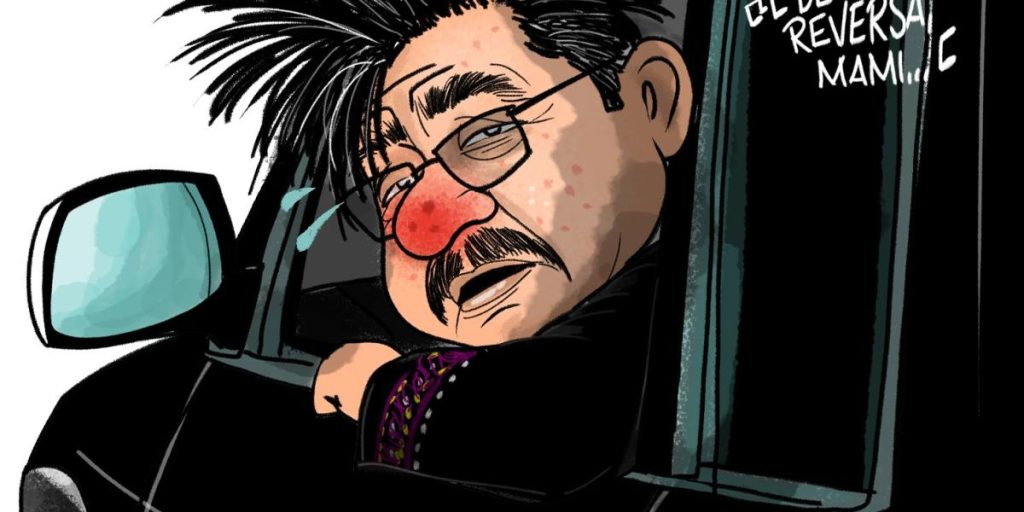
However, the visit, hooded, to a Chinese businessman began to discolor the president. Is it the ghost of Sarratea that continues to haunt you?
It would seem. The president is going to curse wearing that hood for a long time. He projected a sordid image that blurred the initial sympathy he generated. Someone said that politics is, many times, the art of disguising particular interest as general interest. This was how the president tried to justify himself; “Sometimes you do good things that seem bad,” he said. And he argued that he was coordinating the celebration of Peru-China Friendship Day. Today, everyone is wondering: what was businessman Yang looking for from the president and the Minister of the Interior?
How to explain the president’s behavior? Will it be emptied, censored? What would be Jerí’s legacy?
It is surprising that he has been, at the same time, so quick to differentiate himself in style from Boluarte, but so clumsy to continue with an interested exchange of favors. With the constitutionalists discussing how many votes would be required to replace him, it would be better to demand the 87 constitutionally established for the vacancy, a motion that seems difficult to achieve. What would ultimately be his legacy? It will depend on the result of the elections. If a favorable one does not turn out, his hooded photo, on a summer night, will haunt him forever.
Do we live in a kind of cupocracy? Not only criminals extort, but also authorities and politicians. We live in a state of constant blackmail.
President Kennedy said that all mothers dreamed that their children would one day be president. But they did not want them to become politicians along the way, because of the discredit generated by the continuous give-and-take in their work. And in many cases, things are traded that should not be for sale, that should remain in the realm of the sacred. There is a character in the New Testament, Simon Magus, a rogue, who tried to buy the power of the Holy Spirit from some apostles. That’s where the word simony comes from, considered by the Catholic Church as an atrocious sin. In politics, simony would be the buying and selling of public power: positions, advantages, rules or decisions, which should serve the common good, but which are exchanged for particular benefits. This turns citizen representation – a value that should be respected – into a commodity, degrades democracy and replaces merit and public service with private interest. When democracy is purchased, it is the price and not the law that governs. It is evident that for the April elections, organized crime and illegal mining have bought spots on several candidate lists.
The Peruvian right has grown a lot with a view to the 2026 elections, but remains fragmented. Like the Peruvian left in the 80s, which was a huge archipelago of islands that could hardly agree with each other. Is going divided a suicide?
A suicide or a very risky bet. How would they then reconcile for an eventual government? These elections have also had rules that have not stimulated integration. In Chile, for example, there are twenty-something political parties. But, in the last election, there were eight presidential candidates. With the same proportion, we should have a dozen candidates, but we have three times as many. Very few alliances.
In the coming years, academic theses will be written about these elections that we will have in less than 80 days. There is only 2 minutes on average to vote. With a half-sheet booklet, can the vote be completed well in that time? How long will the counting of the preferential votes take, now that the congressional candidates number in the thousands? Each table could register hundreds of different preferences. How many people will register at each table? How many challenges will be presented? It could end up causing quite a mess.
The progressive left of Veronika Mendoza and company has kept its pro-LGBTI and ecological flags in favor of illegal mining and the provincial conservatism of Venceremos and Juntos por el Pueblo. Is it a sincerity, a strategy to repeat the Castillo effect, or a setback by the Peruvian left?
It could be all at once, too. I believe that, at the regional level, most of the left lost the compass a lot with its reaction to the gross fraud carried out by Maduro in the 2024 elections. Only the Chilean president Gabriel Boric had a worthy reaction. Those of Presidents López Obrador, Lula and Petro, on the other hand, as well as that of the Spanish government, even the ambivalent one of President Biden, were regrettable. A singular opportunity for a legitimate democratic intervention supported by the OAS was wasted.
Without the logistical and financial resources previously provided by Venezuela, Cuba and Brazil, the Peruvian left groups may be concentrating around the messages that allowed them to win in 2021. This constitutes a serious setback in the evolution towards a more modern left.
Is José Luna-style left-wing populism an even more popular and therefore dangerous threat than the Marxist socialism of Cerrón and company?
Definitely. José Luna is a maneuverable, skilled and experienced politician. And in Podemos Peru they engage in simony with shamelessness and lack of scruples. Perú21 reported not long ago that it was the party with the most sentenced candidates.
Does the handful of military personnel of all arms in the presidential campaign tell us much about the search for the principle of authority? How do we (still) like the military, as the polka sang?
It is also a consequence of the serious crisis of violence in the streets. Public security constitutes a fundamental function of the State. We already suffer in Peru an average of more than six homicides a day, the stories of which flood the news. Violent region, Latin America has a third of the homicides in the world with only 10% of the population. There are voters who might consider prominent retired military personnel as those who could best contribute to combating crime and reestablishing a minimum of authority. Will candidates Chiabra and Williams benefit from that hypothesis? This is not yet recorded in the surveys.
Fueled by the Castilian discourse, our terrible decentralization and Lima’s centralism, will they polarize the electoral discourse again?
Some good political analyst could predict better than me the foreseeable differences between the 2026 and 2021 processes. The votes further to the right usually decide their candidate a couple of months in advance; those furthest to the left are saved in the don’t-know/don’t-opinion to be downloaded like a huaico at the end. Lima votes to the right, the South more to the left, especially those who self-identify as Quechua or Aymara and those who live in the most rural areas. It would be necessary to add, this time, the effects of a repression with nearly 50 deaths that has not yet been properly investigated. Evo Morales had sex appeal 5 years ago, not anymore. The Bolivian disaster must also have an impact. According to the latest IPSOS survey, López Aliaga leads voting intentions in Lima with 17%, but only has 6% in the rest of the regions. Having been mayor of the capital is not a good letter of introduction to request the regional vote. On the other hand, the economic situation in 2026, due to the high prices of gold and copper, is better than in 2021. This would favor the right. Their candidates also tend to offer, better than those on the left, concrete plans on how to confront public insecurity, a main concern of the population these days. But that’s all theory. The choice still seems to be an open one. The second round can occur between the two pointers, but also between two that are still in the heap. It’s going to be an aggressive campaign. I hope there is no violence to regret. And that the result allows a viable government.
How much of the Trump effect will influence our elections? From his imitators (Álvarez, RLA) to what the real President Trump can say or do to influence 2026.
We would have to ask ourselves if the Peruvian elections are on Donald Trump’s short agenda. He is fed up with Venezuela, Greenland, Iran, not to mention the war in Ukraine and the celebration of 250 years of independence in a country as polarized as shown in Minneapolis. Suddenly we found ourselves under their radar. Ambassador Bernardo Navarro is about to arrive in Lima to present his credentials and it was suggested that Secretary of State Marco Rubio would also visit our capital in February. Ambassador Navarro has been a close collaborator of Secretary Rubio since he was a presidential candidate, so his influence could be key. Will President Trump be attracted to expressing a preference as he did, for example, in Honduras? And what effect would communicating it have? In the Canadian elections he gave his opinion, but it harmed the candidate he preferred. In Honduras, however, he helped him. López Aliaga has connections with the Republican Party and attended its inauguration. Would you expressly support it? Would that be good for López Aliaga to convince the undecided vote? We don’t know today.
The fall of Nicolás Maduro has allowed us to know who is who in the Peruvian elections. Would the announced fall of communism in Cuba put an end to the old references of authoritarian communism that still survive in the minds of our left? Do we ever have a modern left?
Well, China today constitutes an example of a successful communist party. It is a modern elite basically engineering. One million of them graduate a year. In Chile, the PC has just won in the first round. In Peru they need to modernize proposals, better understand economic realities, and respond with imagination to social demands. As long as inequality and poverty persist, the left will have an important space in the field of ideas, but its political expressions must continue to adapt to an increasingly complex reality. Do not cling to a model in crisis like that of Cuba.
How should Peru move in this new imperialist logic 2.0? Will geopolitics revolve around the multipolar world of China, Russia, the EU and the United States?
In the Foreign Ministry there is talk of a policy of active neutrality. It sounds good in theory, but it won’t be so easy to put it into practice well. Active as long as it is chambera and effective, of course. But it could also be convenient for it to be discreet and with a flap. In his presentation before his Congress, Ambassador Navarro expressed concern about the important presence of China in Peru. Last year, Ian Bremmer considered that such neutrality could be viable for countries like Peru, but that was before President Trump reaffirmed the Monroe doctrine, now renamed Donroe. We must avoid becoming a chessboard for some geopolitical conflict. Care must be taken that Chinese investment in infrastructure does not violate sovereignty or ultimate control of resources. Require more substantive cooperation with the US, but ensure that the eventual conditionality of its aid and investments is reasonable. Maintain a pragmatic and subtle neutrality that allows negotiating with both powers and trying to obtain the best from each, without undue commitments in the military field. And in an electoral campaign that is just heating up, presidential candidates should be required to not only make explicit who they would call as Minister of Economy, but also as Chancellor. The latter’s role may turn out to be very relevant in the accommodation or conflict that may exist in the coming years.
RECOMMENDED VIDEO