The United States seems to walk the “thin red line” between polarization, political violence and the militarization of the State. However, beyond the headlines about a possible civil war, what is consolidated is an authoritarian transformation that redefines democracy and the North American social contract. Are we witnessing the end of democracy in the US as we know it?
The current diagnosis of the risk of civil confrontation in the United States, according to a Lisa News study from September 2025, indicates that the most likely scenario is that of a “low-intensity political war,” characterized by intermittent violence, selective attacks on leaders, officials, journalists and campaigns, and peaks in protests followed by repression and institutional litigation. The risk level of fragmented political conflict and selective violence is estimated as moderate-high (30-45% in the next 12-24 months), supported by data from the Department of Homeland Security and the reference press, which report an uptick in targeted attacks and plots, such as the murder of Charlie Kirk. The governance crisis, with episodes of disobedience, disputes between states and the federal government, and judicial blockades, remains at a moderate level (20-30%), while attitudes that justify political violence persist in a significant minority, raising concern about threats against public officials and electoral officials.
In contrast, the risk of a “classic” civil war—with armed fronts, territorial control, and stable chains of command—remains low (less than 5%). The United States retains robust state capacity, cohesive security forces, and sufficient institutional legitimacy to prevent a sustained territorial insurgency. The comparative analysis indicates that the typical triggers of civil wars, such as state collapse, profound anocracy (a political system that is a mixture of democracy and authoritarianism), or ethnic-military factionalization, do not occur on a large scale in the country. In sum, the evolution of the conflict points to an intensification of selective political violence and institutional dispute, rather than a conventional civil war.
That violence of ours. The increase in domestic terrorism and threats directed at congressmen, documented by the FBI and the Department of Homeland Security, has intensified concern about democratic stability and public safety in the United States, evidencing the growing risk of selective violence against political figures and institutional representatives. At the same time, a trend has been observed towards the normalization of impunity in cases of state violence, as demonstrated by emblematic situations related to Renée Good, the actions of ICE and the repression exercised in Minneapolis and Portland. These episodes reveal not only the persistence of coercive practices by security forces, but also the difficulty of guaranteeing accountability and justice in contexts of high polarization. Tolerance towards these events contributes to eroding institutional legitimacy and fosters a climate of mistrust, where violence ceases to be exceptional and becomes part of the landscape. This phenomenon reflects the fragility of the rule of law, fuels the risk of conflict escalation and makes it difficult to rebuild basic consensus for democratic coexistence.
Trump’s response
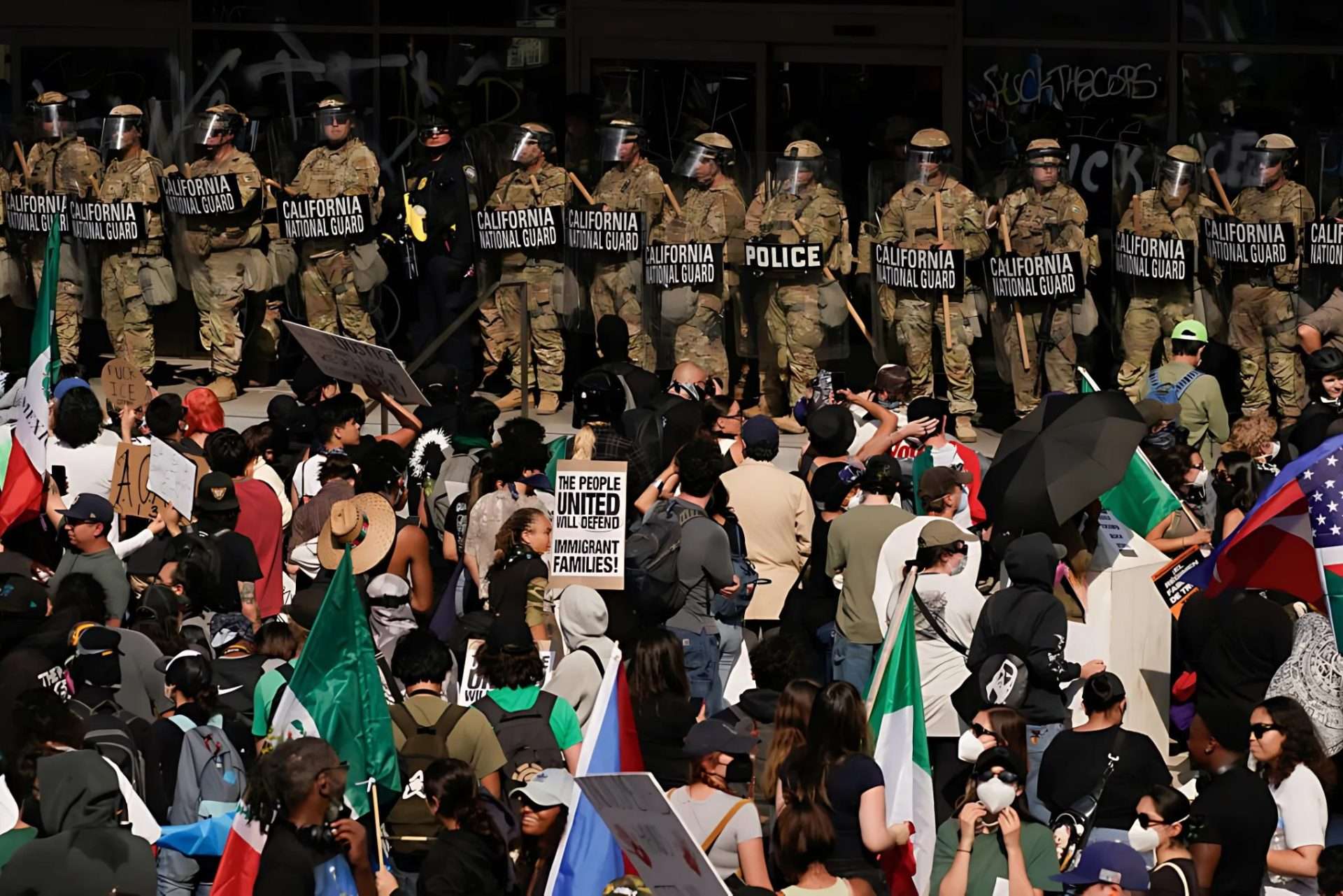
Militarization and institutional control have acquired a growing role in US politics, especially under the strategy promoted by Donald Trump, which included the deployment of federal forces and the military occupation of cities in response to episodes of social disorder. This tactic intensified conflicts between state and federal authorities, evidenced in cases such as Minnesota, where the activation of the National Guard and the invocation of the Insurrection Act generated disputes over local autonomy and the reach of central power. The concentration of power and the usurpation of functions by the federal executive have raised concerns about the democratic balance and the preservation of constitutional checks and balances, since military intervention in civil affairs tends to weaken the legitimacy of control mechanisms and exacerbate polarization. These practices also fuel fear of an authoritarian drift, in which the use of force and institutional control become tools to stifle dissent.
The message to the world: The international implications of recent American political developments are manifested in an increasingly aggressive foreign policy, which not only projects tensions outward, but also reflects and amplifies internal divisions. This approach has generated diverse reactions among traditional allies, who have shown concern about Washington’s unpredictability and unilateralism, as well as among emerging powers (BRICs bloc), which have taken advantage of American attrition to strengthen their own positions on the global stage. Polarization and radicalism in domestic politics have weakened the United States’ ability to lead international consensus and sustain its role as a democratic reference, while institutional fragmentation and confrontational discourse erode trust in its political system. As a result, US global leadership faces notable attrition, with growing challenges in maintaining strategic alliances and responding effectively to international crises. The prospects point to greater geopolitical competition, in which American power will depend both on its ability to overcome internal divisions and on its ability to adapt to a multipolar world, where international prestige and influence are increasingly conditioned by domestic political stability and legitimacy.
The United States walks on fragile terrain, where polarization, political violence and state militarization not only threaten to fracture its political system, but also cast a shadow over the international order. More than a 19th century-style civil war, what is emerging is a low-intensity internal conflict, less visible but equally corrosive, that redefines the rules of the political game and tests the foundations of the social contract. The question, however, goes beyond whether the American system will survive or, on the contrary, succumb to the centrifugal forces that dismember it. The Canadian novelist and critic Stephen Marche refers in his book The next civil war: dispatches from the American future (2022) that “The United States is coming to an end, the question is how.”