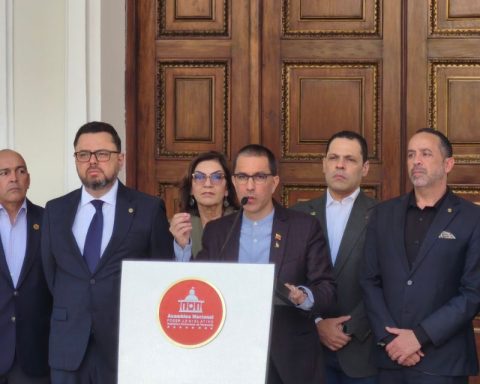
The Libertad parliamentary group saved its vote in the reform of the Organic Hydrocarbons Law and two other regulations that come from Delcy Rodríguez. Opposition deputies highlighted the discretion granted to the Executive for the annulment or repeal of laws, under the proposal of “acceleration and optimization of procedures”, an issue that conflicts with the function of parliament itself.
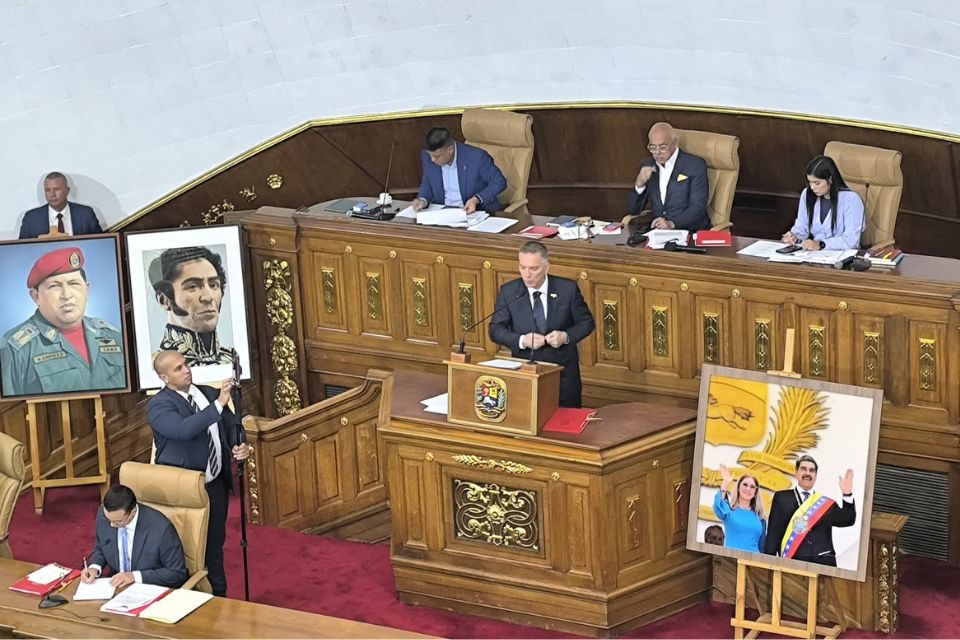
The National Assembly, with the weight of the qualified majority of the PSUV, approved three organic law projects despite the various “failures” pointed out by the opposition benches during the ordinary session on Thursday the 22nd.
The three regulations under discussion this Thursday were delivered by Delcy Rodríguez during the report and account on January 15. They were then incorporated, along with nine other laws proposed by the Executive, to the annual Legislative Plan approved in this ordinary session.
Deputy Orlando Camacho (PSUV) presented the reform to the Organic Hydrocarbons Law. He pointed out that this project “has three major areas of modification”, through the incorporation or change of 18 articles:
- “Successful business models” derived from the Anti-Blockade Law are incorporated. These are “productive participation contracts,” Camacho explained, where the operating company assumes comprehensive management at its own risk.
- “Mechanisms are proposed to guarantee the viability of economic projects in undeveloped fields.” He indicated that these “require a balance to build a fiscal regime… we must have flexibility in royalties so that investment can be attracted.”
- Legal guarantees for investment are “increased” by incorporating mediation through independent mechanisms for conflict resolution.
According to Camacho, the partial reform of this law is a “bold step towards the modernization of the energy sector, ensuring that oil continues to be the engine of economic development in our country.”
On the opposition side, only the Libertad parliamentary group saved its vote, although it was said that they will make contributions to the second discussion.
Parliamentarian Pablo Pérez (Unión y Cambio) said that after the Constitution, the Hydrocarbons Law “is of capital importance”, but in the discussions “we are falling short” by not considering other aspects that affect oil production within the reform.
«Whoever is going to invest needs legal security… Openness to private capital. Here we have to fall into reality, the entry of private capital does not mean that sovereignty is lost… Resolve the issue of the tax burden and an endless number of issues that, from the point of view of hydrocarbons, have to be discussed,” he expressed.
Likewise, he reported that the bench will present to the plenary session a reform to the Organic Law that Reserves Goods and Services Related to Primary Hydrocarbon Activities to the State. He said that this norm, approved in 2009, represented a “massacre” and “desolation” for the Eastern Coast of Lake Maracaibo with the expropriation of companies and the decrease in oil activity in the area.
Although the Vamos Vamos Venezuela bench indicated its support for the reform, deputy Felix Freites (Fuerza Vecinal) indicated that it is necessary to include in the discussions the protection of workers in the oil industry, since with the change in the management of the mixed companies, those employees will no longer be in charge of the Venezuelan State.
He also reported that they will present a bill of “special allocations for States and Municipalities”, so that they can benefit from the funds from oil revenue that the Executive reported in recent days.
For his part, deputy Miguel Pérez Abad (PSUV) said that “we must speak the truth and not hold the government responsible, which did what it should do at the time” when responding to the accusations of the former governor of Zulia. He urged the opposition bench to “not become an element that delays, that slows down the development of the laws.”
He acknowledged that the current law is “outdated,” which is why it requires an appropriate modification “so that the oil business is much more transparent and that oil investment can come.”
«We must improve, train and recover the mature fields and then, as Orlando Camacho proposed, put the green fieldsthe green fields,” said Pérez Abad, who highlighted that the Venezuelan oil industry needs an investment of about 100,000 million dollars in the next five years, and then another investment of 20,000 million to enhance the Oil Belt and increase production capacity.
Switch to “fair prices”
The presentation of the organic bill “for the Protection of Socioeconomic Rights” also brought with it several complaints from the opposition sector. The regulations consist of 96 articles, distributed in five chapters, and propose the creation of a “Superintendence for the Protection of Socioeconomic Rights”, a “national Price Observation system” and a “Committee of Consumers and Users”, where Chavista grassroots organizations will participate.
According to deputy Ramón Lobo (PSUV), this rule replaces the “fair prices” decree, approved in 2015 and which brought with it price control on essential goods and services during years of severe economic contraction, an issue that caused shortages and long lines in establishments.
Paraphrasing Delcy Rodríguez, the parliamentarian said that we must adapt “to the new political and economic moments that the country is experiencing,” so access to fundamental goods and services must be guaranteed.
Lobo said that setting prices together with the business community is part of a “circle” that will benefit the salaries of Venezuelans and the supply of products in the event of a situation.
Representative Nora Bracho (Un Nuevo Tiempo) referred to the constitutional article 117which talks about freedom of economic activity and the promotion of private initiative, and asserted that “it is not a suggestion, it is a mandate.”
Bracho stated that this bill has several “critical knots” by promoting the “fragility of freedom of choice.”
«The project talks about prices of goods and services prioritized in extraordinary circumstances. If the State exceeds its price setting, it ends up annihilating supply,” he highlighted.
Likewise, Bracho included greater bureaucratization and surveillance that can end up suffocating the small merchant, as well as the risks regarding the discretion and proportionality of the sanctions provided for in this regulation.
The parliamentarian assured that it is necessary to “update the entire legal framework and decriminalize certain behaviors that should not be treated as criminal offenses, but rather as administrative offenses… We must act rationally.”
Furthermore, he asked that this law “not become a battering ram, but rather a shield for consumption. Let it serve for productivity and not just to regulate scarcity. “Let us protect socioeconomic rights to guarantee that production in this country is free and dignified.”
Parliamentarian David Uzcátegui (Fuerza Vecinal) said that, despite supporting the reform, he also believes it is necessary to review the figure of the national price observation system and other provisions. “If you want the economy to move forward, for people to recover their purchasing power, we must encourage the greatest amount of national and foreign capital to enter Venezuela.”
For his part, deputy Jesús Faría (PSUV) accused the opposition of not having “moral authority” to make claims in this regard, after having “endorsed a blockade” and “imperialist sanctions.”
He directly pointed out to the deputies that they are “associated with speculators, with usurers, because precisely they are doing everything possible to prevent a law that serves working people from being approved.”
Acceleration of Procedures
The draft organic law “for the Acceleration and Optimization of the Administrative Procedures and Procedures of the Public Administration”, which consists of 13 articles, also did not pass without substantive observations from the opposition bench.
In the presentation of the regulations, made by deputy María Gabriela Vega (PSUV), it was indicated that “it is necessary to eradicate norms and practices” that delay public management, so it is necessary to “adopt urgent measures from the Executive to accelerate and optimize all administrative procedures in favor of the Venezuelan people.”
Both Alfonso Campos (El Cambio) and Ezio Angelini highlighted the discretion granted to the Executive to annul or repeal laws, an issue that conflicts with the function of parliament itself.
Angelini also pointed out that this regulation should allow “entering modernity” and allow the online processing of various procedures, such as company registrations and registrations, among other points.
What happened before the debates?
The opposition deputy Stalin González (Unión y Cambio) stated in his social networks that at 9:38 am this Thursday he received the explanatory statements of the laws to be discussed. An hour later they managed to access the bills. «What do they expect us to debate about if the content of the projects is unknown or they limit our time to give a timely and clear debate? “This way the parliamentary role cannot be fully fulfilled,” he questioned.
*Read also: The US “approved” the changes to the Hydrocarbons Law first than the AN deputies
The bills, according to the Bitácora Económica portal, were first known and approved by the United States, in the midst of the agreements that Donald Trump’s administration has imposed on the Venezuelan Executive – controlled by Delcy Rodríguez – after the military attacks and the capture of Nicolás Maduro on January 3.
Without directly mentioning González, the president of the National Assembly assured that the “only obligation” of the board of directors is to deliver the explanatory statement, scope and title of the bill. He said that the exhibition was delivered after a meeting with the first vice president Pedro Infante.
«Opposition deputies, I understand that you want to make enough noise to appear on social media, but we treat each other like gentlemen or we treat each other like what we are. I propose that we treat each other with synderesis and respect,” said Jorge Rodríguez.
By qualified majority, the “temporary separation” of six parliamentarians to integrate different positions within ministries, foundations and mayors’ offices was also approved. In the case of José Alejandro Aranguren he will now serve as general director of the Mayor’s Office of Sucre (Miranda state), while Arnoldo Olivares will be the new general director of the Mayor’s Office of Maracaibo (Zulia state).
José Walter Gavidia was appointed as president of the Juntos todo es Posible Foundation, Jessica Bello will preside over the Gran Mariscal de Ayacucho foundation, while deputies Gustavo Villapol and Alberto Alvarado will occupy the vice ministries of communication management and communication planning and strategy, respectively, of the Ministry of Communication and Information.
*Journalism in Venezuela is carried out in a hostile environment for the press with dozens of legal instruments in place to punish the word, especially the laws “against hate”, “against fascism” and “against the blockade.” This content was written taking into consideration the threats and limits that, consequently, have been imposed on the dissemination of information from within the country.
Post Views: 339