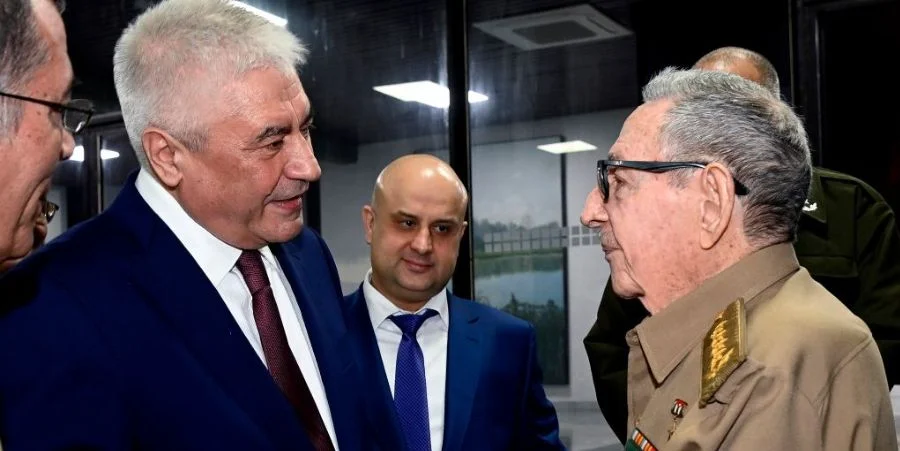
The regime does not detail an agenda or agreements, but displays Castro alongside the Russian soldier.
MIAMI, United States. – The dictator Raúl Castro Ruz received in Havana, this Tuesday afternoon, the Minister of the Interior of the Russian Federation, Vladimir Alexandrovich Kolokoltsev, in a meeting that the Cuban regime barely disclosed. a brief notewithout detailing an agenda, specific agreements or verifiable results.
The meeting, confirmed by state media, took place with the presence of the head of the Russian Ministry of the Interior (MVD), a key portfolio for internal security and the Kremlin’s police structure.
According to official information published by official mediain the exchange they spoke of “the excellent bilateral relations between the Russian Federation and the Republic of Cuba” and the “permanent will to strengthen them.” The note adds that, “in this context,” Raúl Castro sent “affectionate greetings” to Russian President Vladimir Putin.
The statement also states that Víctor Koronelli, Russian ambassador to Cuba, and other members of the Russian delegation attended. On the Cuban side, the member of the Political Bureau and Minister of the Interior, General of the Army Corps, were present. Lázaro Alberto Álvarez Casasas well as other heads of the organization itself.
Beyond these generalities, the official note avoids explaining what specific issues were addressed between the heads of two security apparatuses with decisive weight in the political life of their respective countries. This omission is not minor: according to Prensa Latinathe Russian Ministry of the Interior is responsible for state policy on “internal security, public order and the fight against crime,” and its head coordinates police forces and supervises law enforcement in Russia.
In this framework, the agency stated that Kolokoltsev’s visit “strengthens the links of cooperation between both countries in matters of security and public order”, although without providing verifiable details about mechanisms, programs or commitments.
Prensa Latina also reported that Kolokoltsev began an official visit to Cuba that same day, with planned meetings with other local authorities and participation in commemorative activities linked to the history of the Island, another broad formulation that also does not clarify what spaces, institutions or contents would make up the agenda.
In practice, the Cuban regime presents the rapprochement with Moscow as an “excellent” and expanding relationship, but it once again resorts to a communication pattern based on slogans and diplomatic courtesies, with little accountability for what is negotiated when those responsible for security and internal control sit at the table.