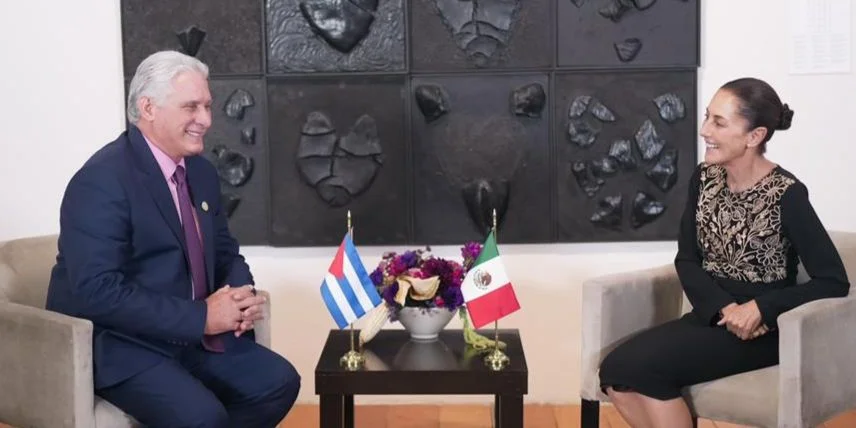
The president defended that her government’s shipment of crude oil to the Island “is not at the expense” of Mexicans.
MIAMI, United States. – The president of Mexico, Claudia Sheinbaum, insisted this Wednesday on her government’s support for the Havana regime through oil shipments and humanitarian assistance. “If Mexico can help generate better conditions for Cuba, we will always be there. It is a relationship with the Cuban people [que vive] “in very difficult conditions,” Sheinbaum said during his morning conference.
The president defended that the shipment of crude oil “is not at the expense” of Mexicans and maintained that the magnitude of the support is reduced compared to national production. “It is not at the cost, because it is really very little, of what is produced, very little is sent, but it is a solidarity support,” he stated.
Sheinbaum framed humanitarian shipments in the Mexican diplomatic tradition and linked the deterioration of conditions in Cuba to the US embargo, while defending the continuity of the bilateral relationship with Havana. The Mexican president has never recognized the violations of the human rights of the Cuban people by the island’s own regime.
Cuba’s prolonged energy crisis is currently aggravated by the alleged paralysis of supplies from Venezuela following the United States military operation in that country at the beginning of January. In this scenario, Mexico has established itself as the main supplier of oil and derivatives for the Island.
At the beginning of this month, Sheinbaum assured that his government was not sending to Cuba “more oil than had been sent historically” and that there was “no particular shipment” that justified the rebound reported by international media in the supply to the Island.
In his usual press conferencethe president responded to a media report Financial Timeswhich indicates that Mexico became Cuba’s main oil supplier. In response to this statement, the president stated: “Yesterday [martes 6 de enero] I asked PEMEX – they did not send me the information – but they are not sending more oil than they have historically sent. There is no particular shipment.”
The president argued that Mexico has sent oil to Cuba “for many years” for different reasons, including contracts and “humanitarian aid.” He also recalled that “even at the time of[l presidente Enrique] Peña Nieto, for example, “a debt owed to Cuba was forgiven,” and presented the dispatches as part of a “historical” pattern of support.
Sheinbaum admitted, however, that “with the current situation in Venezuela” Mexico began to occupy a more visible place as a supplier to the Island.
On the other hand, on December 17, Katherine Dueholm, principal deputy undersecretary for Western Hemisphere Affairs of the State Department, stated that his agency continued to pressure Mexico to play “a constructive regional role aligned with US foreign policy objectives.” and that, “unfortunately,” the current Mexican administration “has frequently acted in ways that run counter to (…) US objectives, including its support for the brutal, corrupt and economically dysfunctional Cuban regime.” Dueholm added: “We continue to urge Mexico to reconsider these positions.”
Cuban-American congressmen Carlos Giménez, Mario Díaz-Balart and María Elvira Salazar also warned of “serious consequences” for Mexico if Sheinbaum continued “undermining US policy by sending oil to the murderous dictatorship in Cuba.”